

The Unspoken Language: The Use of Sign and Symbol in Mathematics
Mathematics, often hailed as the universal language, relies fundamentally on an intricate tapestry of signs and symbols. These seemingly simple marks are far more than mere shorthand; they are the very scaffolding upon which complex ideas are built, communicated, and explored. This article delves into how the judicious use of sign and symbol in mathematics transforms abstract concepts into tangible, manipulable forms, allowing us to transcend the limitations of natural language and unlock profound truths about the universe. From the earliest geometric diagrams to the sophisticated notation of modern calculus, symbols empower us to think with unparalleled precision, conciseness, and universality.
The Genesis of Mathematical Expression: From Gesture to Glyph
For millennia, humanity has sought to quantify, measure, and understand the world around us. Early forms of mathematical thought, as evidenced in the foundational texts of the Great Books of the Western World, often began with practical problems. Counting, land division, and astronomical observation demanded a way to represent quantities and relationships. Initially, this might have involved physical gestures, tally marks, or simple drawings. However, for knowledge to be recorded, shared, and built upon, a more abstract and standardized system was required.
Consider the evolution from a spoken description of "three apples" to the numeral '3' and the symbol 'π' for the ratio of a circle's circumference to its diameter. The former is a direct sign for a quantity; the latter is a symbol encapsulating an infinite, transcendental value. This journey from concrete representation to abstract symbol marks a critical leap in human cognition, allowing for the manipulation of ideas detached from their immediate physical referents. Think of Euclid's Elements, where letters are used to denote points, lines, and figures, allowing proofs to proceed with logical rigor without needing to redraw every single instance.
Distinguishing Sign and Symbol in the Mathematical Realm
While often used interchangeably, there's a subtle yet significant distinction between a sign and a symbol within mathematics:
-
Signs: These are typically direct, conventional representations with a singular, unambiguous meaning. They are often arbitrary but universally agreed upon.
- Examples:
- + (plus sign): Represents addition.
- - (minus sign): Represents subtraction.
- = (equals sign): Denotes equivalence.
- 0, 1, 2... (numerals): Represent specific quantities.
- √ (radical sign): Denotes a square root.
- Examples:
-
Symbols: These often carry a richer meaning, representing concepts, variables, operations, or even entire sets of ideas that can be manipulated or explored. They can be placeholders for unknown values or stand for fundamental constants.
- Examples:
- x, y, z: Variables representing unknown quantities in algebra.
- π (pi): Represents a fundamental mathematical constant (approximately 3.14159...).
- Σ (sigma): Denotes summation.
- ∫ (integral sign): Represents the process of integration in calculus.
- ∀ (for all): A quantifier in logic, representing universal quantification.
- Examples:
The power of mathematics lies in its ability to combine these signs and symbols into sophisticated expressions, forming a unique language that is both precise and profoundly expressive.
Why Symbols are the Heartbeat of Mathematical Language
The reliance on a specialized language of signs and symbols is not an accidental feature of mathematics; it is its defining characteristic and its greatest strength.
1. Precision and Unambiguity:
Natural languages are inherently ambiguous, laden with nuance, context, and metaphor. Mathematical symbols, by contrast, are designed for absolute precision. "The sum of twice a number and five" can be written unambiguously as 2x + 5. This eliminates misinterpretation, a critical factor for logical deduction and scientific inquiry.
2. Conciseness and Efficiency:
Imagine trying to describe the Pythagorean theorem or Newton's second law of motion purely in words without symbols. It would be cumbersome and lengthy.
- a² + b² = c² (Pythagorean Theorem)
- F = ma (Newton's Second Law)
These compact symbolic expressions convey vast amounts of information instantly, allowing mathematicians and scientists to grasp complex relationships at a glance and move quickly to the next logical step.
3. Abstraction and Generalization:
Symbols allow us to work with abstract concepts without needing concrete examples. The variable 'x' can represent any number, enabling us to formulate general rules and theorems that apply across countless specific instances. This capacity for abstraction is what gives mathematics its immense explanatory power, allowing us to model diverse phenomena from economics to astrophysics.
4. Facilitating Manipulation and Problem Solving:
Once an idea is translated into symbolic form, it becomes a manipulable object. Algebraic rules, calculus operations, and logical deductions are all performed by manipulating symbols according to defined procedures. This transformation allows us to solve problems that would be intractable if confined to verbal reasoning.
5. Universality and Communication:
Mathematical symbols transcend cultural and linguistic barriers. A mathematician in Tokyo can understand an equation written by a mathematician in Paris, even if they share no common spoken language. This universality makes mathematics a truly global enterprise, fostering collaborative discovery and shared understanding.
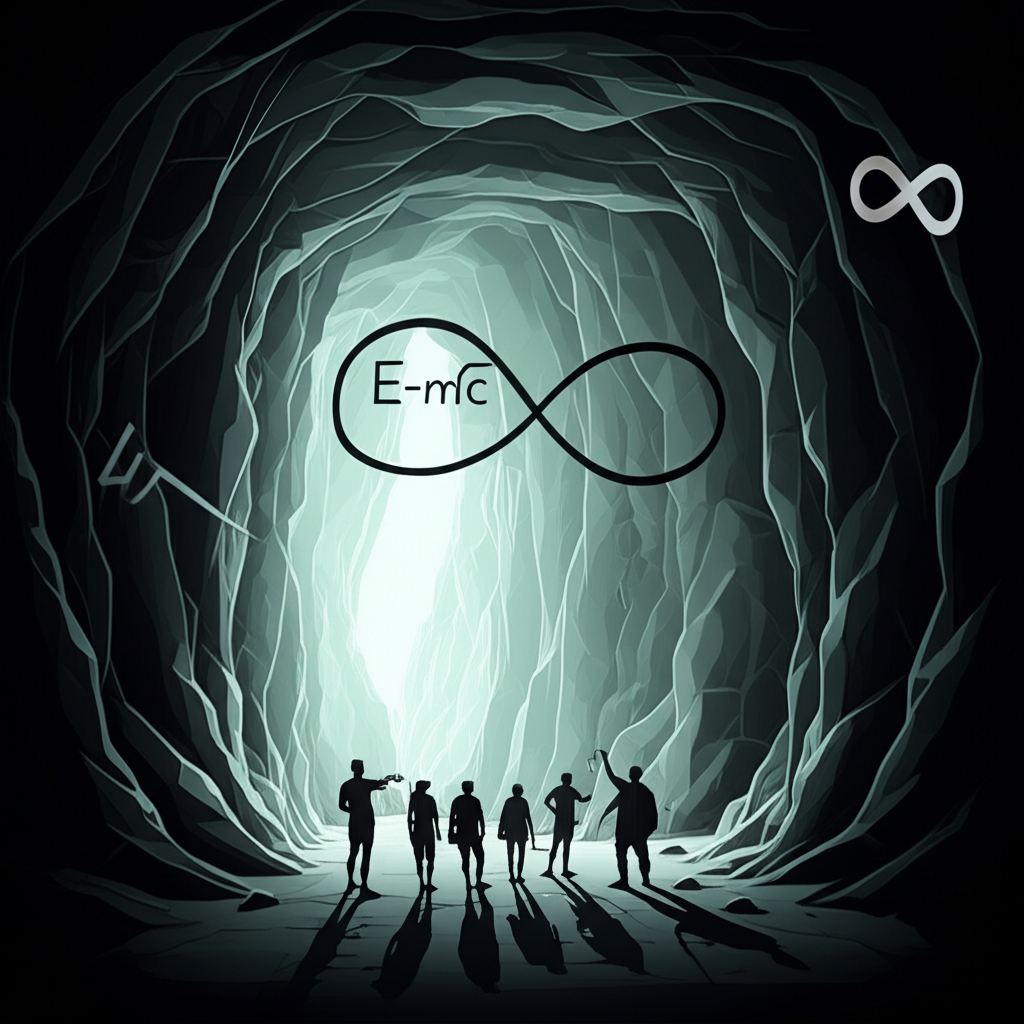 subtly integrated into the shadows on the cave wall, suggesting that mathematics provides the true forms or insights beyond mere appearances. A figure at the cave's mouth looks towards a bright light, representing the pursuit of mathematical truth.)
Philosophical Implications: Discovery or Invention?
The profound use of sign and symbol in mathematics inevitably leads to philosophical questions that have preoccupied thinkers from Plato to Bertrand Russell. Do these symbols merely represent truths that exist independently, waiting to be discovered (Platonism), or are they sophisticated tools of human invention, creating a system of logic and understanding (Formalism/Constructivism)?
The Great Books of the Western World offer various perspectives. Plato's Forms suggest a realm of perfect mathematical objects, which our symbols merely approximate. Descartes, a pivotal figure in the development of analytic geometry, showed how algebraic symbols could describe geometric shapes, bridging two previously distinct mathematical domains. Later, figures like Russell and Whitehead, in Principia Mathematica, attempted to reduce all of mathematics to pure symbolic logic, demonstrating the ultimate power and foundational role of symbols in constructing mathematical knowledge.
Regardless of one's ontological stance, the practical reality is that these signs and symbols are indispensable. They are not just a way to express mathematical thought; they are an integral part of mathematical thought itself. Without them, the vast edifices of modern mathematics—from quantum mechanics to artificial intelligence algorithms—would simply not exist.
Conclusion
The use of sign and symbol in mathematics is more than a mere convenience; it is the very essence of its power and universality. These abstract marks form a precise, concise, and unambiguous language that enables unparalleled intellectual exploration. They allow us to transcend the limitations of everyday speech, to manipulate abstract ideas, and to communicate complex truths across cultures and generations. As we continue to push the boundaries of knowledge, it is through the careful crafting and ingenious application of these fundamental symbols that the deepest mysteries of the universe continue to unfold before us.
📹 Related Video: What is Philosophy?
Video by: The School of Life
💡 Want different videos? Search YouTube for: "The Philosophy of Mathematics - Crash Course Philosophy #10"
📹 Related Video: ARISTOTLE ON: The Nicomachean Ethics
Video by: The School of Life
💡 Want different videos? Search YouTube for: "Why is Math Called the Language of the Universe?"