

The Silent Eloquence: Unpacking the Use of Sign and Symbol in Mathematics
Mathematics, often perceived as a realm of cold, hard numbers, is in truth a vibrant and profoundly expressive language. Its remarkable power lies not merely in computation but in its sophisticated use of sign and symbol to articulate complex ideas with unparalleled precision and universality. This article delves into how these seemingly simple notations form the bedrock of mathematical thought, enabling abstract reasoning and communication across cultures and centuries, much like the great philosophical texts that comprise the Great Books of the Western World.
The Unseen Language of Mathematics
At its core, mathematics is a system of communication. Like any language, it possesses its own alphabet, grammar, and syntax, but its vocabulary is uniquely composed of signs and symbols. These visual shorthand elements transcend spoken words, allowing us to grasp, manipulate, and convey concepts that would be cumbersome, if not impossible, to express in natural language. From the ancient tally marks to the intricate notation of calculus, the evolution of mathematics is inextricably linked to the development of its symbolic lexicon.
Distinguishing Signs from Symbols in Mathematical Discourse
While often used interchangeably, a subtle yet significant distinction exists between a sign and a symbol in the context of mathematics, a distinction echoed in philosophical semiotics.
- Signs: In mathematics, a sign often has a direct, immediate, or iconic reference. It points to something specific, often a concrete quantity or a simple operation.
- Examples: The numeral "3" directly signifies the quantity of three units. The "+" sign directly indicates addition. A tally mark directly represents a single count. Their meaning is often intuitive or learned through direct association.
- Symbols: Symbols, conversely, carry a deeper, often conventional or abstract meaning. They represent concepts, relationships, or operations that are not always immediately apparent or concrete. Their meaning is assigned through agreement and requires a more advanced understanding of the mathematical system.
- Examples: The variable 'x' stands for an unknown quantity, a concept rather than a specific number. The integral sign '∫' symbolizes the complex operation of integration. The '∞' symbol represents the abstract concept of infinity. Symbols often allow for generalization and the encapsulation of complex ideas.
Table 1: Signs vs. Symbols in Mathematics
| Feature | Mathematical Sign | Mathematical Symbol |
|---|---|---|
| Reference | Direct, iconic, often concrete | Abstract, conventional, generalized, conceptual |
| Meaning | Immediate, intuitive, specific | Assigned, requires context, represents complex ideas |
| Examples | Numerals (1, 2, 3), basic operators (+, -, ×, ÷) | Variables (x, y), functions (f(x)), integrals (∫), infinity (∞), logical operators (∧, ∨) |
| Function | To denote specific quantities or simple actions | To represent abstract concepts, relationships, or operations |
The Power of Abstraction: Unlocking Mathematical Universality
The use of signs and symbols is what propels mathematics beyond mere arithmetic into a realm of profound abstraction. By detaching concepts from their specific instances, symbols allow us to generalize principles and formulate universal truths. When we write a² + b² = c², we are not merely describing a specific right-angled triangle; we are expressing a relationship that holds true for all right-angled triangles, anywhere in the universe.
This symbolic abstraction is the engine of mathematical progress. It allows mathematicians to:
- Compress Information: A single symbol can encapsulate an entire definition or a complex set of operations, streamlining thought and calculation.
- Facilitate Manipulation: Abstract symbols can be manipulated according to established rules, leading to new insights and solutions without needing to refer back to concrete examples at every step.
- Ensure Universality: Mathematical language, built upon agreed-upon signs and symbols, transcends spoken language and cultural barriers. A mathematical equation written in China is understood by a mathematician in Brazil, fostering a truly global intellectual discourse, much like the enduring philosophical questions explored in the Great Books.
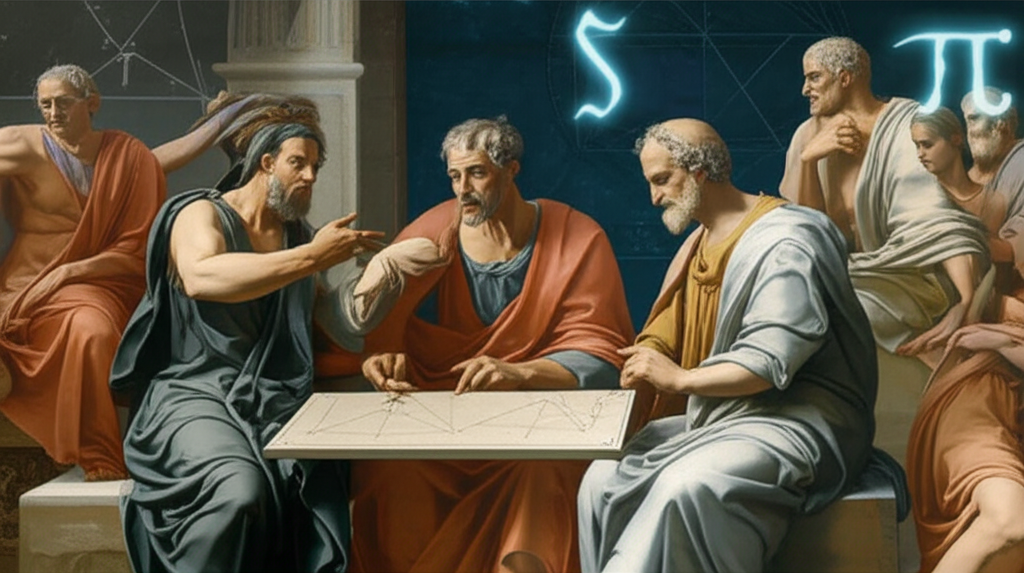
Mathematics as a Language of Unambiguous Precision
One of the most striking philosophical implications of mathematical signs and symbols is their capacity for absolute precision. Unlike natural language, which is often riddled with ambiguity, metaphor, and context-dependent meanings, mathematical notation strives for a singular, unequivocal interpretation. Every sign and symbol has a defined meaning, and every operation follows strict rules of syntax. This rigor is essential for building complex logical structures and for ensuring that mathematical arguments are sound and verifiable.
Consider the simple phrase "the square root of nine." In natural language, one might ponder if it implies both positive and negative roots. In mathematical language, the symbol '√9' unambiguously refers to the principal (positive) square root, while '±√9' would explicitly denote both. This meticulous attention to definition and notation underscores the philosophical commitment of mathematics to clarity and truth.
The Philosophical Echoes of Mathematical Language
The use of signs and symbols in mathematics invites profound philosophical questions. Do these symbols merely represent an external reality, or do they actively shape our understanding and even constitute a form of reality themselves? Are mathematical truths discovered, existing independently of human thought, or are they invented, a product of our symbolic language?
From Plato's ideal forms, suggesting an eternal realm of mathematical truths, to the more constructivist views that see mathematics as a human creation, the philosophical debate continues. What is undeniable, however, is that signs and symbols are the indispensable tools through which we engage with these truths, whether discovered or constructed. They are the scaffolding of our abstract reasoning, allowing us to explore the cosmos, understand the fabric of reality, and push the boundaries of human knowledge.
In essence, the use of sign and symbol transforms mathematics from a mere computational tool into a powerful, elegant language capable of expressing the most profound insights into the nature of quantity, space, and change. It is a testament to human ingenuity, a universal lexicon that continues to reveal the hidden orders of the universe, echoing the timeless wisdom found within the pages of the Great Books of the Western World.
YouTube Video Suggestions:
-
📹 Related Video: What is Philosophy?
Video by: The School of Life
💡 Want different videos? Search YouTube for: "Philosophy of Mathematics Language and Symbols"
2. ## 📹 Related Video: What is Philosophy?
Video by: The School of Life
💡 Want different videos? Search YouTube for: "Great Books Western World on the Nature of Mathematical Truth"