

The Silent Eloquence: Unpacking the Use of Sign and Symbol in Mathematics
Mathematics, often hailed as the most precise of disciplines, finds its formidable power not just in abstract thought, but in its meticulous use of sign and symbol. Far from mere shorthand, these visual constructs form the very language through which mathematical ideas are conceived, communicated, and explored. They are the essential bridge between the ethereal realm of pure concept and the tangible world of calculation and proof, enabling us to grapple with infinities and infinitesimals, to model the universe, and to uncover fundamental truths. This article delves into the profound philosophical and practical significance of these elemental marks, revealing how they shape our understanding and push the boundaries of knowledge.
The Foundation of Mathematical Language: More Than Just Marks
At its core, mathematics is a system of abstract reasoning. Yet, without a means to express these abstractions, they would remain locked within individual minds, incapable of being shared, scrutinized, or built upon. This is where the use of sign and symbol becomes indispensable.
Consider the simple act of counting. The numeral "3" is a sign representing a specific quantity. It's a convention, a mark agreed upon to stand for threeness. A symbol, on the other hand, often carries a deeper, more operational meaning, or represents a variable concept. The plus sign "+" isn't just a mark; it symbolizes the operation of addition. The variable "x" symbolizes an unknown quantity, a placeholder for any number within a given context.
The distinction, while sometimes subtle, is crucial:
- Signs: Directly represent a specific, often singular, concept or value (e.g., 5, π).
- Symbols: Represent operations, relations, variables, or more complex ideas, often requiring context for full interpretation (e.g., ∫, Σ, ∀, f(x)).
This carefully constructed language allows for an unparalleled level of precision and universality. Unlike natural languages, which are fraught with ambiguity and cultural nuances, mathematical symbols strive for singular, unambiguous meaning, making mathematical truths verifiable across cultures and epochs.
From Concrete Marks to Abstract Universals: The Power of Notation
The journey from a concrete mark on a page to a universally understood abstract concept is one of the great achievements of human intellect. The consistent use of sign and symbol allows us to manipulate ideas without being bogged down by their specific instantiations.
For instance, the ancient Greeks, whose contributions to mathematics are foundational, often relied on geometric demonstrations. While elegant, these methods could be cumbersome for complex algebraic relations. The later development of symbolic algebra, particularly by Islamic scholars and then in Renaissance Europe, revolutionized the field. By representing unknown quantities with letters (x, y) and operations with specific signs (+, -, ×, ÷), mathematicians could perform complex manipulations with unprecedented ease and clarity.
| Type of Mathematical Notation | Example | Philosophical Implication |
|---|---|---|
| Numerals | 1, 2, 3 | Quantification, counting discrete units |
| Operators | +, -, ×, ÷ | Actions, transformations, relationships |
| Variables | x, y, z | Abstraction, representing unknowns or general cases |
| Relational Symbols | =, <, > | Comparison, defining equality or inequality |
| Geometric Symbols | Δ (triangle), ∠ (angle) | Spatial representation, ideal forms |
| Calculus Symbols | ∫ (integral), d/dx (derivative) | Change, accumulation, infinite processes |
This systematic notation allows for a kind of mental shorthand, freeing cognitive resources to tackle higher-level problems. It embodies Aristotle's principle that all human thought requires images, even when dealing with abstract concepts. The mathematical symbol serves as that "image," a tangible anchor for an intangible idea.
Mathematics as a Universal Language: Transcending Barriers
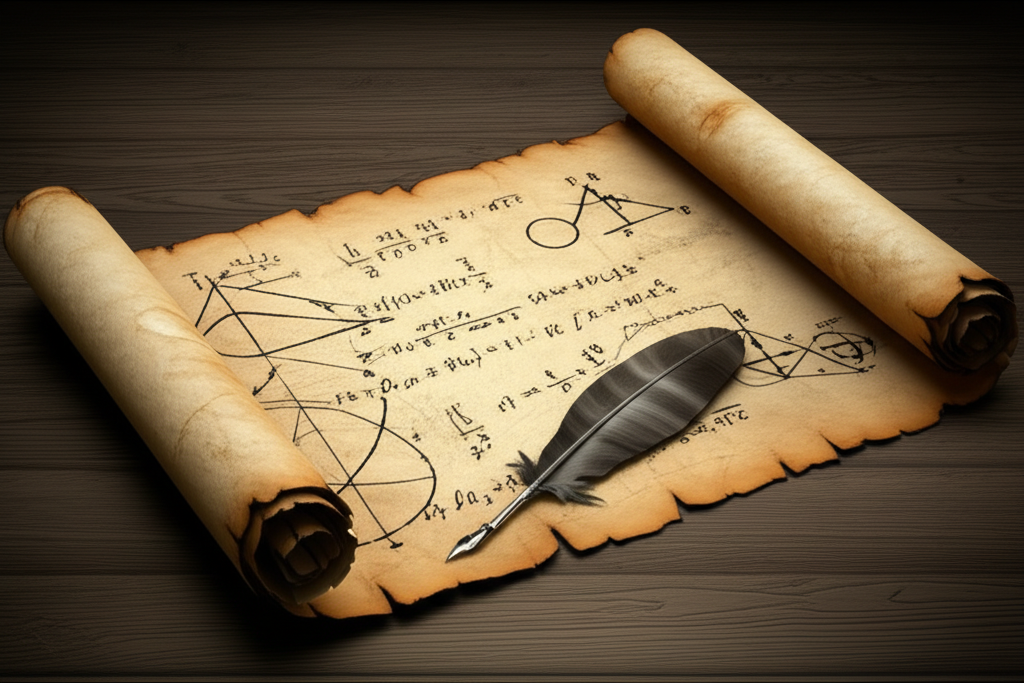
One of the most profound aspects of the use of sign and symbol in mathematics is its aspiration towards a universal language. A physicist in Japan can understand an equation written by a mathematician in Germany, even if they share no common spoken tongue. The symbols transcend the specificities of natural languages, offering a direct conduit for abstract thought.
This universality is not accidental; it is a direct consequence of the rigorous definitions and consistent application of its symbolic system. Each symbol is typically endowed with a precise, unambiguous meaning, creating a shared conceptual framework. This makes mathematics a powerful tool for interdisciplinary communication and a testament to the human capacity for shared logical understanding.
However, this universality is not without its philosophical complexities. While the symbols themselves are universal, their interpretation and the philosophical implications drawn from them can vary. What does it mean for a mathematical truth to "exist"? Is it discovered or invented? These questions, pondered by philosophers from Plato to Kant and beyond, highlight that the language of mathematics, while precise, still invites philosophical inquiry into its nature and relationship to reality.
The Philosophical Weight of Mathematical Signs
The use of sign and symbol in mathematics is not merely a practical convenience; it is deeply entwined with philosophical questions about knowledge, truth, and reality. The Great Books of the Western World offer numerous insights into this relationship.
Plato, in his Republic, posits that mathematics, particularly geometry, serves as a crucial bridge to understanding the eternal Forms. The diagrams drawn by a geometer are imperfect reflections of perfect, immutable Forms that exist independently of human thought. The circle drawn on a blackboard is a sign, but it points to the ideal, perfect Circle. The symbols thus become a path to higher truth.
Later philosophers, such as Leibniz, envisioned a "calculus ratiocinator" – a universal symbolic language of thought that could resolve all disputes through logical calculation, much like solving a mathematical problem. This dream underscores the profound belief in the power of symbolic representation to clarify and systematize reasoning.
Bertrand Russell, a key figure in the philosophy of mathematics, dedicated much of his work to understanding the logical foundations of mathematics, seeing its symbols as fundamental to expressing logical propositions. For Russell, the precision of mathematical symbolism was not just a tool, but an essential component of philosophical rigor itself.
In essence, the signs and symbols of mathematics are more than inert marks; they are:
- Tools for abstraction: Enabling us to generalize from specific instances.
- Vehicles for communication: Ensuring clarity and universality.
- Catalysts for discovery: Guiding our intuition and logical deductions.
- Philosophical anchors: Connecting abstract thought to tangible representation, and prompting deeper questions about the nature of reality and knowledge.
Conclusion: The Enduring Power of Symbolic Thought
The use of sign and symbol in mathematics is an extraordinary testament to human ingenuity. From the simplest numeral to the most complex topological diagram, these marks are the very sinews of mathematical thought, allowing us to quantify, analyze, predict, and ultimately, to understand the intricate order of the universe. They form a language that is both ancient and ever-evolving, capable of expressing ideas of breathtaking complexity with elegant simplicity. As we continue to push the boundaries of mathematical inquiry, it is through the careful, consistent, and profound use of sign and symbol that we will continue to unlock new realms of knowledge, forever bridging the gap between the concrete and the conceptual.
YouTube Video Suggestions:
-
📹 Related Video: What is Philosophy?
Video by: The School of Life
💡 Want different videos? Search YouTube for: ""philosophy of mathematical notation semiotics""
2. ## 📹 Related Video: What is Philosophy?
Video by: The School of Life
💡 Want different videos? Search YouTube for: ""Bertrand Russell philosophy of mathematics symbolism""