

The question of the soul, its nature, and its very existence, has haunted humanity since the dawn of conscious thought. Yet, amidst the mysticism and theological pronouncements, philosophy has consistently turned to one indispensable tool in its quest for understanding: logic. From the ancient Greeks to the Enlightenment, the rigorous application of reasoning has been the bedrock upon which attempts to formulate a coherent definition of the soul have been built, shaping our intellectual heritage profoundly. This article explores how philosophers, through the careful deployment of logic, have grappled with this most profound of concepts, drawing heavily from the foundational texts compiled in the Great Books of the Western World.
The Elusive Soul and the Imperative of Logic
The soul is not a tangible object that can be weighed or measured; it exists, if it exists at all, in the realm of the abstract. This very elusiveness necessitates a disciplined approach. Without the systematic application of logic, any discussion of the soul would devolve into mere opinion or unexamined belief. Philosophers, therefore, have historically employed logic not just to describe but to define the soul, to establish its properties, its relationship to the body, and its potential destiny. This intellectual endeavor demands clear premises, sound inferences, and coherent argumentation, all hallmarks of robust reasoning.
Ancient Foundations: Plato, Aristotle, and the Dawn of Logical Inquiry
The earliest comprehensive philosophical attempts to define the soul are found in the works of Plato and Aristotle, both foundational figures in the Great Books. Their methods, though distinct, exemplify the power of logic.
Plato's Tripartite Soul and Rational Argumentation
Plato, deeply concerned with ethics and metaphysics, used reasoning to posit a complex, tripartite definition of the soul in works like The Republic and Phaedo. For Plato, the soul was not monolithic but comprised distinct parts, each with its own function:
- The Rational Part (Logistikon): Seeks truth, directs the other parts, and is immortal. This is the seat of logic and reasoning.
- The Spirited Part (Thymoeides): Governs emotions like honor, anger, and courage, acting as an ally to reason.
- The Appetitive Part (Epithymetikon): Drives basic desires for food, drink, and sensual pleasure.
Plato’s arguments for the soul's immortality, particularly in Phaedo, are classic examples of deductive logic. He reasoned that if the soul is simple and non-composite, it cannot be broken down or destroyed, and if it apprehends eternal Forms, it must itself be akin to the eternal. His definition of the soul is thus inextricably linked to his logical framework for understanding reality.
Aristotle's Hylomorphism and the Soul as Form
Aristotle, Plato’s student, offered a more biological and empirical definition of the soul in De Anima (On the Soul). His approach was meticulously logical, grounded in observation and a systematic understanding of causality. Rejecting Plato's separate Forms, Aristotle proposed hylomorphism, the idea that all substances are a composite of matter and form.
For Aristotle, the soul is not a separate entity imprisoned in the body, but rather the form of a living body. His famous definition is: "the first actuality of a natural body having life potentially within it."
This means:
- The body is the matter.
- The soul is the form or principle of organization that gives the body its specific nature and capabilities.
- The soul is what makes a living thing alive and able to perform its characteristic functions.
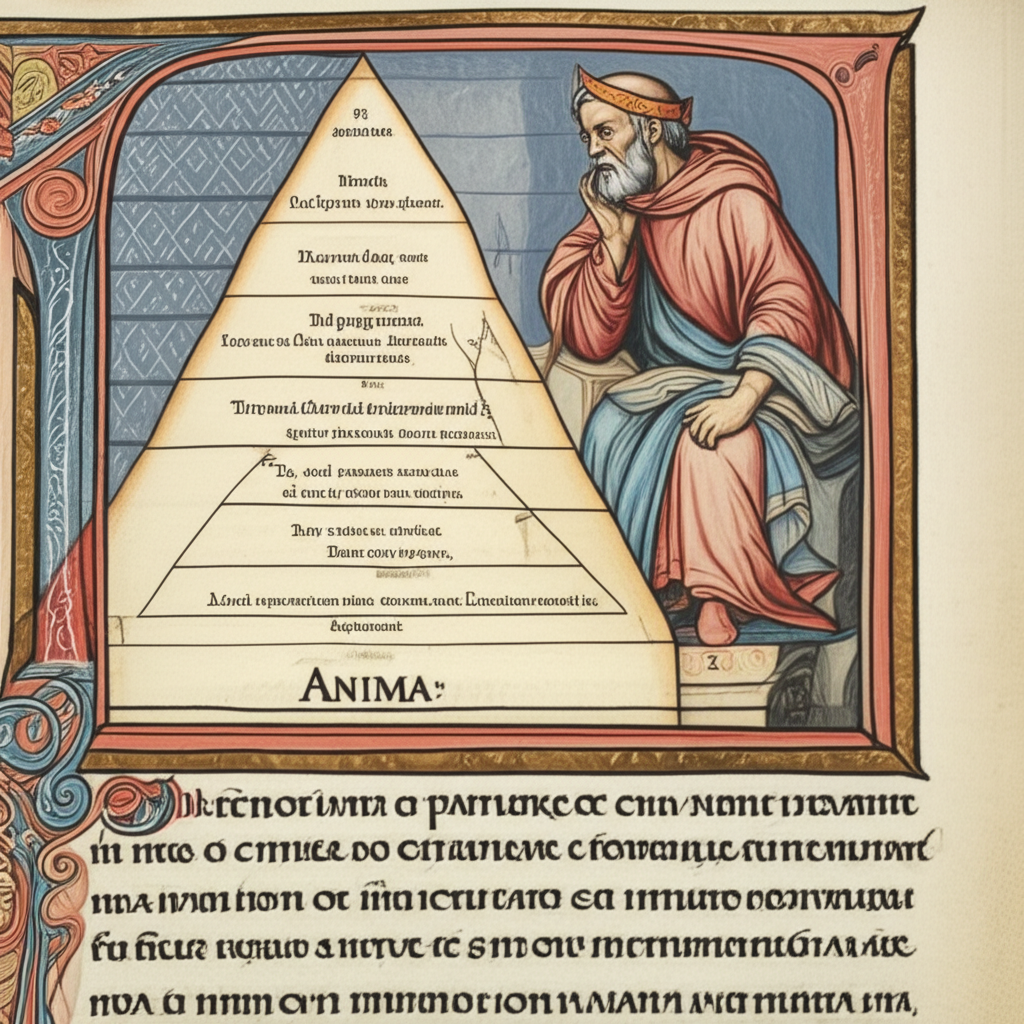
Aristotle's reasoning led him to categorize different types of souls based on their capacities:
- Nutritive Soul: Found in plants, responsible for growth, reproduction, and sustenance.
- Sensitive Soul: Found in animals, possessing nutritive capacities plus sensation, desire, and locomotion.
- Rational Soul: Unique to humans, encompassing all lower capacities plus intellect, thought, and reasoning. This capacity for logic is the defining characteristic of the human soul.
Medieval Scholasticism: Logic as a Divine Tool
The medieval period saw Christian theologians, most notably Thomas Aquinas, integrate Aristotelian logic and metaphysics into a comprehensive theological framework. In his Summa Theologica, Aquinas employed rigorous scholastic reasoning to refine the definition of the soul within a Christian context.
Aquinas, following Aristotle, defined the human soul as the substantial form of the body. However, through careful logic, he argued for the soul's distinctiveness and immortality, something Aristotle left more ambiguous. His reasoning went thus:
- The human soul possesses intellectual operations (e.g., understanding universals, engaging in abstract thought, performing logic itself).
- These intellectual operations are immaterial, as they do not depend on any specific bodily organ (unlike sight or hearing).
- Therefore, the principle from which these operations proceed—the intellectual soul—must itself be immaterial.
- An immaterial substance, being non-composite, cannot naturally corrupt or cease to exist, implying its immortality.
Here, logic served not just to understand nature but to articulate profound theological truths, demonstrating how reasoning could bridge philosophy and faith in the pursuit of a precise definition of the soul.
The Dawn of Modernity: Descartes and the Res Cogitans
With the advent of modern philosophy, René Descartes initiated a radical shift, employing a new form of reasoning—methodological doubt—to arrive at a novel definition of the soul. In his Meditations on First Philosophy, Descartes systematically doubted everything he could, until he arrived at an indubitable truth: "I think, therefore I am" (Cogito, ergo sum).
From this foundation, Descartes logically deduced that his essence, his true self, was a thinking thing (res cogitans). His definition of the soul became synonymous with the mind, a purely immaterial substance whose sole attribute is thought.
- Soul (Mind): A non-extended, immaterial substance whose essence is thinking. It is known directly through introspection and reasoning.
- Body: An extended, material substance, known through the senses.
This sharp, logical distinction between mind and body (Cartesian dualism) profoundly influenced subsequent philosophy, setting the stage for the mind-body problem—a problem that continues to be debated and refined through various logical approaches. Descartes' reasoning thus provided a stark, clear definition of the soul as the seat of consciousness and logic itself.
Challenges and Continuities: Logic's Enduring Role
While the specific definitions of the soul have evolved, been challenged, and sometimes even rejected, the role of logic and reasoning in this philosophical endeavor has remained constant. Thinkers like David Hume, through meticulous empirical reasoning, questioned the very coherence of the concept of an enduring, simple soul. Immanuel Kant, with his transcendental logic, redefined the self not as a substance but as the unifying principle of experience.
Even in contemporary philosophy, where the term "soul" is often replaced by "mind" or "consciousness," the underlying debates about identity, free will, and the nature of subjective experience are conducted with rigorous logic. Whether one argues for materialism, functionalism, or emergent properties, the clarity of definition and the soundness of reasoning are paramount. The journey to define the soul is, fundamentally, a journey through the capabilities and limits of human logic.
Conclusion: The Unfolding Definition through Logic
The quest to define the soul stands as one of philosophy's most enduring and challenging tasks. What the historical survey of the Great Books of the Western World unequivocally demonstrates is that this pursuit is inseparable from the use of logic. From Plato's tripartite soul to Aristotle's form of the body, Aquinas's immortal substance, and Descartes' thinking thing, each significant definition has been meticulously constructed through systematic reasoning.
While a single, universally accepted definition of the soul remains elusive, the ongoing philosophical engagement, driven by the imperative of logic, continues to deepen our understanding of what it means to be human, to think, and to exist. The soul, in its myriad philosophical interpretations, is ultimately a testament to the power and necessity of logic in confronting life's most profound mysteries.
YouTube Video Suggestions:
-
📹 Related Video: PLATO ON: The Allegory of the Cave
Video by: The School of Life
💡 Want different videos? Search YouTube for: "Plato Phaedo Soul Argument Explained"
2. ## 📹 Related Video: ARISTOTLE ON: The Nicomachean Ethics
Video by: The School of Life
💡 Want different videos? Search YouTube for: "Aristotle De Anima Summary Logic"