

The Enduring Power of Dialogue: The Use of Dialectic in Political Theory
Summary: Unpacking the Art of Political Reasoning
The use of dialectic stands as a cornerstone in the edifice of political philosophy, offering a rigorous method for exploring, challenging, and refining our understanding of government and justice. From the Socratic pursuit of truth to Plato's vision of an ideal state, and even to Aristotle's examination of political forms, dialectic provides a framework for critical reasoning that moves beyond mere opinion. This article delves into the historical application of dialectic in shaping political thought, drawing insights from the Great Books of the Western World, and highlights its enduring relevance for contemporary political inquiry. We will explore how this dynamic process of question-and-answer, thesis-antithesis, and rigorous argumentation helps us dissect complex political problems and strive for more rational and just societal structures.
Introduction: The Socratic Spark in Political Thought
When we speak of philosophy, particularly in its political dimensions, it’s impossible to ignore the profound impact of dialectic. This isn't just a fancy word for argument; it's a disciplined method of inquiry, a journey of the mind designed to uncover fundamental truths. For centuries, thinkers have employed dialectic to scrutinize the nature of government, the essence of justice, and the very foundations of human society. As we journey through the pages of the Great Books of the Western World, from the dialogues of Plato to the treatises of Aristotle, we find dialectic not merely as a tool, but as the very engine driving political reasoning. It compels us to move beyond superficial assumptions, to challenge received wisdom, and to build our understanding of the political realm on firmer ground.
What is Dialectic? A Primer on Philosophical Reasoning
At its heart, dialectic is a method of philosophical inquiry that involves a rigorous exchange of ideas, often through question and answer, designed to expose contradictions and arrive at a deeper truth. It is a process of systematic reasoning that seeks to transcend individual opinions and reach a more universal understanding.
Key Characteristics of Dialectical Inquiry:
- Dialogue and Debate: It typically involves two or more participants engaging in a structured conversation.
- Questioning and Challenge: Assumptions are not accepted at face value; they are questioned and scrutinized.
- Identification of Contradictions: The process aims to reveal inconsistencies or fallacies in arguments.
- Synthesis and Refinement: Through the resolution of contradictions, new, more robust conclusions are forged.
- Pursuit of Truth: The ultimate goal is not victory in argument, but the advancement of knowledge and understanding.
This method, famously championed by Socrates, compels us to constantly re-evaluate our positions, pushing us towards clarity and coherence in our thought, especially concerning the complex operations of government and society.
The Socratic Method: Challenging Political Assumptions
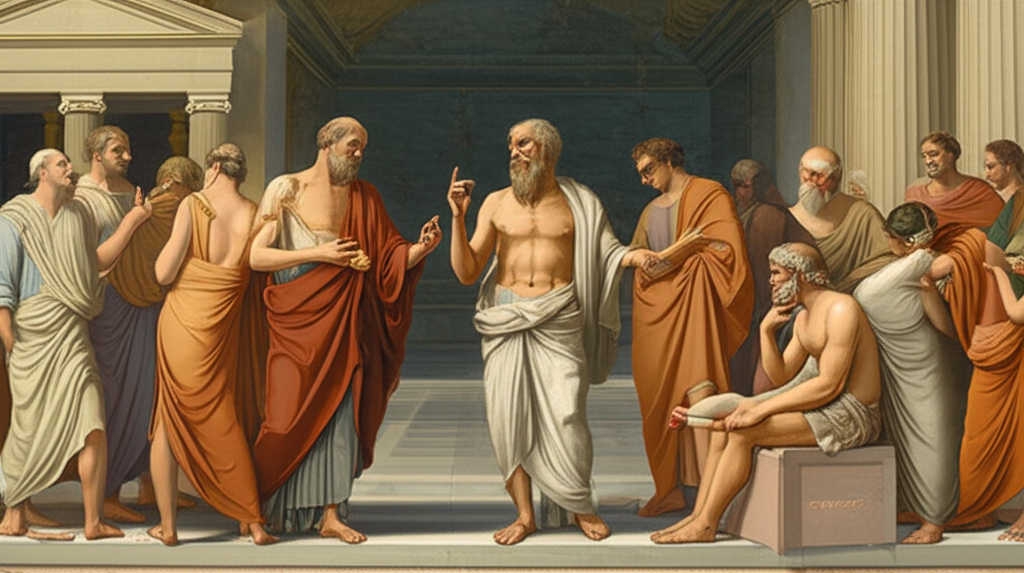
Socrates, as depicted by Plato in the Great Books, embodies the dialectical spirit. He roamed Athens, engaging citizens—from sophists to statesmen—in probing conversations about justice, virtue, and the ideal state. His method, often called elenchus, was to ask a series of questions that would lead his interlocutor to confront the inconsistencies in their own beliefs.
Consider his inquiries into the nature of justice in The Republic. Socrates doesn't offer a definition outright; instead, he dismantles conventional notions, showing how they fall short. This relentless questioning is crucial for political philosophy because it prevents us from blindly accepting existing forms of government or prevailing moral codes. It forces us to ask: Is this truly just? Is this the best way to govern? This form of reasoning is foundational for any meaningful critique or reform of political systems.
Plato's Ideal State: Dialectic as the Path to Governance
For Plato, dialectic was not just a method of argument but the highest form of intellectual pursuit, essential for the education of his philosopher-kings. In The Republic, he argues that only those who have ascended through the rigorous training of mathematics and dialectic can grasp the Forms—the eternal, unchanging essences of things like Justice, Beauty, and the Good.
| Stage of Knowledge | Method of Inquiry | Role in Political Theory |
|---|---|---|
| Opinion (Doxa) | Sensory Experience | Basis for common beliefs about government and society, often flawed. |
| Thought (Dianoia) | Mathematical Reasoning | Develops abstract thought, prepares the mind for higher truths. |
| Understanding (Noesis) | Dialectic | Directly grasps the Forms, leading to true knowledge of justice and the good. |
Plato believed that only individuals trained in this ultimate form of reasoning could truly comprehend the principles necessary to establish and maintain a just government. Their ability to see beyond the shadows of opinion to the Forms themselves would enable them to legislate and rule with genuine wisdom, rather than mere expediency. The philosopher-king, therefore, is the embodiment of dialectical mastery applied to the art of governance.
Aristotle's Practical Dialectic: Examining Political Realities
While Aristotle, Plato's most famous student, might not use the term 'dialectic' in precisely the same metaphysical sense as his teacher, his method of inquiry in works like Politics is profoundly dialectical in its practical application. Aristotle systematically examines existing constitutions, common opinions (endoxa), and the arguments of previous philosophers to arrive at his conclusions about the best forms of government.
His approach involves:
- Collecting Data: Studying various constitutions and forms of government.
- Analyzing Opinions: Reviewing the established views and arguments about political structures.
- Identifying Strengths and Weaknesses: Critically evaluating each system and theory.
- Synthesizing Insights: Building a more comprehensive and nuanced understanding of political virtue and practical governance.
This systematic process of weighing different perspectives and reasoning through their implications is a clear continuation of the dialectical tradition. Aristotle sought to understand the telos (purpose) of the polis and how different forms of government either hindered or facilitated human flourishing, always through a careful, comparative analysis that mirrors the back-and-forth of dialectical engagement.
The Enduring Legacy: Dialectic in Modern Political Thought
The echoes of dialectic resonate far beyond ancient Greece. While the explicit term may have evolved, the underlying spirit of rigorous, critical reasoning remains indispensable to political philosophy. From Enlightenment thinkers debating the social contract to contemporary theorists grappling with global governance, the process of presenting a thesis, scrutinizing it with counter-arguments (antithesis), and striving for a more refined understanding (synthesis) continues.
Modern political discourse, ideally, should embody this dialectical spirit. It demands that we:
- Listen to opposing viewpoints.
- Critically analyze the premises of arguments.
- Seek common ground or, failing that, a deeper understanding of fundamental disagreements.
- Avoid dogmatism and embrace intellectual humility.
In an increasingly complex world, where political challenges span national borders and cultural divides, the capacity for sophisticated reasoning—honed by dialectical practice—is more vital than ever for crafting effective and just forms of government.
Why Dialectic Matters for Political Theory Today
The contemporary political landscape is often characterized by polarization and entrenched positions. In this environment, the disciplined application of dialectic offers a powerful antidote. It teaches us that robust debate is not about winning, but about understanding; not about asserting, but about exploring.
For students and practitioners of political philosophy, embracing dialectic means:
- Cultivating Critical Thinking: Developing the ability to dissect complex political arguments and identify underlying assumptions.
- Fostering Intellectual Humility: Recognizing the limits of one's own knowledge and the value of diverse perspectives.
- Promoting Constructive Dialogue: Moving beyond shouting matches to engage in meaningful conversations that seek common ground or clarify irreducible differences.
- Informing Policy and Governance: Applying rigorous reasoning to design more effective, ethical, and just policies and forms of government.
By returning to the wellsprings of Western thought found in the Great Books, we rediscover that the art of dialectic is not a historical relic, but a living, breathing method essential for navigating the intricate moral and practical challenges of collective human life.
Conclusion: The Unfolding Conversation of Politics
The journey through the use of dialectic in political theory reveals a timeless truth: the best forms of government and the most profound understandings of justice emerge from a continuous, rigorous process of questioning, challenging, and refining ideas. From Socrates' relentless pursuit of definition to Plato's grand vision of philosophical rule and Aristotle's meticulous analysis of political forms, dialectic has been the guiding star for reasoning about our shared lives. As we face the political complexities of our own era, the lessons of dialectical inquiry remain as relevant as ever, inviting us to engage in the ongoing, unfolding conversation of philosophy and politics with depth, rigor, and an unwavering commitment to truth.
📹 Related Video: PLATO ON: The Allegory of the Cave
Video by: The School of Life
💡 Want different videos? Search YouTube for: ""Plato's Republic dialectic explained" or "Socrates political philosophy reasoning""