

The Use of Dialectic in Political Theory: A Path to Deeper Understanding
Introduction: Unveiling Truth Through Dialogue
In the intricate landscape of political thought, the method of dialectic stands as a cornerstone, offering a robust framework for critical inquiry and the pursuit of truth. Far from being a mere academic exercise, dialectic provides a dynamic process of reasoning through which opposing ideas engage, challenge, and ultimately refine our understanding of government, justice, and the ideal society. For any serious student of philosophy and political science, grasping the utility of dialectic is essential, as it illuminates the historical evolution of political ideas and offers a powerful tool for navigating the complex realities of governance today. This article will explore its historical roots, its diverse applications from ancient Greece to modern political discourse, and its enduring value in shaping our collective future.
What is Dialectic? A Foundational Philosophical Method
At its heart, dialectic is a method of philosophical inquiry that involves the rigorous exchange of arguments and counter-arguments, aiming to arrive at a deeper, more refined understanding of a subject. Often associated with the Socratic method, it progresses through a series of questions and answers, exposing contradictions in initial assumptions and leading participants toward a more comprehensive truth. This process is not about winning an argument, but about collaborative reasoning and the intellectual ascent from opinion to knowledge. It’s a journey of intellectual discovery, where thesis meets antithesis, and from their tension, a new synthesis emerges.
From Ancient Greece to Modern Governance: A Historical Journey
The journey of dialectic through political philosophy is long and storied, deeply embedded within the "Great Books of the Western World." Its evolution reflects humanity's continuous quest for better forms of government and societal organization.
Plato's Republic and the Socratic Method: Seeking Ideal Forms
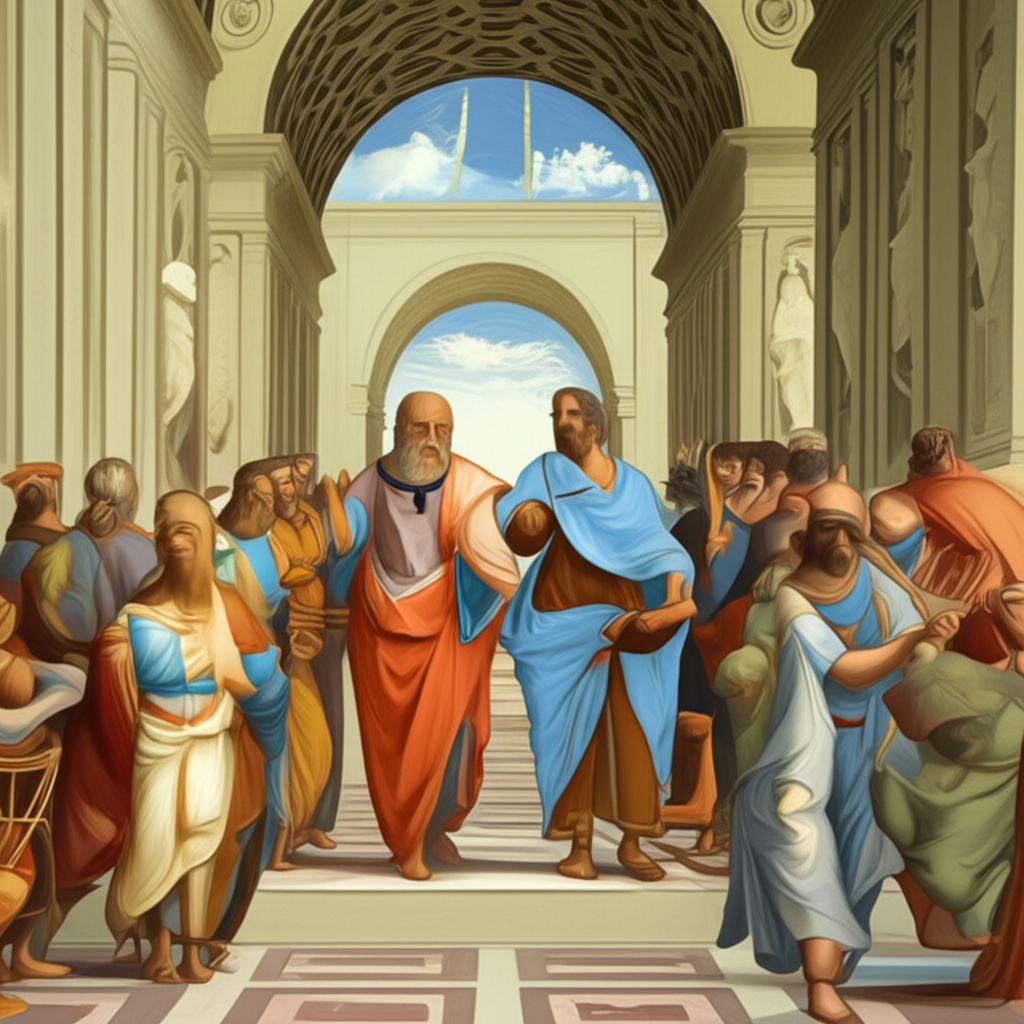
Perhaps the most iconic early application of dialectic in political theory is found in Plato's Republic. Through the character of Socrates, Plato demonstrates how rigorous questioning can dismantle preconceived notions about justice, virtue, and the ideal state. The Socratic method, a prime example of dialectic, forces interlocutors to critically examine their beliefs, exposing inconsistencies and guiding them toward a more coherent understanding of ultimate truths. For Plato, this method of reasoning was indispensable for philosophical kings—those best suited to lead a just government—as it enabled them to perceive the Forms of Justice and Goodness, upon which a virtuous polis could be built.
Aristotle's Logic and the Art of Persuasion
While Aristotle's approach was more systematic and empirical than Plato's, his logical treatises, particularly the Organon, laid the groundwork for structured argumentation that underpins dialectical exchange. His emphasis on syllogisms and the principles of non-contradiction provided the formal tools necessary for effective philosophical and political reasoning. In his Politics, Aristotle engages in a comparative dialectic, examining various forms of government to determine their strengths and weaknesses, ultimately seeking the most practical and stable constitution for human flourishing.
Hegel's Historical Dialectic: The Evolution of the State
Centuries later, G.W.F. Hegel reinterpreted dialectic as a driving force of historical and conceptual development. In works like Phenomenology of Spirit and Philosophy of Right, Hegel posited that history itself unfolds dialectically, through the clash of opposing ideas or forces (thesis and antithesis) leading to a higher, more complex synthesis. For Hegel, the state is the realization of ethical life, evolving through this dialectical process towards greater freedom and rationality. This grand narrative of historical reasoning profoundly influenced subsequent political thought, viewing government not as static, but as dynamically evolving.
Marx's Materialist Dialectic: Conflict and Change
Karl Marx, deeply influenced by Hegel but inverting his idealism, applied dialectic to material conditions and class struggle. In Das Kapital and The Communist Manifesto, Marx argued that the inherent contradictions within economic systems (e.g., between the bourgeoisie and the proletariat) drive societal change. This materialist dialectic posits that the conflict between these classes will inevitably lead to a revolutionary transformation of government and society, culminating in a classless communist state. Marx's use of dialectic underscores its power as a tool for analyzing and advocating for radical political change.
The Practical Application of Dialectic in Contemporary Government
Beyond its historical and theoretical significance, dialectic remains a vital tool for contemporary political practice, fostering robust debate and informed decision-making within government and public life.
Enhancing Policy Debate and Critical Reasoning
In modern democracies, policy-making often involves a complex interplay of competing interests and ideologies. The dialectical method encourages a structured approach to these debates, where various proposals (theses) are subjected to critical scrutiny through opposing arguments (antitheses). This process of collective reasoning allows for a thorough examination of potential consequences, ethical implications, and practical feasibility, leading to more comprehensive and effective policies (syntheses). It moves beyond mere partisan conflict to a genuine search for the best path forward.
Navigating Ethical Dilemmas in Public Service
Public servants and political leaders frequently face profound ethical dilemmas—decisions with far-reaching societal impacts. Employing dialectic in these situations means systematically exploring the moral arguments for and against different courses of action, considering diverse perspectives, and identifying underlying values in conflict. This rigorous ethical reasoning can help to clarify complex issues, expose biases, and guide decisions toward greater fairness and justice within government.
The Enduring Value and Challenges of Dialectic
| Benefits of Dialectic in Political Theory | Challenges of Dialectic in Political Theory |
|---|---|
| Deeper Understanding: Moves beyond surface-level opinions to uncover fundamental truths. | Complexity and Abstraction: Can be difficult to apply to concrete, immediate political problems. |
| Critical Thinking: Develops rigorous analytical and evaluative skills. | Potential for Manipulation: Can be misused to obscure rather than clarify, or to dominate rather than engage. |
| Identification of Contradictions: Reveals inconsistencies in arguments or systems of government. | Time-Consuming: Requires significant intellectual effort and time, which is often scarce in political decision-making. |
| Fosters Intellectual Rigor: Elevates political discourse beyond rhetoric to substantive reasoning. | Requires Open-Mindedness: Participants must be willing to have their views challenged and changed. |
| Promotes Evolution of Ideas: Drives progress in philosophy and political structures. | Risk of Relativism: If not grounded, it can lead to endless debate without reaching a definitive conclusion. |
Further Exploration:
To delve deeper into the fascinating world of dialectic and its impact on political philosophy, consider exploring these resources:
-
📹 Related Video: PLATO ON: The Allegory of the Cave
Video by: The School of Life
💡 Want different videos? Search YouTube for: ""Plato's Republic Socratic Method Explained""
-
📹 Related Video: What is Philosophy?
Video by: The School of Life
💡 Want different videos? Search YouTube for: ""Hegel's Dialectic Simplified Political Philosophy""