

The Use of Dialectic in Defining Good and Evil
The enduring human quest to understand and define good and evil stands as one of philosophy's most profound challenges. Throughout history, thinkers have grappled with these elusive concepts, seeking universal truths or, at least, coherent frameworks for moral action. A cornerstone method in this intellectual endeavor, particularly illuminated within the pages of the Great Books of the Western World, is dialectic. This article explores how dialectic, as a rigorous process of intellectual engagement, has been instrumental in clarifying, challenging, and evolving our understanding of morality, moving us closer to robust definitions of good and evil.
What is Dialectic? A Philosophical Compass
At its core, dialectic is the art of investigating or discussing the truth of opinions. It's a method of inquiry where opposing ideas or arguments are presented and critically examined to uncover truths, resolve contradictions, and arrive at a deeper understanding. Far from mere debate, dialectic aims to transcend superficial agreement or disagreement, pushing towards more precise definitions and a comprehensive grasp of the subject matter.
Historically, its manifestations have varied:
- Socratic Elenchus: Questioning to expose contradictions in interlocutors' beliefs.
- Plato's Ascent: A journey of the mind, moving from sensory experience to intellectual understanding of Forms.
- Kant's Antinomies: Identifying inherent contradictions within pure reason when applied to metaphysics.
- Hegel's Thesis-Antithesis-Synthesis: A dynamic process driving historical and conceptual development.
In the context of good and evil, dialectic serves as a crucial tool for dissecting moral dilemmas, scrutinizing ethical principles, and refining our definitions of what it means to act rightly or wrongly.
The Socratic Method: Unmasking Moral Assumptions
The figure of Socrates, as portrayed in Plato's dialogues, is the quintessential practitioner of dialectic in moral inquiry. Socrates tirelessly engaged Athenians in conversations, challenging their conventional wisdom and unexamined beliefs about virtues like justice, piety, courage, and temperance—all facets of good and evil.
His method, the elenchus, involved:
- Questioning: Posing a question about the definition of a moral concept (e.g., "What is justice?").
- Eliciting a Thesis: Obtaining an initial answer from the interlocutor.
- Cross-Examination: Asking further questions that reveal inconsistencies or absurd implications within the initial definition.
- Refutation: Demonstrating that the interlocutor's belief leads to a contradiction, thus proving it inadequate.
Through this process, Socrates aimed not necessarily to provide a definitive answer himself, but to expose ignorance (aporia) and clear the ground for true knowledge. By showing what good or evil is not, he paved the way for a more rigorous and truthful definition. This relentless self-examination of one's moral beliefs is a fundamental step in any serious philosophy of ethics.
Plato's Ascent to the Form of the Good
Building upon Socrates, Plato's philosophy posits that the visible world is but a shadow of a higher, unchanging reality of Forms. For Plato, the ultimate definition of good resides in the "Form of the Good"—the supreme Form from which all other Forms derive their existence and intelligibility.
Plato's dialectic is the intellectual journey that allows the philosopher to ascend from the realm of sensory perception and mere opinion (doxa) to the apprehension of these eternal Forms, culminating in the Form of the Good. This ascent involves:
- Moving beyond particulars: Recognizing commonalities among instances of beauty or justice.
- Grasping universal concepts: Forming abstract ideas about these qualities.
- Apprehending the Forms: Directly perceiving the pure, perfect essence of, for example, Beauty Itself or Justice Itself.
- Reaching the Good: Understanding the Form of the Good as the source of all value and reality.
For Plato, evil is understood as a privation of the Good, a lack of knowledge, or a distortion caused by the soul's attachment to the material world. Dialectic is thus crucial for purifying the soul and directing it towards the ultimate truth, thereby providing a robust metaphysical definition of good and explaining the nature of evil.
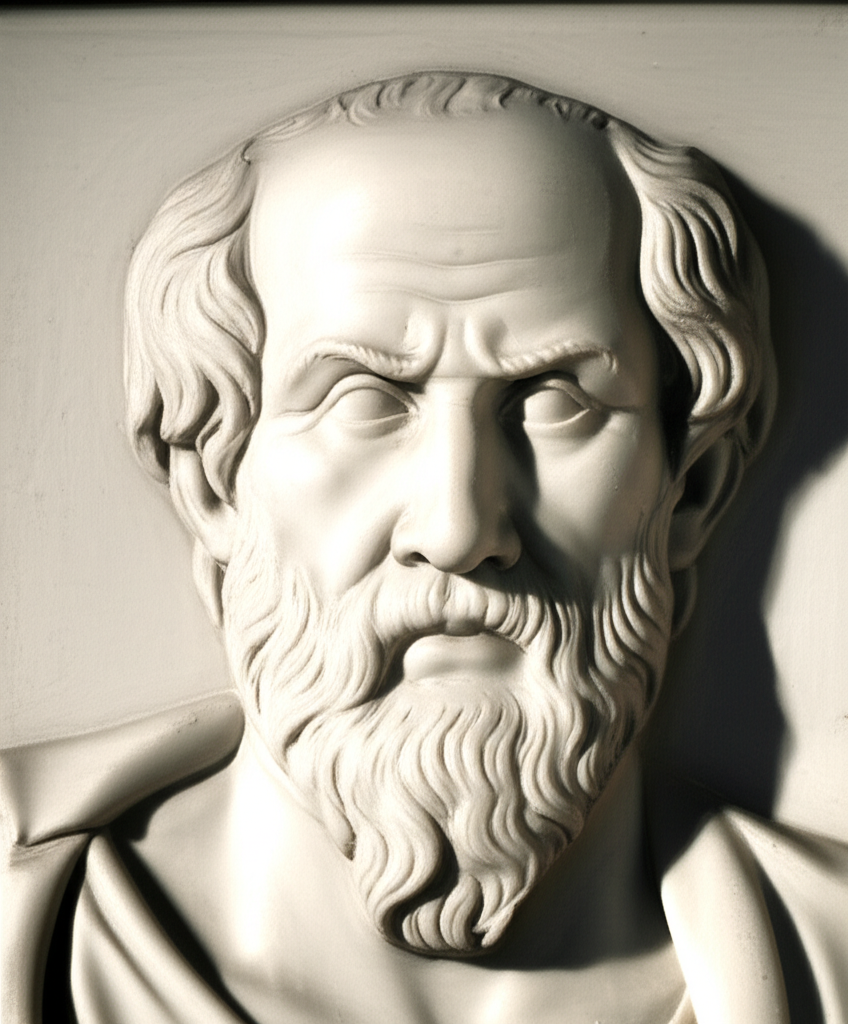 engaged in intense discussion with a younger student. Both figures are gesturing expressively, their faces conveying deep thought and intellectual engagement. The background is simple, suggesting an ancient Greek setting. The overall composition emphasizes the dynamic, back-and-forth nature of philosophical inquiry and the pursuit of truth through dialogue.)
Aristotle: Dialectic in Practical Philosophy
While Aristotle did not employ the Socratic elenchus in the same way, his ethical methodology, as seen in works like the Nicomachean Ethics, involves a form of dialectic in its systematic examination of common opinions (endoxa) and the views of the wise. He begins by surveying what people generally believe about good and evil, and then subjects these views to rational scrutiny, refining them through logical argument and empirical observation.
For Aristotle, the highest good for humans is eudaimonia—often translated as flourishing, living well, or human excellence. His definition of good is teleological, focused on the proper function (telos) of human beings. Evil, conversely, arises from failing to achieve this proper function.
Aristotle's dialectic in ethics manifests in:
- Examining competing views: Weighing arguments for pleasure, honor, or wealth as the ultimate good.
- Seeking consistency: Ensuring that ethical principles are coherent and do not lead to contradictions.
- Refining concepts: Arriving at a nuanced definition of virtue as a "mean" between extremes.
His concept of phronesis (practical wisdom) itself embodies an internal dialectic—the ability to deliberate well about what is good and advantageous, not in a general sense, but for a human being in specific circumstances, navigating the complexities of moral choice.
Kant's Moral Law and the Antinomies of Reason
Immanuel Kant, a pivotal figure in modern philosophy, employed dialectic in a unique way. In his Critique of Pure Reason, he uses a "Transcendental Dialectic" to expose the inherent illusions and contradictions (antinomies) that arise when pure reason attempts to grasp concepts beyond the limits of possible experience (e.g., the nature of the soul, the universe, God). While this concerns theoretical reason, his moral philosophy seeks to establish a universal definition of good that is equally rigorous.
Kant sought to ground morality not in empirical observation or religious decree, but in pure practical reason. His definition of good is centered on the good will, which he famously declares to be the only thing good without qualification. An action is morally good if it is done from duty, in accordance with a maxim that can be universalized without contradiction—this is the Categorical Imperative.
The dialectic in Kant's moral philosophy arises when:
- Testing Maxims: One subjects a proposed moral rule (maxim) to the universalization test: "Can I will that my maxim become a universal law?" This is a dialectical confrontation of individual desire with universal reason.
- Resolving Moral Conflicts: Although Kant primarily focused on the derivation of moral law, the application of universal principles to particular situations often involves a dialectical process of reasoning to discern the correct duty.
For Kant, evil is not a mere absence of good, but a positive choice to act on maxims that cannot be universalized, a deviation from the moral law dictated by reason.
Hegel's Historical Dialectic: The Evolution of Morality
Georg Wilhelm Friedrich Hegel's philosophy presents perhaps the most famous and comprehensive system built upon dialectic. For Hegel, dialectic is not just a method of argument but the very structure of reality and history. History itself is a dialectical process, driven by the Spirit (Geist) moving through stages of thesis, antithesis, and synthesis towards absolute knowledge and freedom.
In this grand narrative, the definition and understanding of good and evil are not static, but evolve through historical struggles and the resolution of contradictions. Ethical concepts, legal systems, and social norms are all products of this ongoing dialectical development.
Hegel's dialectic illuminates good and evil by:
- Contextualizing Morality: Showing how moral codes and definitions emerge from specific historical and cultural contexts (e.g., the transition from ancient Greek civic good to Christian individual conscience).
- Revealing Contradictions: Highlighting the inherent tensions within ethical systems (e.g., the conflict between individual freedom and social order).
- Driving Progress: Arguing that the resolution of these contradictions leads to a higher, more rational, and more encompassing understanding of good.
For Hegel, true ethical life (Sittlichkeit) is realized not in abstract moral rules, but in the concrete institutions of family, civil society, and the state, which themselves are products of a complex dialectic of historical development. Evil, in this framework, can be seen as an alienation from the rational unfolding of Spirit or a failure to recognize the interconnectedness of individual and collective freedom.
The Enduring Power of Dialectic in Ethical Inquiry
From the ancient agora to the modern lecture hall, dialectic remains an indispensable tool in the philosophy of good and evil. Its power lies in its ability to:
- Clarify Definitions: It forces precise articulation of terms, exposing ambiguity and vagueness in moral language.
- Expose Inconsistencies: It rigorously tests propositions, revealing logical flaws or contradictions in ethical arguments.
- Promote Deeper Understanding: By engaging with opposing viewpoints, it fosters a more comprehensive and nuanced grasp of complex moral issues.
- Facilitate Moral Progress: It allows for the refinement and evolution of ethical thought, leading to more robust and inclusive moral frameworks.
While dialectic can sometimes be criticized for leading to endless debate or for promoting relativism, its true value lies in the process of critical inquiry itself. It reminds us that our definitions of good and evil are rarely final and always benefit from rigorous examination and re-examination.
Conclusion: A Perpetual Conversation
The quest to define good and evil is an ongoing, dynamic process, and dialectic provides the essential framework for this critical philosophical conversation. From Socrates' relentless questioning to Plato's ascent to the Good, Aristotle's ethical deliberation, Kant's categorical imperative, and Hegel's historical unfolding of Spirit, the Great Books of the Western World consistently demonstrate the transformative power of dialectic. It ensures that our understanding of morality is continually tested, refined, and deepened, moving us closer to comprehensive and justifiable definitions of what it means to live a truly good life and to confront the nature of evil.
YouTube Video Suggestions:
-
📹 Related Video: PLATO ON: The Allegory of the Cave
Video by: The School of Life
💡 Want different videos? Search YouTube for: "Plato's Dialectic Explained"
-
📹 Related Video: KANT ON: What is Enlightenment?
Video by: The School of Life
💡 Want different videos? Search YouTube for: "Hegel's Master-Slave Dialectic Good Evil"