

The Dialectical Path to Moral Understanding: Defining Good and Evil
The human quest to define Good and Evil is as old as philosophy itself. From the earliest Socratic dialogues to the grand systems of German Idealism, thinkers have grappled with establishing objective, or at least coherent, ethical frameworks. At the heart of this enduring endeavor lies the dialectic – a method of philosophical inquiry that, through rigorous argumentation and the examination of opposing ideas, seeks to arrive at a deeper, more comprehensive understanding. This article explores how the dialectic has been employed throughout the history of Western thought to illuminate the elusive definitions of Good and Evil, revealing its indispensable role in our moral and ethical development.
What is Dialectic? A Foundation for Ethical Inquiry
At its core, dialectic refers to a method of argument for resolving disagreement. It's not merely a debate, but a structured process of reasoned discourse aimed at discovering truth or clarifying concepts. Originating in ancient Greece, its form has evolved significantly: from the Socratic method of question and answer, through Plato's ascent to the Forms, to Hegel's historical unfolding of spirit. Regardless of its specific manifestation, the dialectic consistently involves:
- Engagement with opposing viewpoints: Confronting contradictions and inconsistencies.
- Systematic reasoning: Moving beyond superficial opinions to deeper principles.
- Refinement of concepts: Iteratively improving definitions and understanding.
For the purpose of defining Good and Evil, the dialectic provides the intellectual crucible necessary to test assumptions, expose biases, and strive towards a more robust and universally applicable definition.
Ancient Roots: Socrates and Plato's Pursuit of the Good
The earliest and perhaps most iconic use of dialectic in the pursuit of ethical definition can be found in the works of Plato, particularly through the character of Socrates.
The Socratic Precedent: Questioning for Clarity
Socrates, as depicted in Plato's dialogues (part of the Great Books of the Western World), employed a relentless method of questioning to expose contradictions in his interlocutors' beliefs. This Socratic method is a foundational form of dialectic. He would often begin by asking for a definition of a virtue like justice, courage, or piety. Through a series of questions, he would demonstrate the inadequacy of initial answers, pushing towards a more precise and defensible understanding. While often ending in aporia (a state of perplexity), the Socratic method laid the groundwork by demonstrating that:
- Common assumptions about Good and Evil are often ill-defined.
- True understanding requires critical self-examination and logical consistency.
Plato's Ascent to the Form of the Good
Plato took the dialectic a step further, conceiving it as the highest form of intellectual activity, enabling the philosopher to ascend from the realm of sensible particulars to the unchanging, eternal Forms. For Plato, the ultimate goal of philosophical inquiry, especially ethical inquiry, was to grasp the Form of the Good.
In works like The Republic, Plato argues that true justice, beauty, and goodness are not merely subjective opinions or cultural constructs but partake in an objective, transcendent reality. The dialectic is the rigorous intellectual process by which one moves beyond hypotheses and sensory experience to "grasp by intelligence itself the nature of each thing" – ultimately apprehending the Form of the Good, which illuminates all other Forms and makes them intelligible. Without this dialectical ascent, our understanding of Good and Evil remains confined to shadows and opinions.
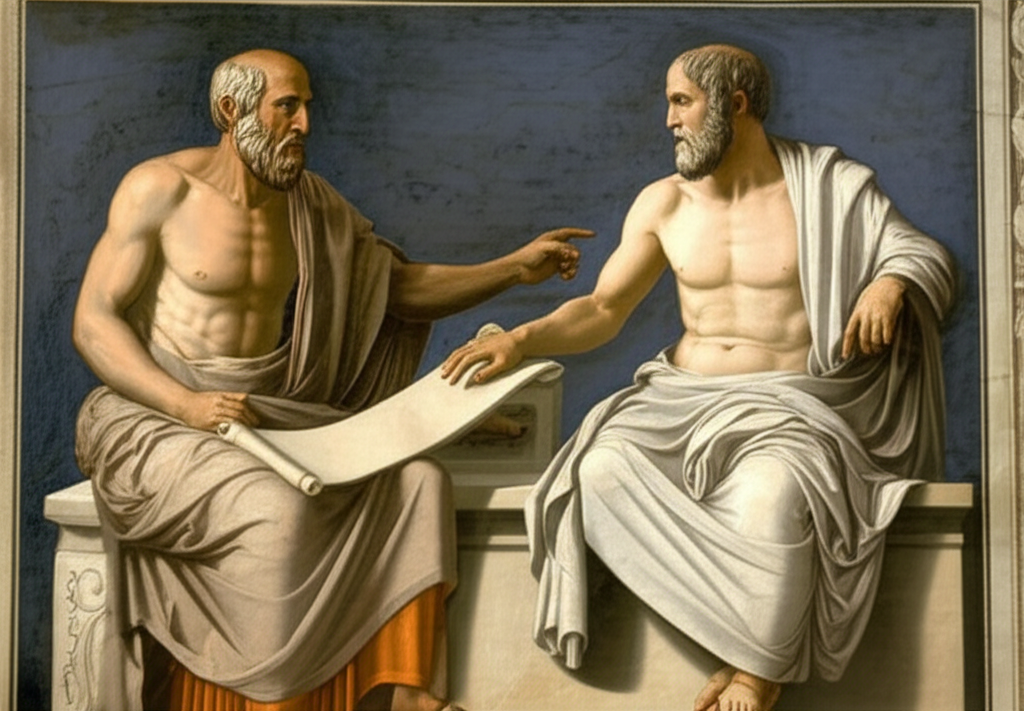
Aristotle's Pragmatic Dialectic in Ethics
While Aristotle, a student of Plato, diverged from his mentor on the nature of the Forms, he too recognized the importance of dialectic in ethical reasoning. In his Nicomachean Ethics (another cornerstone of the Great Books), Aristotle did not seek to derive ethical definitions from transcendent Forms but rather from a careful examination of human experience, common opinions (endoxa), and the practical pursuit of eudaimonia (flourishing or happiness).
Aristotle's dialectic in ethics often involved:
- Beginning with endoxa: Systematically reviewing prevailing beliefs about Good and Evil, virtue, and happiness.
- Identifying inconsistencies: Pointing out where these beliefs conflict with each other or with observed reality.
- Refining definitions: Through reasoned argument, arriving at more coherent and practical definitions of virtues like courage, temperance, or justice, often finding the "mean" between extremes.
For Aristotle, the dialectic was a crucial tool for practical wisdom (phronesis), allowing individuals and communities to navigate the complexities of moral life and arrive at informed ethical judgments. It was less about reaching a singular, absolute Form of the Good and more about developing robust, contextually sensitive definitions of what constitutes a good life and good character.
Hegel's Grand Synthesis: Dialectic and the Evolution of Morality
Centuries later, G.W.F. Hegel transformed the dialectic into a dynamic process of historical and conceptual development. For Hegel, the dialectic was not just a method of argument but the very engine of reality and consciousness itself, unfolding through a process of thesis, antithesis, and synthesis.
In works like Phenomenology of Spirit and Philosophy of Right (also part of the Great Books), Hegel applied this grand dialectic to understanding the evolution of human morality, law, and ethical life (Sittlichkeit). He argued that our understanding of Good and Evil is not static but develops historically as societies confront contradictions in their ethical systems.
Consider the evolution of moral consciousness:
| Stage of Ethical Understanding | Thesis | Antithesis | Synthesis |
|---|---|---|---|
| Early Morality | Simple tribal custom, unreflective obedience | Individual conscience, subjective freedom | Objective ethical life (family, civil society, state) |
| Conscience | Individual conviction of good | The evil of subjective caprice | Universal ethical principles embodied in institutions |
| Freedom | Abstract freedom of will | Constraints of law, demands of community | Concrete freedom within a rational ethical order |
Through this dialectical process, Good and Evil are not merely abstract concepts but are understood as integral to the historical unfolding of Spirit, leading to ever more comprehensive and rational definitions of ethical reality. Hegel believed that this process ultimately culminates in a rational, self-aware ethical life where individual freedom and universal good are reconciled.
The Enduring Value and Challenges of Dialectic in Defining Good and Evil
The journey through the history of philosophy reveals the enduring power of the dialectic in shaping our understanding of Good and Evil. It compels us to:
- Scrutinize assumptions: To question what we take for granted about morality.
- Embrace complexity: To move beyond simplistic binary oppositions.
- Seek coherence: To construct ethical frameworks that are logically consistent and practically applicable.
While the dialectic provides a robust framework, it is not without its challenges. Critics sometimes argue about the subjectivity of the "synthesis," or the potential for dialectical reasoning to be used to justify predetermined conclusions. Nevertheless, its fundamental commitment to reasoned discourse, the examination of opposing views, and the iterative refinement of definitions remains invaluable. In an increasingly polarized world, the dialectic offers a timeless method for engaging with profound ethical questions and striving towards a more nuanced and shared understanding of what constitutes Good and Evil.
YouTube:
- "Plato's Dialectic and the Form of the Good Explained"
- "Hegel's Dialectic: Thesis, Antithesis, Synthesis in Ethics"
📹 Related Video: What is Philosophy?
Video by: The School of Life
💡 Want different videos? Search YouTube for: "The Use of Dialectic in Defining Good and Evil philosophy"