

The Unending Dialogue: Using Dialectic to Define Good and Evil
The concepts of Good and Evil are perhaps the most fundamental and vexing in all of philosophy. They underpin our moral codes, legal systems, and personal ethical choices. Yet, despite their pervasive influence, arriving at a universally accepted definition for either remains an elusive quest. This article explores how dialectic, as a rigorous method of inquiry, has been and continues to be an indispensable tool in our tireless pursuit of understanding these profound moral poles. From ancient Athens to modern discourse, the dialectical process offers not merely a path to answers, but a framework for the very questions themselves, helping us navigate the complex terrain of human morality.
Unpacking the Dialectic: A Journey Through Philosophical Inquiry
At its core, dialectic is a method of argument and discussion that seeks to investigate truth, often through the examination of opposing ideas or propositions. It’s a dynamic, iterative process, far removed from a static declaration. When we speak of applying dialectic to Good and Evil, we are talking about a journey of rigorous intellectual engagement, challenging assumptions, and refining our understanding.
Historically, the concept has taken various forms:
- Socratic Dialectic: Characterized by persistent questioning (elenchus) to expose contradictions in an interlocutor's beliefs, aiming to reveal ignorance and prompt a deeper search for truth.
- Platonic Dialectic: An ascent from particular instances to universal Forms, culminating in the apprehension of the Form of the Good itself, which illuminates all other virtues.
- Medieval Scholastic Dialectic: Employed by thinkers like Thomas Aquinas, it involved presenting arguments, counter-arguments (objections), and then providing a reasoned synthesis (response) to reconcile faith and reason in theological and ethical matters.
- Hegelian Dialectic: A grand historical and philosophical process involving a thesis, its inherent contradictions leading to an antithesis, and their eventual resolution into a higher synthesis. This process drives the evolution of consciousness, culture, and ethical understanding.
The Socratic Method and the Birth of Ethical Foundations
Perhaps the most accessible entry point into dialectic for ethical definition is the method of Socrates, vividly captured in Plato's dialogues (prominent in the Great Books of the Western World). Socrates didn't offer grand pronouncements on Good and Evil; instead, he relentlessly questioned those who claimed to know.
Consider a dialogue like Euthyphro, where Socrates challenges Euthyphro's definition of piety. Through a series of incisive questions, Socrates exposes the inconsistencies and inadequacies of Euthyphro's understanding. This isn't just about winning an argument; it's about:
- Exposing ignorance: Revealing that what one thought they knew was poorly understood.
- Moving beyond superficiality: Pushing past common opinion (doxa) to seek reasoned understanding (episteme).
- Striving for universal definitions: The underlying goal was to find concepts that held true consistently, not just in specific instances.
For Socrates, the inability to define virtue or good meant one could not truly possess it. The dialectical process was, therefore, not merely academic; it was a moral imperative, essential for living a good life.
Plato's Forms and the Pursuit of the Good
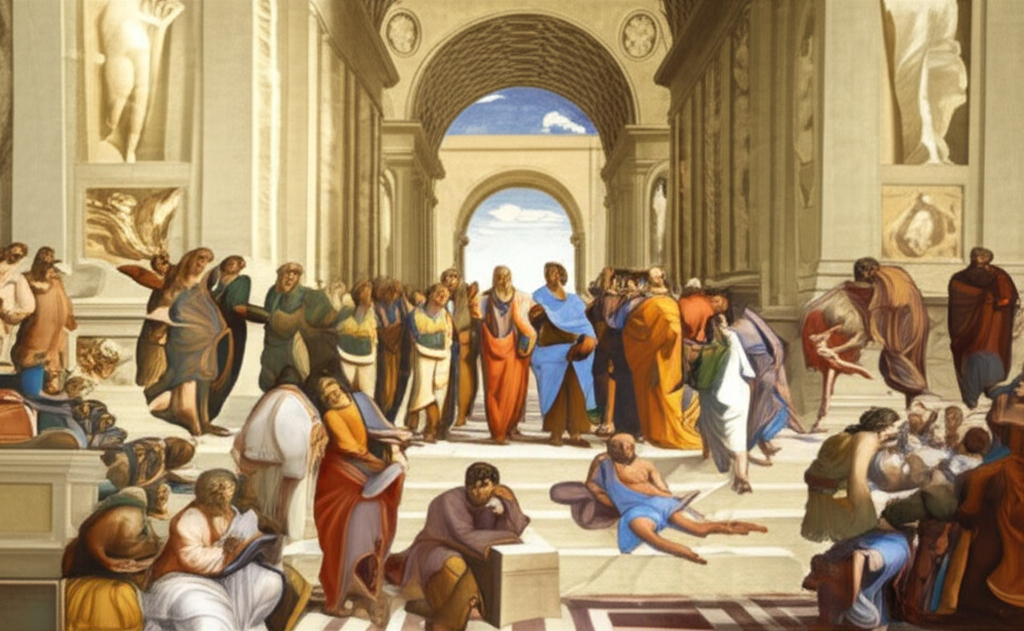
Plato, building on Socrates, posited that true definition of concepts like justice, beauty, or good lay not in the empirical world but in the transcendent Realm of Forms. His dialectic involves a more complex ascent, a rigorous intellectual journey away from sensory experience and towards the contemplation of these perfect, unchanging essences.
In The Republic, the Form of the Good is presented as the ultimate source of all being and knowledge, analogous to the sun that illuminates everything. The philosopher, through a long and arduous dialectical training, endeavors to apprehend this Form. It is only by grasping the Form of the Good that one can truly understand what is good in particular actions, states, or individuals. The dialectic here is the intellectual ladder, allowing the mind to climb from shadows and opinions to the radiant truth.
Medieval Scholasticism: Reconciling Faith and Reason
Centuries later, the dialectic found a renewed purpose in the hands of medieval scholastic philosophers, most notably Thomas Aquinas. In his monumental Summa Theologica, Aquinas tackles countless questions, including those pertaining to Good and Evil, sin, and virtue, through a highly structured dialectical method.
Each article in the Summa follows a pattern:
- Question: Posing a specific philosophical or theological problem (e.g., "Whether evil is a substance?").
- Objections: Presenting arguments against Aquinas's eventual position.
- Sed Contra: A brief statement (often from scripture or authority) supporting the opposite view of the objections.
- Respondeo: Aquinas's own reasoned argument, often synthesizing various philosophical and theological traditions.
- Replies to Objections: Addressing and refuting each initial objection.
This method is a grand exercise in definition and clarification, using reason to explore and delineate the boundaries of Good and Evil within a theological framework. It's a testament to the power of dialectic not just to explore, but to systematically build and defend a comprehensive moral philosophy.
Hegel's Dialectic: A Dynamic Process of Moral Evolution
Moving into modernity, G.W.F. Hegel transformed dialectic into a dynamic process that underpins the very unfolding of history and the evolution of human consciousness and ethical life. For Hegel, Good and Evil are not static concepts but are constantly being redefined through a process of thesis, antithesis, and synthesis.
Consider the development of moral norms in a society:
- Thesis: An existing ethical principle or social structure (e.g., individual freedom).
- Antithesis: The inherent contradictions or limitations of that principle, or an opposing force (e.g., the need for social order and collective responsibility).
- Synthesis: A new, more comprehensive ethical understanding that resolves the tension between the thesis and antithesis, incorporating elements of both into a higher form (e.g., a concept of freedom that acknowledges its social embeddedness and responsibilities).
For Hegel, Evil often arises from the partiality or one-sidedness of a particular perspective, while the Good is found in the holistic, rational integration achieved through the dialectical process. This isn't just about defining Good and Evil in a static sense, but understanding their historical and conceptual development.
The Enduring Value of Dialectic in Ethical Deliberation
The journey through various forms of dialectic reveals a crucial insight: while a definitive, universally exhaustive definition of Good and Evil may remain an ideal, the dialectical process itself is invaluable. It is a method for:
- Clarification: Unpacking vague notions and revealing underlying assumptions.
- Critical Examination: Challenging dogma and unexamined beliefs.
- Nuance and Complexity: Moving beyond simplistic binaries to appreciate the multifaceted nature of ethical dilemmas.
- Fostering Empathy: By engaging with opposing viewpoints, we can better understand the motivations and reasoning of others.
- Progressive Understanding: Even if ultimate truth remains elusive, dialectic allows for a continuous refinement and deepening of our ethical insights.
The utility of dialectic in philosophy is not always about reaching a final, immutable conclusion, but about the rigor and depth of the inquiry itself. It is the engine that drives ethical progress and intellectual honesty.
Challenges and Nuances
While powerful, the application of dialectic is not without its challenges:
- The Problem of Shared Premises: For a productive dialectical exchange, participants must often agree on fundamental terms or axioms, which can be difficult in debates concerning Good and Evil.
- Sophistry and Manipulation: The method can be misused by those more interested in winning an argument than in pursuing truth.
- The Elusiveness of "Synthesis": Not all conflicts resolve neatly into a higher synthesis; some tensions may be irreducible.
- Cultural Relativism: If ethical concepts evolve dialectically within different cultures, does a universal definition of Good and Evil even remain a coherent goal?
Despite these difficulties, the commitment to engaging with differing perspectives, to scrutinizing arguments, and to constantly seeking deeper understanding remains a cornerstone of ethical philosophy.
Conclusion: The Unending Dialogue
The quest for a definitive definition of Good and Evil is an eternal human endeavor, a testament to our innate moral compass and our capacity for profound self-reflection. From the penetrating questions of Socrates to the grand historical sweep of Hegel, dialectic has served as our most potent intellectual tool in this journey. It forces us to confront our assumptions, to articulate our reasons, and to engage with the complexities of human experience.
Ultimately, dialectic teaches us that the understanding of Good and Evil is not a destination but a continuous process—an unending dialogue that shapes our individual lives and the collective conscience of humanity. It is through this rigorous, challenging, and often uncomfortable process that we come closest to grasping the essence of what it means to live a truly ethical life.
YouTube Video Suggestions:
-
📹 Related Video: PLATO ON: The Allegory of the Cave
Video by: The School of Life
💡 Want different videos? Search YouTube for: "Plato Apology Euthyphro philosophy summary"
2. ## 📹 Related Video: PLATO ON: The Allegory of the Cave
Video by: The School of Life
💡 Want different videos? Search YouTube for: "Hegel dialectic explained good evil history"