

The Dialectical Lens: Sharpening Our Definition of Good and Evil
Defining concepts as profound and pervasive as Good and Evil is arguably one of philosophy's most enduring and challenging tasks. This article asserts that the dialectic is not merely one tool among many, but an indispensable method for navigating the complexities inherent in these moral constructs, allowing us to move beyond superficial understandings towards more robust and nuanced definitions. Through a process of rigorous questioning, critical examination, and synthesis of opposing viewpoints, dialectic, as exemplified throughout the Great Books of the Western World, offers a pathway to clarity in the often-murky waters of moral philosophy.
The Enduring Quest for Moral Understanding
From the earliest philosophical inquiries, humanity has grappled with the distinction between Good and Evil. What constitutes a virtuous life? What actions are inherently right or wrong? These are not questions with easy, universally accepted answers. Cultures, individuals, and historical epochs often present wildly divergent perspectives, making a definitive, singular understanding seem elusive. This is where philosophy, particularly through the method of dialectic, steps in, offering a structured approach to dissecting these formidable concepts.
What is Dialectic? A Socratic Legacy
At its core, dialectic is a method of philosophical argument that involves a contradiction of ideas and a counter-argument to resolve it. It is a process of intellectual inquiry, a systematic and logical approach to uncovering truth and refining understanding through dialogue.
Key Characteristics of Dialectic:
- Questioning and Elenchus: As famously practiced by Socrates, it begins with questioning deeply held beliefs and assumptions to expose inconsistencies or lack of clear definition. This Socratic elenchus is a crucial first step.
- Thesis, Antithesis, Synthesis: In its Hegelian form, dialectic involves a proposition (thesis), which generates an opposing idea (antithesis), leading to a resolution or higher truth (synthesis).
- Critical Examination: It demands rigorous analysis of arguments, challenging premises and logical leaps.
- Collaborative Pursuit of Truth: Historically, it's often a dialogue between individuals, aiming for a shared, more refined understanding rather than individual victory.
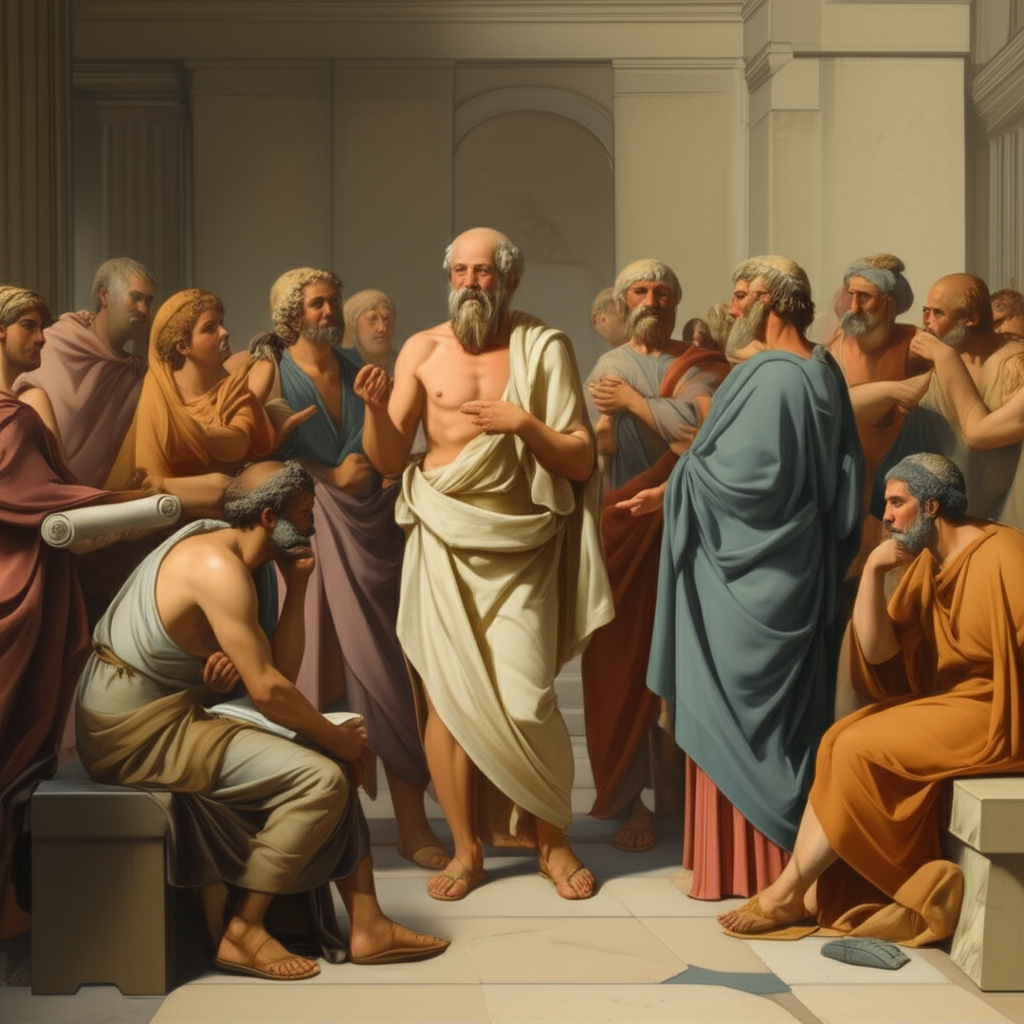
This systematic back-and-forth, found in the dialogues of Plato, forces participants to scrutinize their own beliefs and the beliefs of others, pushing them toward a more precise definition of complex ideas.
The Socratic Method: Defining Virtue and Vice
Plato's dialogues, central to the Great Books of the Western World, provide perhaps the most vivid examples of dialectic in action, particularly in the pursuit of moral definitions. In works like the Republic, Socrates engages his interlocutors in extensive discussions about justice, courage, and piety, which are all facets of Good. He doesn't offer a ready-made definition but rather guides his companions through a process of trial and error, exposing the flaws in their initial assumptions.
Consider the early attempts to define justice in the Republic:
- Cephalus's Definition: Justice is speaking the truth and paying one's debts.
- Socrates' Counter: Is it just to return a weapon to a madman? No, it could cause harm.
- Polemarchus's Definition: Justice is helping friends and harming enemies.
- Socrates' Counter: How do we truly know who our friends and enemies are? And does a just person ever truly harm anyone, even an enemy, in their capacity as a just person? Harming makes people worse, and justice makes people better.
Through this dialectical process, the initial definitions are shown to be inadequate, leading to a deeper search. This iterative refinement is precisely how dialectic helps us approach the definition of Good and Evil. It's not about finding a simple slogan but about understanding the intricate nuances and implications.
Dialectic as a Tool for Clarifying Moral Concepts
The application of dialectic in defining Good and Evil offers several profound benefits:
- Unmasking Ambiguity: Many moral disagreements stem from a lack of clear definition. Dialectic forces us to articulate precisely what we mean by "good" or "evil" in a given context, exposing hidden assumptions and vague language.
- Challenging Relativism: While dialectic acknowledges diverse perspectives, it also seeks to find underlying principles or a more universal understanding. By testing various cultural or individual definitions against logical consistency and practical implications, it can highlight commonalities or fundamental truths.
- Refining Ethical Principles: Through the constant back-and-forth, our understanding of moral principles evolves. We move from simplistic, often contradictory, notions to more coherent and comprehensive ethical frameworks.
The Evolution of Moral Understanding: A Hegelian Perspective
Later philosophers, such as G.W.F. Hegel, expanded the concept of dialectic beyond individual conversation to encompass the historical development of ideas. For Hegel, the definition of concepts like freedom, justice, and indeed Good and Evil, evolves through a dialectical process over time. A prevailing idea (thesis) generates its opposite (antithesis), and their conflict resolves into a new, more advanced understanding (synthesis). This historical dialectic suggests that our current definitions of Good and Evil are not static but are the product of centuries of intellectual and social struggle, constantly being refined and re-evaluated. This broader view, too, underscores that definition is not a one-time act but an ongoing, dynamic process.
Applying the Dialectical Method Today
In our contemporary world, where moral issues are often polarized and complex, the dialectical method remains an invaluable guide. Whether discussing environmental ethics, social justice, or personal responsibility, engaging in a genuine dialectical process can:
- Foster Empathy: By truly listening to and engaging with opposing viewpoints, we can better understand the motivations and reasoning behind them, even if we ultimately disagree.
- Promote Critical Thinking: It encourages us to question not only others' arguments but also our own, leading to more robust and defensible positions.
- Facilitate Consensus (or at least mutual understanding): Even if full agreement on the definition of Good and Evil is impossible, dialectic can help clarify the points of divergence, allowing for more productive dialogue and compromise.
Conclusion: The Ongoing Dialogue
The use of dialectic in defining Good and Evil is not a quest for a final, immutable answer, but rather a commitment to an ongoing process of intellectual rigor and moral clarity. From the Socratic inquiries into virtue to Hegel's grand historical narrative, philosophy has consistently demonstrated that the most profound definitions emerge not from pronouncements, but from persistent questioning, critical analysis, and the courageous engagement with conflicting ideas. In a world yearning for moral compass, the dialectical method remains our most reliable guide in charting the elusive territories of Good and Evil.
YouTube Video Suggestions:
-
📹 Related Video: PLATO ON: The Allegory of the Cave
Video by: The School of Life
💡 Want different videos? Search YouTube for: ""Socrates' Dialectic Method Explained" or "Plato's Republic Justice Dialogue""
2. ## 📹 Related Video: What is Philosophy?
Video by: The School of Life
💡 Want different videos? Search YouTube for: ""Hegel's Dialectic Simplified" or "Understanding Hegel's Philosophy Good Evil""