

The Enduring Dialectic: Unraveling Good and Evil Through Philosophical Discourse
A Benjamin Richmond Exploration of Moral Definition
Summary: The perennial human quest to define good and evil finds one of its most potent tools in the philosophical method of dialectic. From Socratic inquiry to Hegelian synthesis, dialectic offers a structured, rigorous process for scrutinizing assumptions, testing propositions, and refining our understanding of these fundamental moral concepts. This article explores how dialectic, as a core method in philosophy, serves not merely as a debate technique but as an essential pathway towards the definition of what constitutes the ethically laudable and the morally reprehensible, drawing extensively from the intellectual heritage preserved in the Great Books of the Western World.
The Philosophical Imperative: Why Define Good and Evil?
The distinction between good and evil is arguably the most critical and complex undertaking in human thought. It underpins our laws, shapes our societies, and guides our individual choices. Yet, these concepts often remain nebulous, subject to cultural relativism, personal sentiment, or dogmatic assertion. It is precisely in this quagmire of uncertainty that philosophy—and specifically the dialectic—offers a beacon. Rather than accepting pre-existing notions, the dialectical method compels us to engage in a dynamic process of questioning, counter-argument, and synthesis, pushing us closer to a more robust and defensible definition of good and evil.
What is Dialectic? A Method of Inquiry and Ascent
At its heart, dialectic is a method of philosophical argumentation that involves a rigorous exchange of ideas, often through dialogue, to arrive at truth or to clarify concepts. It is not merely a debate where one side wins, but a collaborative or internal process of intellectual refinement.
Key Characteristics of Dialectic:
- Questioning and Scrutiny: It begins with a proposition or an assumed truth, which is then subjected to intense questioning.
- Contradiction and Counter-Argument: Opposing viewpoints or inherent contradictions within the initial proposition are brought to light.
- Synthesis and Refinement: Through the resolution of these contradictions, a new, more comprehensive understanding or a more nuanced proposition emerges. This new understanding then becomes the subject of further dialectical inquiry.
This cyclical process, often described as thesis-antithesis-synthesis, pushes thought beyond superficial agreement to deeper, more foundational truths.
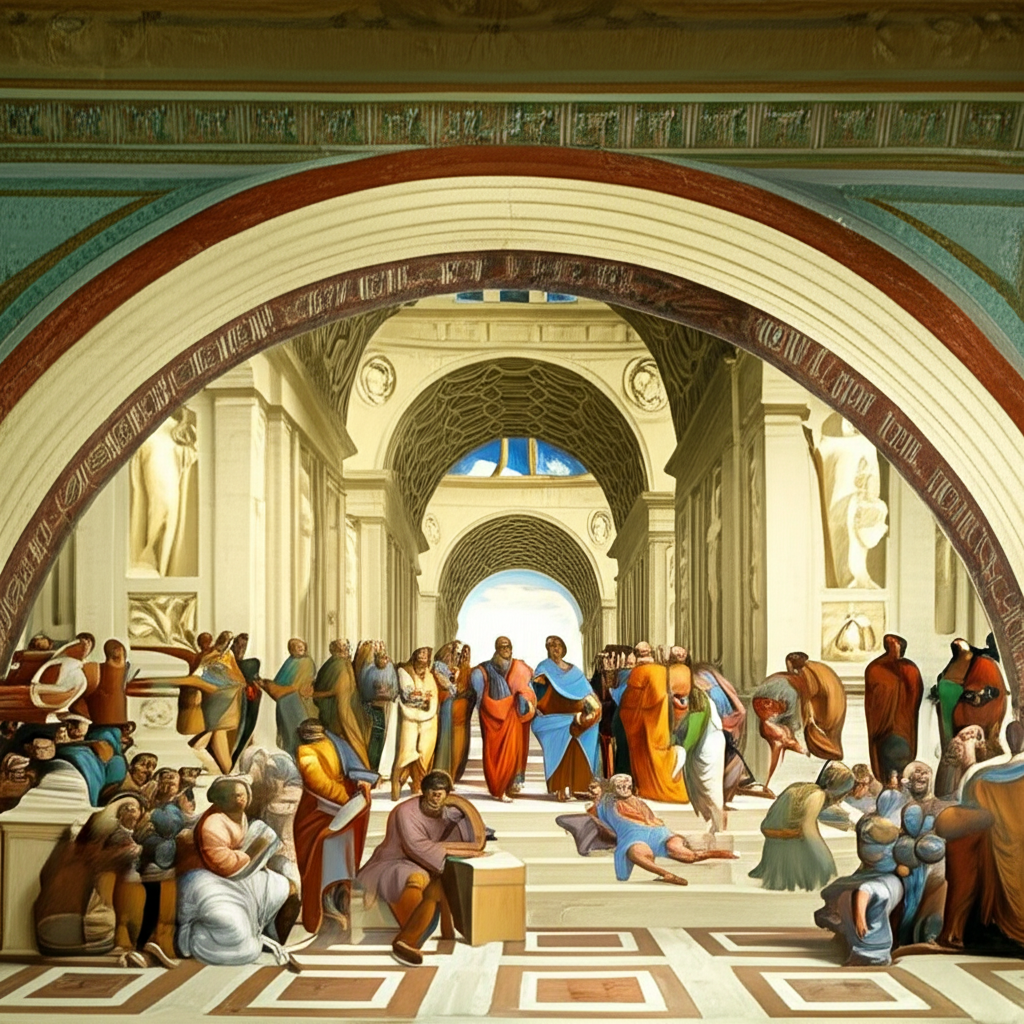
Plato's Dialectical Ascent to the Form of the Good
Perhaps no philosopher more profoundly articulated the role of dialectic in understanding the good than Plato. In his seminal work, The Republic, Plato posits that the highest form of knowledge is the apprehension of the Form of the Good. This is not achieved through sensory experience or mere opinion, but through a demanding intellectual journey—the dialectical ascent.
The Platonic Dialectic and Moral Understanding:
- Challenging Assumptions: Socrates, Plato's mentor and protagonist, famously employed dialectic (the Socratic method) to expose the ignorance of those who claimed to know the definition of virtues like justice or piety. By asking probing questions, he revealed inconsistencies in their beliefs.
- Moving Beyond Appearances: For Plato, our everyday understanding of "good" actions or "evil" deeds is akin to shadows on the wall of a cave. Dialectic, through rigorous intellectual discipline, allows the philosopher to turn away from these fleeting appearances and ascend towards the immutable Forms.
- Apprehending the Good Itself: The ultimate goal of dialectical training, particularly for the philosopher-kings, is to grasp the Form of the Good—the ultimate source of all truth, beauty, and being. This intellectual apprehension, rather than a mere opinion, provides the foundation for true ethical governance and individual virtue. As stated in The Republic, "Dialectic...is the coping-stone of the sciences, and is set over them; no other science can be placed higher."
For Plato, the definition of good and evil is not a matter of consensus but of intellectual insight achieved through the arduous path of dialectical reasoning.
Aristotle's Practical Dialectic: Defining Virtue and Vice
While Aristotle, Plato's most famous student, diverged from his teacher on the nature of Forms, he nonetheless utilized a form of dialectical reasoning, particularly in his ethical treatises like the Nicomachean Ethics. Aristotle's approach was more empirical and practical, yet still relied on a process of examining common opinions (endoxa), identifying problems, and refining concepts.
Dialectic in Aristotelian Ethics:
- Examining Common Beliefs: Aristotle begins by surveying what people generally believe about happiness, virtue, and the good life. This is a dialectical starting point, engaging with existing propositions.
- Identifying Contradictions and Nuances: He then critically analyzes these beliefs, pointing out where they are inconsistent or incomplete. For example, he distinguishes between apparent goods and real goods.
- Refining Definitions Through Reason: Through this process, Aristotle arrives at his definition of virtue as a mean between two extremes of vice (e.g., courage as a mean between cowardice and rashness). This is a reasoned, refined understanding that emerges from a dialectical engagement with common experience and philosophical insight.
- The Telos of Human Action: The ultimate good, for Aristotle, is eudaimonia (flourishing or living well), which is achieved through virtuous activity. Defining these virtues requires careful, reasoned deliberation—a practical application of dialectical thinking.
Hegel's Grand Dialectic: History, Spirit, and Moral Evolution
Centuries later, G.W.F. Hegel elevated dialectic to a cosmic principle, viewing it as the fundamental engine of history and the evolution of consciousness, including our understanding of good and evil. In works like the Phenomenology of Spirit and Philosophy of Right, Hegel describes a process where ideas, social structures, and moral systems develop through inherent contradictions.
Hegelian Dialectic and Moral Progress:
| Stage | Description | Example in Morality |
|---|---|---|
| Thesis | An initial idea, concept, or state of being. It's often incomplete or contains inherent contradictions. | An early, perhaps simplistic, notion of "good" based on immediate gratification or tribal loyalty. |
| Antithesis | The opposing force or contradiction that arises from the thesis, revealing its limitations or flaws. | The recognition that immediate gratification can lead to long-term suffering, or that tribal loyalty can foster inter-group conflict (evil). |
| Synthesis | A new, higher-level concept that resolves the tension between the thesis and antithesis, incorporating elements of both into a more comprehensive and rational understanding. This then becomes a new thesis. | A more universal ethical framework (e.g., Kantian categorical imperative or utilitarianism) that transcends narrow self-interest or tribalism. |
For Hegel, the definition of good and evil is not static but evolves through this historical dialectic. Each stage represents a more rational and comprehensive grasp of freedom and morality, culminating in the realization of Absolute Spirit. The "evil" of one era might be the necessary antithesis that pushes humanity towards a greater good in the next.
The Enduring Relevance: Dialectic in Contemporary Ethics
The dialectical method remains crucial in modern ethical discourse. When we grapple with complex moral dilemmas—from bioethics to artificial intelligence—we implicitly or explicitly engage in dialectical reasoning.
How Dialectic Continues to Define Good and Evil:
- Clarifying Ethical Principles: Debates around concepts like justice, autonomy, or equality involve presenting initial understandings, challenging them with counter-examples or conflicting principles, and striving for more nuanced, robust definitions.
- Navigating Moral Pluralism: In a diverse world, dialectic allows for a respectful yet rigorous engagement with differing moral perspectives, seeking common ground or at least a deeper understanding of irreducible differences, rather than simply asserting one's own view.
- Exposing Moral Blind Spots: By systematically questioning our ethical assumptions, dialectic can reveal biases, inconsistencies, and areas where our current moral frameworks fall short, pushing us towards ethical progress.
Conclusion: The Unceasing Pursuit of Moral Clarity
The dialectic is more than just a philosophical technique; it is a fundamental mode of intellectual engagement that is indispensable for the definition of good and evil. From Plato's ascent to the Form of the Good, through Aristotle's practical ethics, to Hegel's grand historical synthesis, the dialectical process has consistently served as the engine of moral inquiry. It compels us to move beyond superficial agreement, to confront contradictions, and to strive for a more profound and universally defensible understanding of what it means to live a moral life. In a world still grappling with profound ethical challenges, the rigorous, reflective spirit of dialectic remains our most powerful tool for navigating the intricate landscape of morality.
YouTube Video Suggestions:
-
📹 Related Video: PLATO ON: The Allegory of the Cave
Video by: The School of Life
💡 Want different videos? Search YouTube for: ""Plato's Republic The Allegory of the Cave and the Form of the Good Explained""
2. ## 📹 Related Video: ARISTOTLE ON: The Nicomachean Ethics
Video by: The School of Life
💡 Want different videos? Search YouTube for: ""Hegel's Dialectic Explained Simply - Thesis Antithesis Synthesis""