

The Use of Analogy in Philosophical Reasoning: A Guiding Light and a Treacherous Path
Analogy, at its heart, is the art of understanding something new by comparing it to something familiar. In the grand tapestry of philosophical reasoning, it stands as a venerable tool, employed by thinkers across millennia to illuminate abstract concepts, build arguments, and explore the very nature of existence. This article delves into the profound utility and inherent limitations of analogical thinking within philosophy, examining how this powerful device both clarifies and complicates our quest for truth. We will explore its historical prominence, its logical underpinnings, and the critical discernment required to wield it effectively, ultimately seeking to understand the delicate relation between comparison and comprehension.
Unpacking Analogy: A Core Philosophical Device
At its simplest, an analogy draws a comparison between two distinct things or systems, highlighting similarities in their structure, function, or relation to other elements. It posits that because two things are alike in some known respects, they are likely to be alike in others. For philosophers, this isn't merely a rhetorical flourish; it's a fundamental mode of reasoning that helps bridge the gap between the concrete and the abstract, the observed and the inferred.
Key Components of an Analogy:
- Target Domain: The concept or phenomenon we are trying to understand or explain.
- Source Domain: The familiar concept or phenomenon used for comparison.
- Inferred Similarities: The properties, structures, or relations transferred from the source to the target.
While often confused with metaphor, analogy in philosophy typically aims for a more systematic and argumentative comparison, seeking to demonstrate a structural or functional parallel rather than merely a poetic one. It's a method crucial for developing hypotheses, illustrating complex theories, and even for evaluating the logic of an argument.
A Historical Panorama: Analogy Through the Great Books
The history of philosophy is replete with profound and often contentious uses of analogy. From ancient Greece to the Enlightenment, great thinkers have leveraged this mode of reasoning to build their intellectual edifices.
Plato's Illuminations and Allegories
Perhaps no philosopher is more famously associated with analogy than Plato. In The Republic, he masterfully employs the Allegory of the Cave to illustrate the human condition, the nature of reality, and the arduous journey towards enlightenment. The shadows on the cave wall are analogous to our sensory perceptions, while the journey out of the cave represents philosophical education. Similarly, his Ship of State analogy explains the ideal governance and the dangers of incompetent leadership, comparing a state to a vessel requiring a skilled navigator (the philosopher-king). These are not mere stories; they are intricate argumentative structures designed to convey complex metaphysical and political truths.
Aristotle's Systematic Comparisons
Aristotle, while more focused on empirical observation and formal logic, also recognized the utility of analogy. In his biological works, he often compared the organs and functions of different species to understand underlying principles. In his Metaphysics, he discusses analogy in terms of relation (pros hen analogy), where multiple things are related to a single primary meaning, as in "healthy" referring to a healthy body, healthy food, or a healthy complexion, all deriving their meaning from health of the organism. This demonstrates a sophisticated understanding of how terms can share meaning through relation rather than strict univocity.
Aquinas and the Analogy of Being
Thomas Aquinas, deeply influenced by Aristotle, developed the concept of the analogy of being to speak about God. He argued that when we attribute perfections (like "good" or "wise") to God, we do not mean them univocally (in the exact same way as when applied to humans) nor equivocally (in entirely different ways). Instead, we apply them analogically, recognizing a relation of proportion and causality. God is good in a way infinitely superior to human goodness, yet our understanding of human goodness offers a glimpse, an analogous understanding, of divine goodness. This was a crucial piece of logic for medieval theology.
Hume's Skeptical Scrutiny
David Hume, in his Dialogues Concerning Natural Religion, offers a powerful critique of analogical arguments, particularly the design argument. He questions the relation between the universe and a human-made machine, arguing that the disanalogies are too vast. We have no experience of universe-making, nor can we infer a unique, perfect designer from a world teeming with imperfections. Hume's work highlights the critical need to scrutinize the strength and relevance of the similarities being drawn.
Kant's Regulative Principles
Immanuel Kant, in his Critique of Pure Reason, discusses "Analogies of Experience" not as arguments for external objects, but as regulative principles of the understanding that make experience itself possible. For example, the analogy of substance asserts that "in all changes of appearances substance persists, and its quantum in nature is neither increased nor diminished." These are not analogies in the sense of comparing two empirical objects, but rather principles that allow us to perceive a coherent and unified empirical world, positing necessary relations between phenomena.
The Strengths of Analogical Reasoning in Philosophy
The enduring appeal of analogy in philosophy is due to its manifold strengths:
- Clarification of Complex Ideas: Analogies can render abstract philosophical concepts tangible and comprehensible. Plato's Cave makes the theory of Forms accessible.
- Hypothesis Generation: By noticing similarities, philosophers can formulate new questions and hypotheses about less understood phenomena.
- Conceptual Exploration: Analogies allow us to explore the implications of a concept by transferring its structure to a different domain, revealing new facets.
- Rhetorical Power and Persuasion: A well-chosen analogy can be incredibly persuasive, engaging the reader's intuition and making an argument feel self-evident.
- Highlighting Structural Relations: Analogies force us to identify the underlying relations and patterns, moving beyond superficial differences.
The Perils and Pitfalls: When Analogy Deceives
Despite its power, analogical reasoning is fraught with danger. A poor analogy can lead to profound error and misunderstanding.
- False Equivalences: Assuming similarities where none truly exist, or exaggerating minor resemblances.
- Oversimplification: Reducing complex philosophical problems to misleadingly simple comparisons, thus obscuring crucial nuances.
- Ignoring Disanalogies: Focusing solely on similarities while neglecting critical differences that undermine the comparison. Hume's critique of the design argument is a prime example.
- Misleading Implications: An analogy might carry unintended baggage from the source domain, leading to false conclusions about the target.
- Circular Reasoning: Sometimes an analogy is used to "prove" something that is already implicitly assumed within the analogy itself.
Table: Strengths vs. Weaknesses of Philosophical Analogies
| Strength | Weakness |
|---|---|
| Clarifies abstract concepts | Risks oversimplification |
| Generates new hypotheses | Can lead to false equivalences |
| Aids conceptual exploration | Prone to ignoring critical disanalogies |
| Enhances rhetorical persuasion | May introduce misleading implications |
| Reveals structural relations | Can obscure nuanced differences |
Constructing and Evaluating Philosophical Analogies
To leverage analogy effectively in philosophy, one must be adept at both constructing compelling comparisons and critically evaluating their validity.
- Identify the Core Relation: What is the fundamental structure or function being compared? Is it a relation of cause and effect, part to whole, means to end, or something else?
- Assess Relevance: Are the similarities truly relevant to the point being made? Do they pertain to the essential aspects of the target phenomenon?
- Scrutinize Disanalogies: Actively seek out differences between the source and target domains. Are these differences significant enough to invalidate the comparison? A strong analogy can withstand significant disanalogies if the core relation holds firm.
- Distinguish Explanatory from Argumentative Analogy:
- Explanatory analogies (like Plato's Cave) aim to illustrate and clarify, making a concept easier to grasp.
- Argumentative analogies (like the design argument) aim to prove a conclusion based on the observed similarities. These require a much higher standard of logic and rigor.
- Avoid Begging the Question: Ensure the analogy doesn't presuppose the very point it aims to prove.
The judicious use of analogy requires intellectual honesty and a keen eye for both connection and divergence. It is a powerful tool for philosophical reasoning, but one that demands constant vigilance.
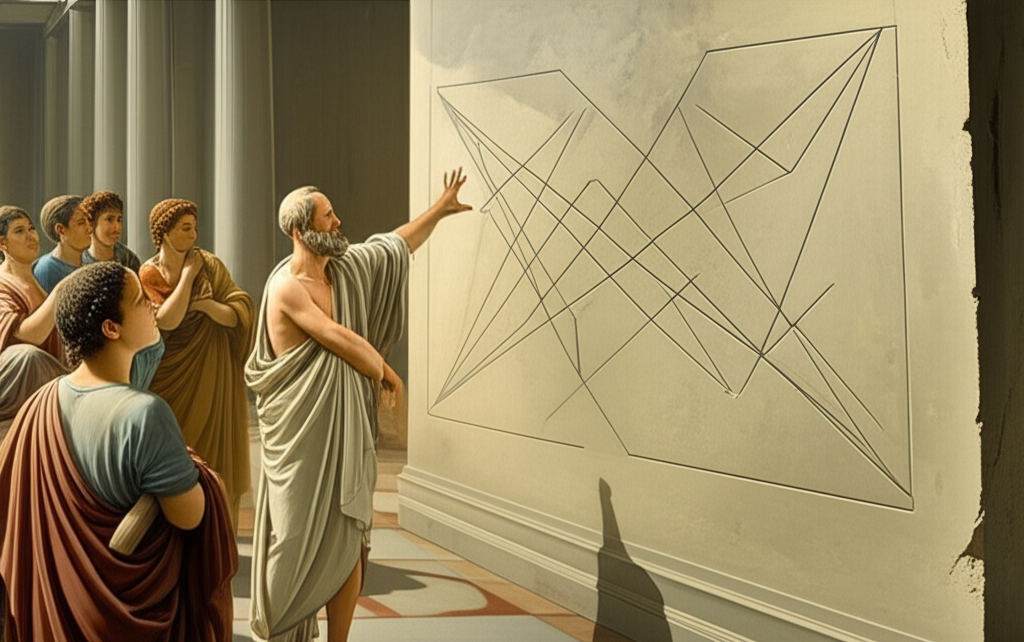
Conclusion: The Enduring Dance of Comparison
Analogy, therefore, remains a double-edged sword in the arsenal of philosophical reasoning. It is indispensable for making the ineffable intelligible, for building bridges between disparate ideas, and for sparking the imaginative leaps that drive philosophical inquiry forward. Yet, its persuasive power can also mask deep flaws in logic, leading us astray through specious relations and facile comparisons.
To truly engage with philosophy is to master the art of analogy: to appreciate its capacity to illuminate, to understand its structural logic, and to approach its conclusions with a healthy dose of critical skepticism. In doing so, we not only sharpen our own reasoning but also gain a deeper appreciation for the rich history of thought contained within the Great Books of the Western World, where analogy has consistently served as both a guiding light and a challenging puzzle.
YouTube Video Suggestions:
-
📹 Related Video: PLATO ON: The Allegory of the Cave
Video by: The School of Life
💡 Want different videos? Search YouTube for: "Plato's Allegory of the Cave explained"
2. ## 📹 Related Video: KANT ON: What is Enlightenment?
Video by: The School of Life
💡 Want different videos? Search YouTube for: "Analogical reasoning critical thinking"