

The Indispensable Bridge: The Use of Analogy in Philosophical Reasoning
Analogy serves as a cornerstone of philosophical inquiry, providing a powerful tool for illuminating complex ideas, generating hypotheses, and exploring the relations between disparate concepts. Far from being mere illustrative devices, analogies are fundamental to how we engage in reasoning within philosophy, acting as intellectual bridges that connect the known to the unknown, guiding our understanding and shaping our logic. This article delves into the nature, utility, and inherent challenges of employing analogy in philosophical discourse, drawing upon the rich tradition found in the Great Books of the Western World.
Unpacking Analogy: A Core Philosophical Tool
At its heart, an analogy is a comparison between two subjects, or systems of subjects, that are different in most respects but share significant similarities in their structure or relations. Philosophers wield analogy not just to make their arguments more palatable, but to explore the very fabric of reality, ethics, and knowledge itself. It allows us to transfer understanding from a domain we comprehend well to one that is more obscure, thereby advancing our philosophical reasoning.
What Analogy Offers to Philosophy:
- Clarification: Simplifying intricate concepts by likening them to more familiar ones.
- Hypothesis Generation: Suggesting new possibilities or avenues for investigation.
- Conceptual Exploration: Pushing the boundaries of existing ideas and their relations.
- Persuasion: Building intuitive understanding and fostering agreement through relatable comparisons.
Historical Echoes: Analogy in the Great Books
From ancient Greece to the Enlightenment, the Great Books of the Western World are replete with instances where analogy is not just used, but forms the very backbone of profound philosophical arguments.
Plato's Enduring Analogies
Perhaps no philosopher is more famously associated with analogy than Plato. In his seminal work, The Republic, he employs a series of powerful analogies to convey his theories of knowledge, reality, and the ideal state:
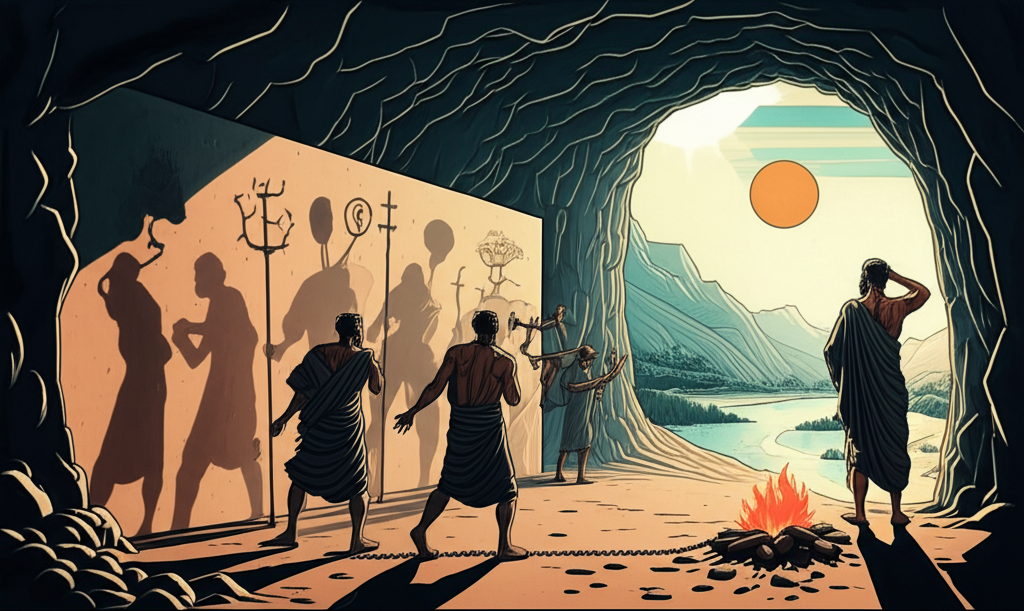
- The Allegory of the Cave: This iconic analogy illustrates the journey from ignorance to enlightenment, comparing our everyday perceptions to shadows on a cave wall and philosophical understanding to seeing the sun directly. It profoundly shapes our reasoning about truth and appearance.
- The Divided Line: This analogy maps different levels of reality and corresponding modes of cognition, from images and physical objects to mathematical forms and the Forms themselves.
- The Ship of State: Plato likens the governance of a state to the navigation of a ship, arguing that just as a ship requires a skilled navigator, a state requires a wise philosopher-king.
Aristotle's Systematic Comparisons
Aristotle, while often contrasting with Plato, also extensively utilized analogy, particularly in his biological and ethical treatises. He often drew relations between the functions of living organisms and the functions of society or the individual soul, applying principles of natural observation to abstract philosophical problems. His system of categorization and logical definition often relied on discerning analogous structures across different domains.
Aquinas and Analogical Predication
In the medieval period, Thomas Aquinas grappled with how we can speak about God, who transcends human understanding. He developed the concept of analogical predication, arguing that terms like "good" or "wise" when applied to God are not used in precisely the same way as when applied to humans (univocal), nor are they entirely different (equivocal). Instead, they are used analogically, preserving a relation of proportion or similarity in difference. This was a sophisticated application of logic to theological reasoning.
Descartes and the Mechanical Universe
Later, René Descartes employed the analogy of the universe as a grand machine, implying that its workings could be understood through mechanistic principles, much like a clock. This influential analogy profoundly shaped the scientific revolution and the philosophical logic of the modern era, suggesting a discoverable, predictable order underlying all phenomena.
The Mechanics and Limitations of Analogical Reasoning
While immensely powerful, analogical reasoning is not without its perils. Understanding its structure helps us appreciate both its strengths and its limitations.
Structure of an Analogical Argument:
- Identify two subjects (A and B): These are the primary subject (the target of understanding) and the auxiliary subject (the source of comparison).
- Ascribe properties/relations to the auxiliary subject (B): We know B has characteristics P, Q, R.
- Identify shared properties/relations: A also has characteristics P, Q.
- Infer the transfer of properties/relations: Therefore, A likely also has R.
Example:
- A (Primary Subject): The human mind
- B (Auxiliary Subject): A computer program
- Shared Properties: Both process information, store data, perform complex operations.
- Inference: Therefore, the human mind might also operate according to a set of underlying algorithms or rules.
Strengths and Weaknesses of Analogical Reasoning:
| Aspect | Strengths | Weaknesses |
|---|---|---|
| Illumination | Provides intuitive understanding of complex ideas. | Can oversimplify or obscure crucial differences. |
| Heuristic | Generates new hypotheses and directions for inquiry. | Not a form of deductive proof; conclusions are probabilistic. |
| Connection | Establishes relations between disparate domains. | Relies heavily on the quality and relevance of the comparison. |
| Persuasion | Makes arguments more accessible and relatable. | Can lead to fallacies if the analogy is superficial (false analogy). |
| Conceptual | Helps define and refine concepts through comparison. | Disanalogies (points of difference) can invalidate the inference. |
Analogy, Logic, and the Pursuit of Truth
In the broader landscape of philosophical logic, analogical reasoning falls under the umbrella of inductive reasoning. Unlike deductive arguments, which aim for certainty, analogical arguments aim for probability. They suggest that because two things are similar in some known respects, they are likely to be similar in other unknown respects.
The challenge for the philosopher is to evaluate the strength of an analogy. This involves scrutinizing the relation between the compared subjects, assessing the number and significance of shared attributes, and critically examining potential disanalogies. A good analogy is not just vivid; it highlights deep structural or functional relations that genuinely advance our understanding and reasoning.
Conclusion: The Enduring Power of Comparison
The use of analogy in philosophical reasoning is a testament to the human mind's capacity to find patterns, draw relations, and extend understanding. From Plato's timeless parables to modern discussions of artificial intelligence, analogy remains an indispensable tool for exploring the vast terrain of philosophy. While it demands careful application and critical evaluation, its power to illuminate, inspire, and guide our logic ensures its continued prominence in the pursuit of wisdom.
📹 Related Video: PLATO ON: The Allegory of the Cave
Video by: The School of Life
💡 Want different videos? Search YouTube for: ""Plato's Allegory of the Cave explained simply""
📹 Related Video: ARISTOTLE ON: The Nicomachean Ethics
Video by: The School of Life
💡 Want different videos? Search YouTube for: ""The Role of Analogy in Philosophical Argumentation""