

The Illuminating Gaze: Analogy as a Compass in Philosophical Reasoning
A Direct Path Through Complex Ideas
In the grand tapestry of human thought, few tools are as consistently employed, yet as frequently misunderstood, as analogy. This article delves into the profound utility of analogy within philosophical reasoning, exploring its capacity to illuminate complex concepts, forge new understanding, and even guide the very architecture of our logic. From ancient Greece to contemporary discourse, analogy has served as a crucial bridge, helping us grasp the abstract by relating it to the concrete, thereby fostering deeper relation and insight into the fundamental questions of philosophy. We will examine its strengths as a pedagogical and exploratory device, while also critically assessing its inherent limitations and the careful discernment required for its proper application.
What is Analogy? Unpacking the Core Concept
At its heart, an analogy is a comparison between two otherwise dissimilar things based on a shared feature, function, or relation. It posits that if two things are alike in some respects, they may also be alike in others. This isn't merely a simile or a metaphor, though it often employs such figures of speech; rather, it's a form of inductive reasoning that seeks to transfer understanding from a familiar domain (the source) to an unfamiliar one (the target).
Consider the fundamental structure:
- A is to B as C is to D.
- X shares features F, G, H with Y. X also has feature J. Therefore, Y likely also has feature J.
The power lies in its ability to highlight structural similarities, allowing us to extrapolate, hypothesize, and clarify. It's a method of making the abstract tangible, the foreign familiar, and the complex digestible.
The Potent Force of Analogy in Philosophical Reasoning
Analogies are not mere rhetorical flourishes in philosophy; they are often integral to the very process of thought and argument. Their utility stems from several key functions:
Elucidation of Complex Concepts
Philosophical ideas often grapple with concepts that are abstract, counter-intuitive, or beyond direct empirical observation. Analogy provides a conceptual scaffold. How do we explain the nature of reality, the soul, or the structure of government? By drawing parallels to things we already comprehend.
- Example: Plato, in his Republic (a cornerstone of the Great Books of the Western World), uses the Allegory of the Cave to explain the journey from ignorance to knowledge, the nature of reality, and the philosopher's role. The shadows on the wall are analogous to our sensory perceptions, while the external sun represents the Form of the Good. This rich analogy allows readers to grasp profound epistemological and metaphysical points through a vivid, relatable narrative. Similarly, his Ship of State analogy illuminates the ideal governance, comparing the state to a vessel and its citizens to the crew, each requiring a skilled and wise navigator (the philosopher-king).
Hypothesis Generation and Exploration
Analogies can serve as fertile ground for generating new hypotheses or exploring the implications of existing ones. By seeing a problem in a new light, philosophers can uncover previously unnoticed aspects or potential solutions.
- Example: When considering the mind-body problem, analogies to software and hardware, or a conductor and an orchestra, can help frame different theories, even if ultimately flawed, by suggesting potential relations and interactions.
Persuasion and Rhetoric
While logic dictates the validity of an argument, analogy often dictates its persuasiveness. A well-chosen analogy can make an argument resonate emotionally and intuitively, fostering understanding and acceptance in a way that abstract propositions alone might not. This is particularly true in ethical and political philosophy, where moral intuitions are often guided by comparisons to familiar situations.
Historical Echoes: Analogies in the Great Books
The history of Western philosophy, as chronicled in the Great Books of the Western World, is replete with iconic analogies that have shaped our understanding:
| Philosopher | Analogy | Purpose | Key Philosophical Area |
|---|---|---|---|
| Plato | Allegory of the Cave, Ship of State | Epistemology, Metaphysics, Political Philosophy | Understanding reality, knowledge, ideal governance |
| Aristotle | The Acorn to the Oak Tree (Implicit in teleology), Craftsmanship | Metaphysics, Ethics | Potency and Act, the pursuit of eudaimonia |
| Descartes | The Clockwork Universe, The Pilot in the Ship | Metaphysics, Mind-Body Problem | Mechanism of nature, the soul's relation to the body |
| Hume | The Watch and the Watchmaker | Philosophy of Religion, Epistemology | Critiquing the Argument from Design |
| Kant | The Copernican Revolution (in philosophy) | Epistemology, Metaphysics | Shifting focus from object to subject in knowledge |
These examples demonstrate that analogy is not a peripheral embellishment but a fundamental tool for constructing, communicating, and challenging philosophical reasoning.
The Perilous Path: Limitations and Pitfalls of Analogical Reasoning
Despite their power, analogies are not without their dangers. Their very nature as comparisons means they are always incomplete and can be misleading if not handled with rigorous logic.
False Equivalence
The most common pitfall is assuming that because two things are similar in one or two respects, they must be similar in all relevant respects. This can lead to drawing conclusions that are not supported by the actual relation.
Overextension
An analogy might hold true for a specific aspect of a comparison but break down when pushed too far beyond its initial scope. Applying it universally can lead to fallacious reasoning.
Ignoring Disanalogies
A critical flaw is to focus solely on the similarities while neglecting crucial differences between the two things being compared. These disanalogies can undermine the entire argument. For instance, while the "Ship of State" analogy is illuminating, a state is not literally a ship, and its citizens are not merely passive crew members; these differences are vital to acknowledge.
The Need for Independent Justification
An analogy can illustrate a point or suggest a hypothesis, but it rarely proves it. The conclusions drawn from an analogy ultimately require independent logical or empirical justification. As David Hume famously showed with the Watchmaker analogy, the very structure of the argument from design, though intuitive, faces severe logical challenges regarding the relation of a finite universe to an infinite creator.
Cultivating a Critical Eye for Analogies
To harness the power of analogy effectively and avoid its pitfalls, one must develop a discerning critical faculty. This involves:
- Identifying the Core Relation: What is the fundamental similarity being asserted? Is it structural, functional, or causal?
- Assessing the Strength of the Analogy: How many points of similarity exist? Are these similarities relevant to the conclusion being drawn?
- Scrutinizing Disanalogies: What are the key differences between the source and target? Do these differences undermine the argument or conclusion?
- Testing for Independent Support: Does the conclusion drawn from the analogy have other forms of support, either logical or empirical? An analogy should be a guide, not the sole foundation, of reasoning.
- Contextual Awareness: Is the analogy being used to explain, to persuade, or to explore? The purpose often dictates the acceptable level of rigor.
By applying these critical steps, we can ensure that analogies serve as powerful tools for understanding and advancing philosophy, rather than as deceptive shortcuts.
Conclusion: Analogy – A Double-Edged Sword in the Philosophical Arsenal
The use of analogy in philosophical reasoning is a testament to the human mind's capacity to find patterns and draw connections. It is an indispensable tool for clarifying the obscure, generating new ideas, and communicating complex philosophical truths. From the allegories of Plato in the Great Books of the Western World to contemporary thought experiments, analogies continue to shape our discourse. However, their power is matched only by their potential for misdirection. A deep understanding of logic, a keen eye for relation, and a commitment to rigorous critical evaluation are essential to wield this double-edged sword effectively, ensuring that analogies illuminate rather than obscure the path to wisdom.
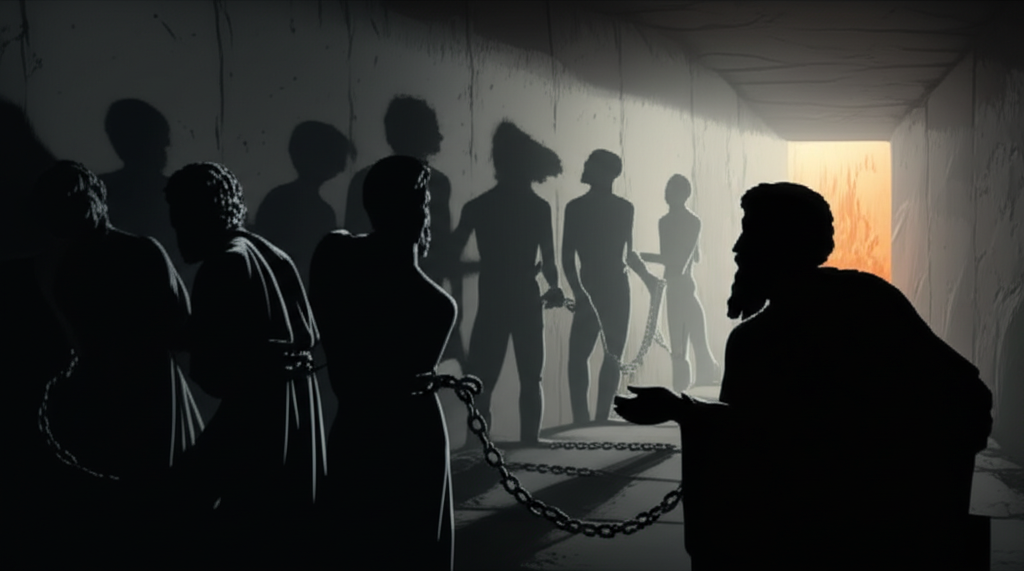
📹 Related Video: PLATO ON: The Allegory of the Cave
Video by: The School of Life
💡 Want different videos? Search YouTube for: ""Plato's Allegory of the Cave Explained""
📹 Related Video: ARISTOTLE ON: The Nicomachean Ethics
Video by: The School of Life
💡 Want different videos? Search YouTube for: ""The Role of Analogy in Philosophical Arguments""