

The Use of Analogy in Philosophical Reasoning
Analogy, at its core, is a powerful tool in the philosopher's toolkit, acting as a bridge between the known and the unknown. It is a form of reasoning that illuminates complex concepts by drawing a relation between two distinct things based on a shared structure or common properties. While not a definitive proof in the strict sense of formal logic, analogy serves as an invaluable aid for clarification, exploration, and persuasion within philosophy. This article delves into the nature of analogical reasoning, its profound utility, its inherent pitfalls, and how it has shaped the landscape of Western thought, particularly as evidenced in the enduring works compiled in the Great Books of the Western World.
Unpacking Analogical Reasoning
Analogy, from the Greek analogia, signifies proportionality or correspondence. In philosophical discourse, it involves inferring that if two or more things are similar in some respects, they are likely to be similar in others. It's a method of comparing two subjects (the source and the target) to highlight their shared characteristics, often to explain or argue a point about the less familiar target based on the more familiar source.
The Mechanism of Analogy
The essence of analogy lies in identifying a structural relation or a pattern that holds true across different domains. It is distinct from inductive reasoning, which generalizes from specific instances, and deductive logic, which draws necessary conclusions from premises. Analogy operates on the principle of similarity, suggesting that because A is like B in certain ways, it might also be like B in other, yet-to-be-established ways.
- Source Domain: The familiar concept, object, or situation.
- Target Domain: The less familiar or more complex concept, object, or situation that needs explanation.
- Shared Attributes/Relations: The points of similarity between the source and target.
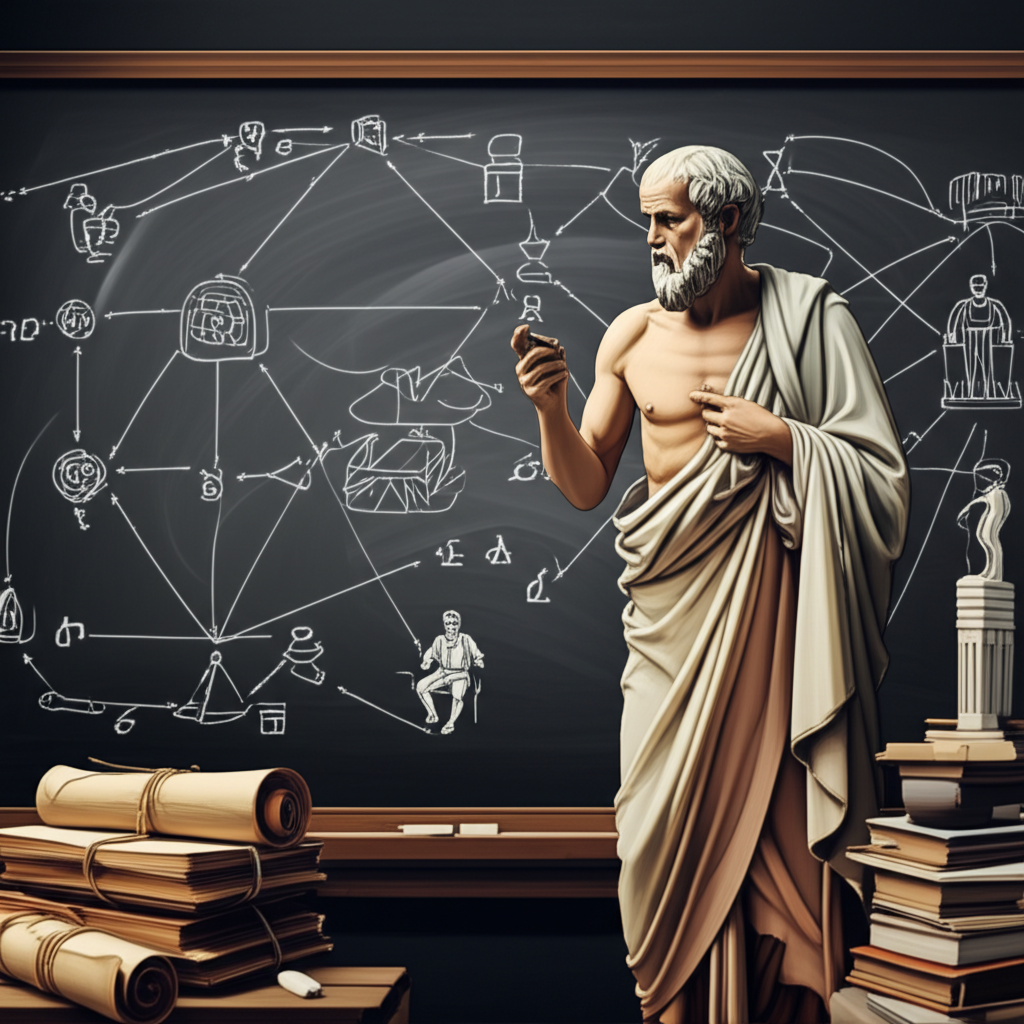
The Potent Role of Analogy in Philosophical Inquiry
Throughout the history of philosophy, analogy has been indispensable for making the abstract tangible, the obscure clear, and the novel comprehensible.
Clarification and Elucidation
Philosophers often grapple with concepts that defy direct empirical observation or simple definition. Analogy provides a means to ground these ideas in everyday experience, making them accessible to reasoning and contemplation.
- Simplifying Complexity: By likening a complex philosophical system to a familiar structure (e.g., the state as a ship, the mind as a computer), an analogy can provide an intuitive grasp of its underlying principles.
- Bridging Conceptual Gaps: It helps to connect disparate ideas, revealing underlying harmonies or contrasts that might otherwise remain hidden.
Exploration and Discovery
Beyond mere explanation, analogy can be a catalyst for intellectual exploration, suggesting new hypotheses or avenues of inquiry.
- Generating Hypotheses: Noticing a relation between two phenomena might lead a philosopher to hypothesize that further similarities exist or that the same underlying principles are at play.
- Conceptual Innovation: Analogies can help forge new concepts or refine existing ones by highlighting specific aspects or functions.
Persuasion and Rhetoric
In philosophical debate, a well-chosen analogy can be immensely persuasive, making an argument more vivid and compelling.
- Engaging the Audience: Analogies appeal to intuition and common sense, drawing the audience into the argument rather than merely presenting a dry logic.
- Emotional Resonance: Some analogies can evoke strong emotional responses, further solidifying the argument in the minds of listeners or readers.
Illustrious Analogies from the Great Books of the Western World
The Great Books are replete with examples where analogy has been employed with profound effect, shaping our understanding of fundamental philosophical questions.
| Philosopher | Work (Great Books) | Analogy | Purpose | Key Philosophical Concept |
|---|---|---|---|---|
| Plato | Republic | The Allegory of the Cave | To illustrate the process of enlightenment and the distinction between appearance and reality. | Epistemology, Metaphysics, Political Philosophy |
| Plato | Republic | The Ship of State | To explain the ideal governance, where only the wise (philosopher-king) are fit to rule. | Political Philosophy |
| Aristotle | Physics, Metaphysics | The Builder and the House | To explain the four causes (material, formal, efficient, final) and the relation between potentiality and actuality. | Metaphysics, Causality |
| Descartes | Meditations on First Philosophy | The Wax Argument | To demonstrate that the mind, not the senses, is the primary means of knowing the essence of things. | Epistemology, Philosophy of Mind |
| Locke | An Essay Concerning Human Understanding | Tabula Rasa (Blank Slate) | To argue that the mind at birth is empty and all knowledge is derived from experience. | Epistemology, Empiricism |
| Hume | Dialogues Concerning Natural Religion | The Watchmaker Analogy | To critique the argument from design for the existence of God, questioning the logic of inferring a divine designer from the apparent order of the universe. | Philosophy of Religion, Argument from Design |
These examples demonstrate how analogies provide a powerful framework for reasoning through complex ideas, making abstract arguments relatable and memorable.
The Perils and Pitfalls of Analogical Reasoning
While immensely useful, analogy is a double-edged sword. Its strength as a tool for illumination can also be its weakness if not handled with rigorous critical reasoning.
False Equivalencies
The most common pitfall is assuming that because two things are similar in some respects, they are similar in all respects. This leads to drawing conclusions that are not supported by the actual relation.
- Superficial Similarities: An analogy can be compelling even if the similarities are superficial and do not extend to the core properties relevant to the argument.
- Ignoring Dissimilarities: Overlooking crucial differences between the source and target domains can invalidate the entire analogical argument.
Overextension and Misapplication
Pushing an analogy beyond its reasonable limits, or applying it to situations where the underlying relation does not hold, can lead to absurd or misleading conclusions.
- Begging the Question: Sometimes an analogy is used in a way that assumes the very point it is trying to prove, rather than illuminating it.
- Creating Confusion: A poorly chosen or overly complex analogy can obscure rather than clarify, hindering effective reasoning.
The Importance of Logic and Critical Evaluation
To avoid these pitfalls, one must always subject analogies to careful logical scrutiny. The strength of an analogical argument is directly proportional to the number and relevance of the similarities, and inversely proportional to the number and relevance of the dissimilarities.
- Identify the Core Relation: What is the fundamental similarity being asserted?
- Test for Relevance: Are the shared features actually pertinent to the conclusion being drawn?
- Seek Dissimilarities: What are the ways in which the source and target differ? Do these differences undermine the argument?
Conclusion: Analogy as a Guide, Not a Master
In the grand tapestry of philosophical reasoning, analogy is an indispensable thread. From Plato's Cave to Locke's Tabula Rasa, it has enabled thinkers to articulate profound insights, explore novel ideas, and persuade audiences. It fosters understanding by revealing underlying relations and patterns. However, its power necessitates caution. A true philosopher, like a skilled craftsman, understands that while analogy can guide the hand, it must never replace the precision of rigorous logic and critical evaluation. When wielded thoughtfully, analogy remains a beacon, illuminating the intricate pathways of human thought and aiding our perpetual quest for wisdom.
YouTube Video Suggestions:
-
📹 Related Video: PLATO ON: The Allegory of the Cave
Video by: The School of Life
💡 Want different videos? Search YouTube for: ""Plato's Allegory of the Cave explained""
2. ## 📹 Related Video: ARISTOTLE ON: The Nicomachean Ethics
Video by: The School of Life
💡 Want different videos? Search YouTube for: ""Philosophical Analogies and Their Use in Argumentation""