

The Use of Analogy in Philosophical Reasoning: A Bridge to Understanding
Summary: In the grand tapestry of human thought, analogy stands as an indispensable loom, weaving together disparate concepts to forge understanding. This article explores how philosophers, from antiquity to the present day, have wielded analogy as a potent tool for reasoning, illuminating complex ideas, generating hypotheses, and communicating profound truths. While analogy offers a powerful means to grasp abstract relations and advance philosophical inquiry, we will also delve into the critical logic required to employ it judiciously, acknowledging its inherent limitations and potential pitfalls.
The Indispensable Bridge: Why Analogy Matters in Philosophy
The human mind, in its quest for knowledge, often seeks familiarity in the unfamiliar. Confronted with concepts too vast, too abstract, or too novel to grasp directly, we instinctively reach for comparisons. This fundamental cognitive process forms the bedrock of analogical reasoning—a method as old as philosophy itself, and one that remains vital for exploring the deepest questions of existence, knowledge, and morality.
For "Henry Montgomery," the elegance of a well-crafted analogy lies in its ability to reveal hidden relations, to make the opaque transparent, and to invite deeper contemplation. It is not merely a rhetorical flourish but a genuine pathway to insight, allowing us to build conceptual bridges from what we know to what we seek to understand.
What Exactly is Analogy?
At its core, an analogy is a comparison between two objects or systems of objects that are alike in some respects, but not necessarily in others. Its purpose is to explain or clarify one set of objects (the target) by referring to another (the source) that is more familiar or better understood. The essence lies in the shared relation or structure, rather than identical properties.
- Analogy vs. Metaphor vs. Simile: While often used interchangeably in casual speech, in philosophical reasoning, distinctions are crucial:
- Simile: Explicit comparison using "like" or "as" (e.g., "The mind is like a blank slate").
- Metaphor: Implicit comparison, stating one thing is another (e.g., "The mind is a blank slate").
- Analogy: A deeper, more extended comparison focusing on structural or relational similarities, often used to argue or explain (e.g., "Just as a skilled craftsman shapes raw materials into a useful tool, so too does education shape the raw potential of a mind into a capable intellect.").
The Power and Purpose of Analogical Reasoning in Philosophical Inquiry
Philosophers employ analogy for a multitude of reasons, leveraging its unique capacity to extend our understanding beyond immediate experience.
1. Making the Abstract Concrete
Many philosophical concepts—suchs as justice, consciousness, or the nature of reality—are inherently abstract. Analogy provides a tangible framework, grounding these ethereal ideas in something relatable. Plato's famous Allegory of the Cave, for instance, uses the concrete imagery of prisoners, shadows, and light to explain the philosophical journey from ignorance to enlightenment.
2. Generating Hypotheses and Exploring Possibilities
Analogy is often a starting point for discovery, not merely a tool for explanation. By observing a relation in one domain, a philosopher might hypothesize a similar relation in another, leading to new lines of inquiry and the development of novel theories. It's a form of creative reasoning that expands the conceptual landscape.
3. Communicating Complex Ideas
For educators and communicators of philosophy, analogy is invaluable. It simplifies complex arguments without necessarily oversimplifying the underlying ideas, making them accessible to a wider audience and facilitating deeper engagement.
4. Structuring Arguments and Thought Experiments
Many pivotal philosophical arguments and thought experiments rely heavily on analogical construction. They invite us to consider a hypothetical scenario that mirrors a real-world problem, allowing us to isolate variables and test intuitions.
Notable Philosophical Analogies and Their Impact
Throughout the history of Western thought, as chronicled in the Great Books, analogies have served as cornerstones for entire systems of reasoning.
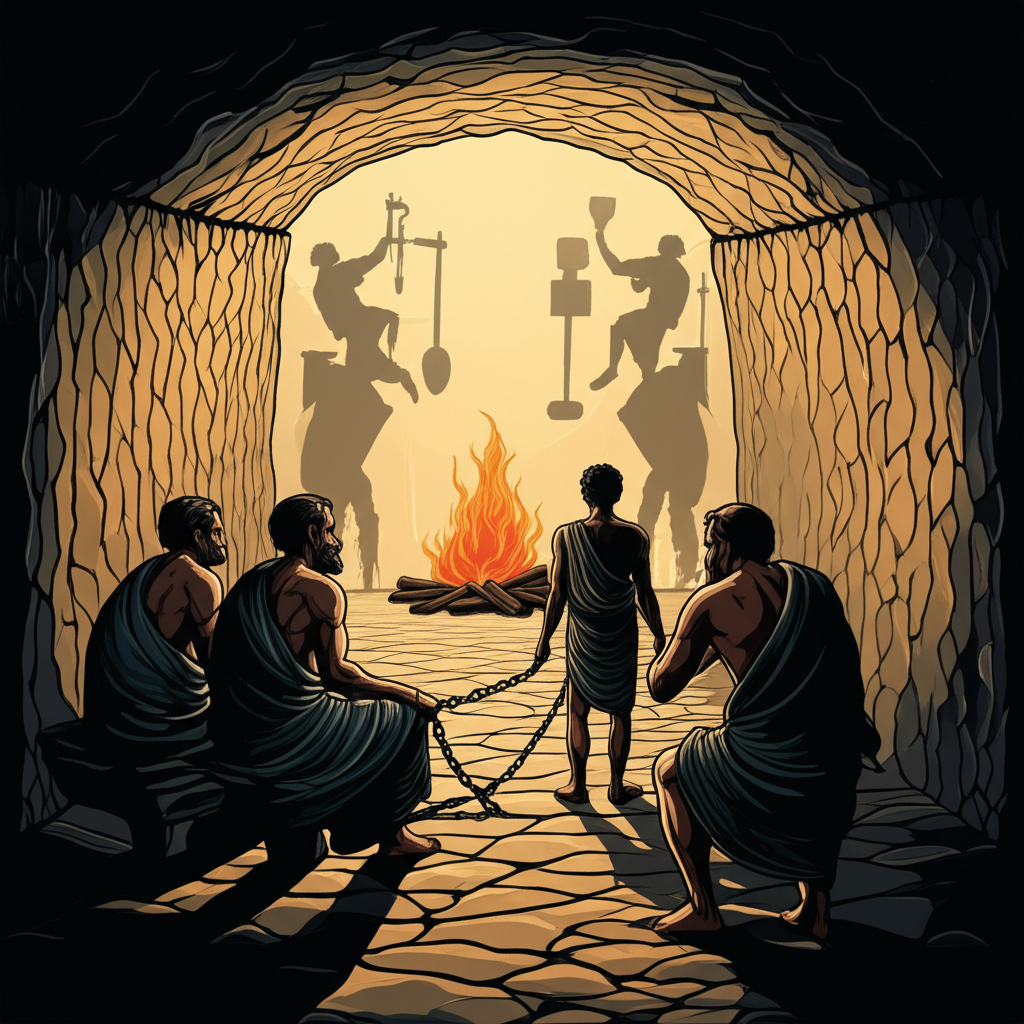
Here are a few classic examples:
| Analogy / Source | Philosophical Purpose | Key Relation Explored |
|---|---|---|
| Plato's Cave | Nature of reality, knowledge, and education | The relation between perceived reality (shadows) and true reality (outside world) |
| Aristotle's Craftsman | Teleology, potentiality, and actuality | The relation between an acorn (potential) and an oak tree (actual), guided by its form |
| Descartes' Wax Argument | Nature of substance, mind, and perception | The relation between sensory perception and intellectual understanding of a substance |
| Hume's Watchmaker | Argument from design for God's existence (critique) | The relation between a complex artifact (watch) and its supposed creator (God) |
| Locke's Tabula Rasa | Empiricism, origin of ideas | The relation between the mind at birth (blank slate) and experience (writing upon it) |
The Logic and Limitations of Analogical Reasoning
While powerful, analogical reasoning is not without its caveats. Its logic is primarily inductive, meaning its conclusions are probable, not certain.
The Structure of Analogical Argument
A typical analogical argument follows this general form:
- Object A has properties P, Q, and R.
- Object B has properties P and Q.
- Therefore, Object B probably also has property R.
The strength of such an argument depends critically on the relevance and number of shared properties (P and Q) to the inferred property (R). The more relevant similarities, and the fewer relevant dissimilarities, the stronger the argument.
Pitfalls and Precautions
"Henry Montgomery" would caution against the seductive simplicity of analogy, for it can mislead as easily as it can illuminate.
- False Analogy: This fallacy occurs when the two things being compared are not sufficiently alike in relevant respects to warrant the conclusion drawn. For example, arguing that because a complex machine (like a government) needs a single, powerful operator to function efficiently, a society also needs an absolute ruler, might be a false analogy if the relations of complexity and control are not truly comparable.
- Oversimplification: While analogies simplify, they can also strip away crucial nuances, leading to a distorted understanding of the original concept.
- Distraction: A particularly vivid or engaging analogy might distract from weaknesses in the underlying logic or the actual philosophical argument it is meant to support.
- Begging the Question: Sometimes an analogy implicitly assumes the very point it is trying to prove, rather than offering independent evidence.
To wield analogy effectively in philosophical reasoning, one must constantly scrutinize the points of comparison, questioning their relevance and exploring potential disanalogies. The true value lies not just in drawing connections, but in understanding the precise nature and limits of those relations.
Conclusion: Analogy as an Art of Philosophical Understanding
The use of analogy in philosophical reasoning is a testament to the human mind's creative capacity to grapple with the unknown. From the foundational myths of ancient Greece to the intricate thought experiments of modern analytic philosophy, analogy has served as an essential tool for exploration, explanation, and persuasion.
It is an art that demands both imagination and rigor—the imagination to perceive novel relations, and the rigor to test the logic and limits of those perceived similarities. As we continue to navigate the complex landscape of philosophical inquiry, analogy will undoubtedly remain a vital bridge, guiding our reasoning and enriching our understanding of the world and our place within it.
YouTube Video Suggestions:
-
📹 Related Video: PLATO ON: The Allegory of the Cave
Video by: The School of Life
💡 Want different videos? Search YouTube for: ""Logical Fallacies: False Analogy Explained""
-
📹 Related Video: PLATO ON: The Allegory of the Cave
Video by: The School of Life
💡 Want different videos? Search YouTube for: ""Plato's Allegory of the Cave explained simply""