

The Universal Principle of Life: An Enduring Philosophical Inquiry
A Glimpse into the Cosmic Tapestry
At the heart of philosophical inquiry lies a persistent yearning to understand the fundamental nature of existence. Among the most profound of these quests is the pursuit of The Universal Principle of Life. This isn't merely a biological question, but a deep dive into the very essence of being, seeking to uncover the singular, overarching truth that animates all living things, from the smallest microbe to the grandest cosmos. This article embarks on a journey through this concept, exploring its definitions, manifestations, and the timeless insights offered by the rich tradition of the Great Books of the Western World, ultimately inviting us to ponder our own intricate place within Nature's grand design, where Life and Death dance in an eternal embrace.
Unveiling the "Principle": From Arche to Essence
To speak of a "universal principle" is to seek the arche – the fundamental beginning, the underlying cause, or the ultimate reason – for all that is. In philosophy, a Principle is not just a rule, but a foundational truth from which other truths derive. When applied to life, it suggests an inherent, guiding force or structure that transcends individual instances.
The challenge lies in distinguishing the Universal and Particular. We observe countless particular manifestations of life: a budding flower, a soaring bird, a thinking human. Each is unique, distinct, and bound by its own specific conditions. Yet, across this vast array, there seems to be a common thread, a shared spark, a unifying characteristic that allows us to categorize them all as "living." This shared essence, this unifying force, is what we attempt to grasp when we speak of a Universal Principle of Life. It's the "what makes life, life," independent of its specific form or location.
Life's Kaleidoscopic Manifestations: Bridging the Universal and Particular
The diversity of life on Earth is breathtaking, a testament to the endless creativity of Nature. From the microscopic world to the majestic creatures of land and sea, each organism embodies life in its own unique way. Yet, beneath this bewildering variety, philosophers have long sought commonalities that point towards a deeper, universal truth.
Consider the shared attributes often ascribed to living things: growth, reproduction, metabolism, response to stimuli, and adaptation. These are not merely coincidental features; they are expressions of an underlying dynamic. The particular ways a plant photosynthesizes or an animal hunts are specific strategies, but the universal drive to sustain itself, to propagate, and to interact with its environment speaks to a common Principle.
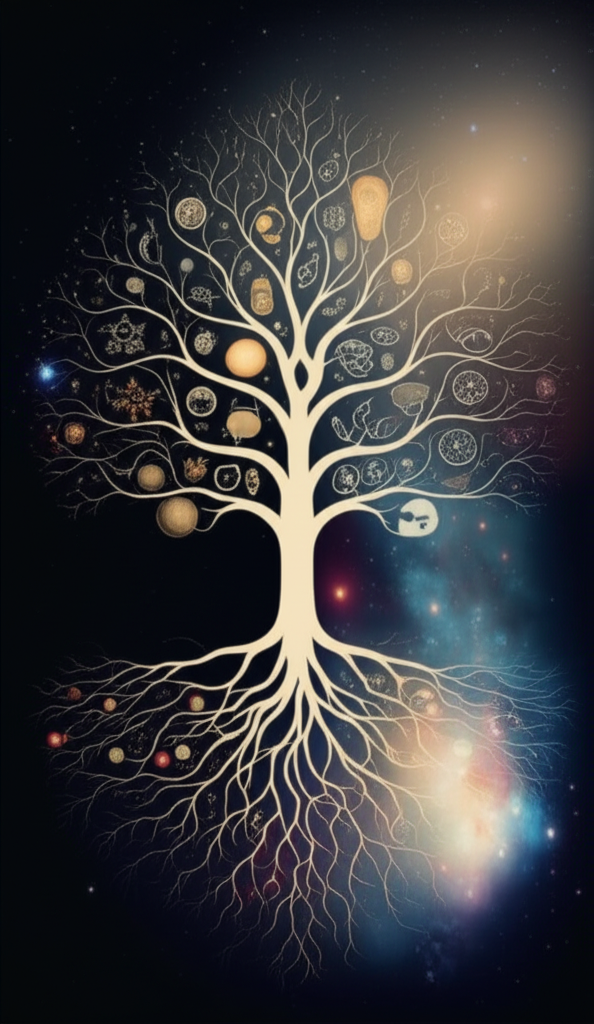
This constant interplay between the Universal and Particular is crucial. The universal principle isn't an entity separate from life; rather, it is expressed through the particularities. It is the invisible blueprint, the underlying code, that allows for the infinite variations we witness.
The Inseparable Dance: Life and Death in Nature's Cycle
Perhaps nowhere is the Universal Principle of Life more profoundly understood than in its relationship with Death. These are not opposing forces but two essential components of a continuous cycle, deeply embedded in the fabric of Nature. For life to flourish, death must occur; for new beginnings, there must be endings.
Philosophers across the ages have grappled with this duality. From ancient Greek thought, which often viewed the cosmos as a constantly changing flux, to later theological and metaphysical systems, the understanding of Life and Death has been central to comprehending existence. Death is not merely an absence of life, but an integral part of its process – a transformation, a return to the source, or a necessary precursor for renewal.
| Aspect of the Life-Death Cycle | Description | Philosophical Implication |
|---|---|---|
| Renewal and Regeneration | The decay of one organism provides nutrients for others; the passing of generations allows for evolution and adaptation. | Suggests a universal "economy" of being, where nothing is truly lost but merely transformed. Life's principle is not static but dynamic and regenerative. |
| Transience and Permanence | Individual lives are fleeting (particular), but life itself persists (universal). | Highlights the distinction between the ephemeral nature of individual existence and the enduring quality of the life principle. It forces contemplation on what truly endures beyond individual forms. |
| Balance and Harmony | The constant interplay maintains ecological equilibrium and prevents stagnation. | Points towards a cosmic order or inherent wisdom in Nature that governs the flow of existence, ensuring balance through continuous cycles of creation and dissolution. |
| Meaning and Value | The finitude of life often imbues it with greater meaning and urgency, driving purpose and action. | Challenges us to consider the ethical and existential implications of our brief tenure, and how our particular lives contribute to, or reflect, the universal principle. |
This cyclical understanding of Life and Death is a cornerstone of many philosophical traditions, positing that the Universal Principle of Life is not about endless individual existence, but about the enduring, transformative power of life itself as a continuous process within Nature.
Echoes from the Great Books: Seeking the Underlying Order
The pursuit of a Universal Principle of Life is a recurring theme throughout the Great Books of the Western World. While no single philosopher might have articulated it identically, many have approached it through various lenses, attempting to grasp the underlying order of existence.
- Ancient Greek Philosophy: Thinkers like Plato, with his Theory of Forms, suggested an ideal, unchanging realm where the perfect "Form of Life" might reside, of which all earthly living things are mere imperfect copies. Aristotle, on the other hand, focused on entelechy – the inherent purpose or potential within an organism that guides its development, a kind of internal principle of life.
- Stoicism: Emphasized a rational, divine Logos or universal reason that permeates and organizes all of Nature, including the principle of life itself, guiding its processes with inherent wisdom.
- Medieval Thought: Figures like Aquinas synthesized classical philosophy with Christian theology, often viewing God as the ultimate source and Principle of all life, imbuing creation with its vital force and purpose.
- Early Modern Philosophy: Spinoza, in his Ethics, conceived of a single, infinite Substance (God or Nature) of which everything, including life, is a modification. Here, the Universal Principle of Life is inseparable from the very essence of reality itself.
- German Idealism: Hegel's concept of the "Absolute Spirit" unfolding through history and Nature also presents a grand, evolving principle of life, where consciousness and existence are inextricably linked in a dynamic, universal process.
Across these diverse perspectives, a common thread emerges: the conviction that beneath the surface of fleeting phenomena lies an enduring, organizing Principle that gives rise to and sustains life in all its forms.
Our Place in the Grand Tapestry: Implications for Self and Nature
Understanding the Universal Principle of Life is not merely an academic exercise; it has profound implications for how we perceive ourselves and our relationship with Nature. If there is indeed a unifying principle, then our individual lives, our particular existence, are not isolated events but integral threads in a much larger, interconnected fabric.
This perspective fosters a sense of belonging and responsibility. Recognizing that we are expressions of this universal principle encourages a deeper reverence for all life and for the natural world that sustains it. It challenges us to look beyond the immediate and the individual, to see the profound patterns and cycles that govern existence.
Ultimately, the quest for the Universal Principle of Life remains an open-ended inquiry, a testament to humanity's enduring curiosity and our innate desire to find meaning and order in the universe. It invites us to contemplate the mystery, to embrace the interconnectedness of Life and Death, and to marvel at the intricate dance of the Universal and Particular within the boundless theatre of Nature.
YouTube: "Ancient Greek Philosophy on Life and Death"
YouTube: "Spinoza's Ethics explained: Substance, Attributes, and Modes"
📹 Related Video: What is Philosophy?
Video by: The School of Life
💡 Want different videos? Search YouTube for: "The Universal Principle of Life philosophy"