

The Unseen Thread: Exploring The Universal Principle of Life
Summary: The quest for a singular, unifying Principle animating all existence has captivated thinkers across millennia. This article delves into "The Universal Principle of Life," exploring how a fundamental truth underpins the myriad forms of being, from the smallest microbe to the grandest cosmos. Drawing insights from the Great Books of the Western World, we examine the intricate relationship between the Universal and Particular, recognizing Life and Death not as opposites but as integral phases of this ongoing Nature, and how understanding this principle offers profound insights into our place within the grand design.
For centuries, the most profound minds have grappled with a singular, persistent question: Is there a fundamental Principle that governs all Life? A core essence from which all existence springs, and to which it ultimately returns? This isn't merely a biological inquiry, but a deeply philosophical one, touching upon the very fabric of reality, as meticulously documented in the Great Books of the Western World. To seek this "Universal Principle of Life" is to search for the unseen thread that weaves together the vast, diverse tapestry of Nature.
What is a "Principle" in the Grand Scheme?
In philosophy, a Principle (from the Greek arche) is more than just a rule; it is a foundational source, an ultimate cause, or an irreducible element from which others are derived. Thales' water, Anaximander's apeiron, Heraclitus's fire – these early attempts to identify a primary substance reveal humanity's innate drive to find a singular origin. For us, the "Universal Principle of Life" transcends a mere material substance; it speaks to the underlying dynamic that permits, sustains, and transforms all living things.
- The Arche and the Telos: This principle encompasses both the arche – the beginning or origin – and the telos – the end or purpose. It's the intrinsic force that propels growth, adaptation, and ultimately, dissolution, ensuring the continuity of the greater whole. It's not just what life is, but how life is, and why it is.
The Dance of the Universal and Particular
One of the most enduring philosophical dilemmas is the relationship between the Universal and Particular. If there is a "Universal Principle of Life," how does it manifest in the countless unique, individual forms we observe?
Consider a tree. It is a particular tree – an oak, perhaps, standing majestically in a specific forest. Yet, it embodies the universal principles of "treeness": growth, photosynthesis, reproduction, the cycle of seasons. The Universal Principle of Life provides the template, the potential, the underlying blueprint, while the particular conditions of species, environment, and individual experience shape its unique expression.
| Aspect of Life | Universal Manifestation | Particular Manifestation |
|---|---|---|
| Growth | The inherent drive to increase in size and complexity | The specific rate and form of growth for an individual plant or animal |
| Reproduction | The imperative to perpetuate one's kind | The unique reproductive strategies of different species (e.g., sexual, asexual) |
| Metabolism | The fundamental process of energy conversion | The specific biochemical pathways in a human vs. a bacterium |
| Adaptation | The capacity to adjust to changing environments | The evolution of fins in fish or wings in birds |
This constant interplay reveals that the universal is not some abstract, detached entity, but is intimately woven into every particular expression of life. Each individual, each species, is a unique articulation of a grander, underlying truth.
Life and Death: Two Sides of the Same Principle
Perhaps the most profound aspect of the Universal Principle of Life is its embrace of Life and Death not as opposing forces, but as inseparable components of a continuous cycle. From the ancient Egyptians' understanding of regeneration to the Stoics' acceptance of fate, the Great Books consistently highlight this duality.
Death is not an arbitrary cessation but an intrinsic part of the living process. It clears the way for new growth, recycles matter, and underscores the preciousness of existence. Without death, life as we know it — with its capacity for evolution, adaptation, and renewal — would cease. The energy and matter of a deceased organism return to Nature, fueling new life, demonstrating the principle's continuous, transformative power.
- Cycles of Being: Think of the seasons, the birth and decay of stars, the rise and fall of civilizations. All illustrate a universal rhythm, a principle of becoming and unbecoming, where endings are merely preludes to new beginnings. This isn't nihilism, but a profound affirmation of flux and transformation as the very essence of life.
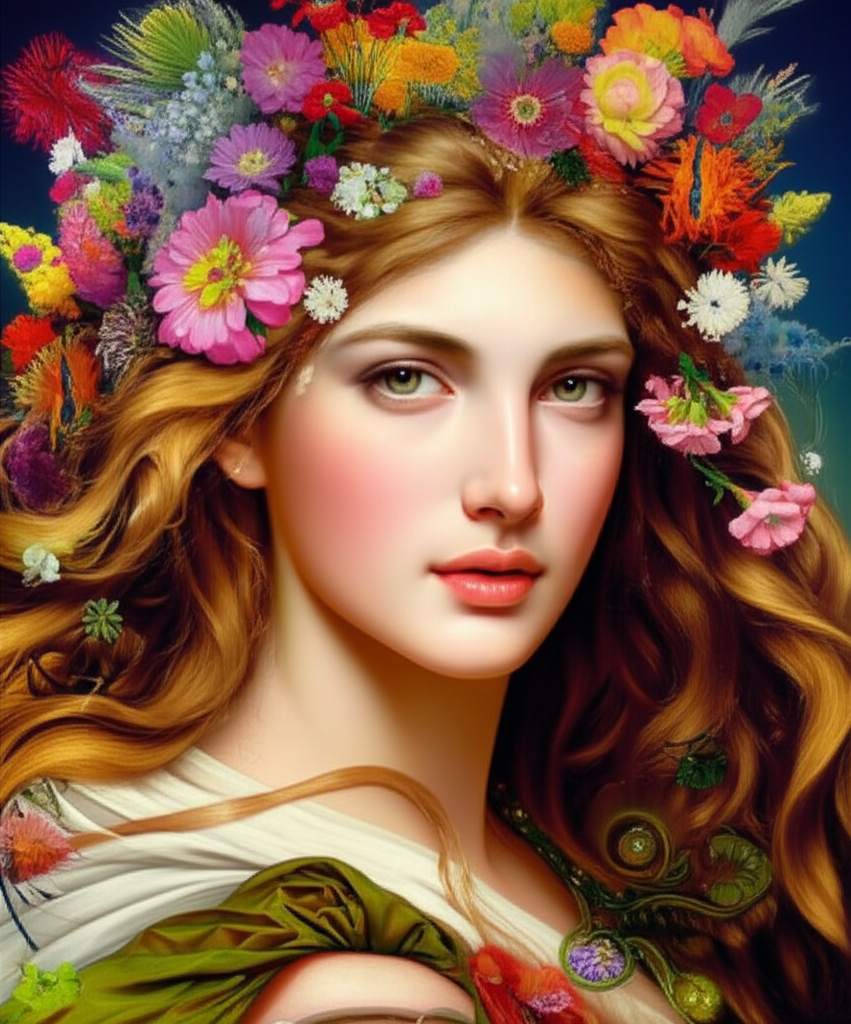 holding a blooming branch, gazing serenely towards another figure representing "Death" (a cloaked, skeletal, or veiled figure with an aged, wise countenance) who holds an hourglass with sand flowing. The background features a landscape transitioning from lush, verdant greenery on one side to autumnal decay and barrenness on the other, symbolizing the natural cycle, with a subtle, unifying light source emanating from above, suggesting a higher, overarching principle.)
Nature: The Canvas of the Universal Principle
Where do we observe this principle in its most unfiltered form? In Nature. From the intricate dance of ecosystems to the unfathomable complexity of a single cell, Nature is the grand manifestation of the Universal Principle of Life. It operates without human intervention, driven by inherent laws and processes that reflect this underlying order.
- Cosmic Order and Terrestrial Existence: The same principles that govern the orbits of planets and the formation of galaxies seem to echo in the patterns of leaves, the branching of rivers, and the neural networks of a brain. This suggests a coherence, a deep-seated rationality, that pervades all levels of existence. The harmonious, often brutal, efficiency of natural selection, the delicate balance of ecosystems – these are not random occurrences but expressions of a profound, universal logic.
Echoes in the Great Books
Philosophers throughout history have articulated aspects of this universal principle, even if they used different terminology:
- Plato's Forms: The idea that perfect, eternal Forms exist independently of the material world, serving as blueprints for all particular things, resonates with the concept of a universal principle.
- Aristotle's Entelechy: His notion of an inherent potential or "inner purpose" driving an organism towards its full realization speaks directly to the inherent dynamism of the Universal Principle of Life.
- Stoic Logos: The Stoics believed in a rational, divine Logos or reason that pervades and orders the cosmos, a universal law governing all Nature and Life.
- Spinoza's Substance: His concept of a single, infinite, self-caused substance (God or Nature) from which all finite modes derive, offers a powerful articulation of a unifying principle.
These diverse perspectives, found within the pages of the Great Books, all point towards a shared human intuition: that beneath the surface of apparent chaos and diversity, there lies an underlying unity, a fundamental rhythm that defines what it means to be alive.
Embracing the Grand Design
To contemplate "The Universal Principle of Life" is to move beyond the superficial and to seek the profound. It encourages us to see ourselves not as isolated entities, but as integral, particular expressions of a boundless, universal flow. It reframes Life and Death as essential partners in an eternal dance and reveals Nature as the ultimate teacher of this grand, unifying Principle. By understanding this, we may find a deeper sense of belonging and purpose within the intricate, beautiful tapestry of existence.
YouTube Video Suggestions:
-
📹 Related Video: PLATO ON: The Allegory of the Cave
Video by: The School of Life
💡 Want different videos? Search YouTube for: ""Plato Aristotle Forms Entelechy Philosophy Universal Particular""
2. ## 📹 Related Video: STOICISM: The Philosophy of Happiness
Video by: The School of Life
💡 Want different videos? Search YouTube for: ""Stoicism Logos Nature Life Death Ancient Philosophy""