

The Universal Nature of Beauty
Is beauty merely a matter of personal taste, or does it possess a deeper, more fundamental essence that resonates across cultures and individuals? This enduring philosophical question, explored by thinkers from antiquity to the present, delves into the very nature of what we perceive as beautiful. While our individual experiences of beauty are undeniably particular, there's a compelling argument to be made for a universal dimension—a shared understanding rooted in discernible principles and discernible Form. This article will navigate this fascinating terrain, drawing on the insights of classical philosophy to explore the possibility of an objective standard within the subjective realm of aesthetics.
The Enduring Question: Is Beauty in the Eye of the Beholder?
For centuries, the debate has raged: is beauty purely subjective, residing solely in the perception of the observer, or does it possess an inherent quality, an objective truth that transcends individual preferences? The common adage, "beauty is in the eye of the beholder," champions the subjective view, suggesting that what one person finds captivating, another might find unremarkable. Yet, across diverse civilizations and epochs, certain patterns, harmonies, and structures consistently evoke admiration. This persistent convergence suggests something more profound than mere individual whim—a potential universal thread weaving through our aesthetic experiences.
Plato's Realm of Forms: Beauty as a Universal
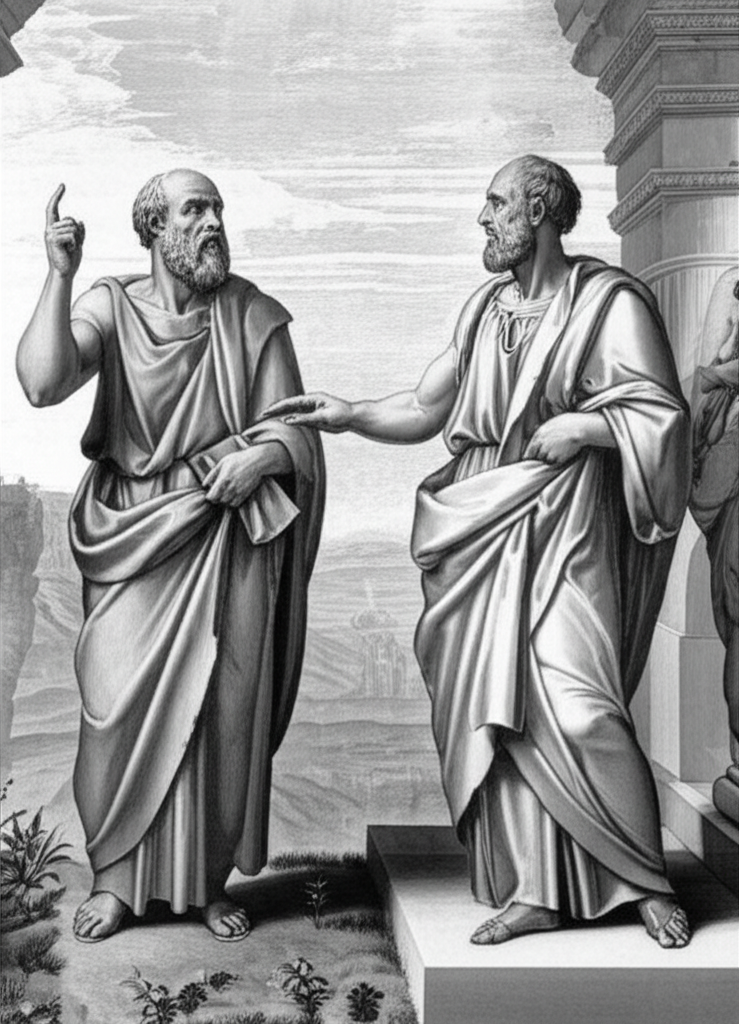
Perhaps no philosopher has more profoundly articulated the concept of universal beauty than Plato. In his dialogues, particularly the Symposium and Phaedrus, Plato posits that earthly beauties are but imperfect reflections or shadows of a perfect, immutable, and eternal Form of Beauty existing in a transcendental realm.
For Plato, true Beauty is not found in a specific person, a particular painting, or a fleeting sunset. These are merely instances, particular manifestations that remind us of the ideal. The Form of Beauty itself is:
- Eternal and Unchanging: It does not age, fade, or alter.
- Perfect and Complete: It lacks nothing and cannot be improved upon.
- Non-physical and Intelligible: It is grasped by the mind, not the senses.
- The Source of All Particular Beauties: Anything we call beautiful on earth derives its beauty from participating in this ultimate Form.
To encounter something beautiful, according to Plato, is to catch a glimpse of this higher reality, to remember the perfect Form our souls knew before birth. This suggests a profound, innate human capacity to recognize and respond to a universal standard, even if we only ever perceive its fragmented echoes.
Aristotle's Empirical Approach: Order, Symmetry, and Definiteness
While Aristotle, Plato's most famous student, departed from his teacher's transcendental Forms, he nonetheless sought universal principles underlying beauty through an empirical lens. Examining the nature of things in the world, Aristotle identified qualities that contribute to aesthetic pleasure. For him, beauty was not a separate entity but an inherent characteristic of well-made or well-ordered objects.
Key Aristotelian principles contributing to beauty include:
- Order (Taxis): A harmonious arrangement of parts.
- Symmetry (Symmetria): A proper proportion and balance between elements.
- Definiteness (Horismenon): A clear, bounded structure that allows for comprehension.
Aristotle argued that these qualities, whether in a tragedy, a sculpture, or a living organism, contribute to its perfection and, consequently, its beauty. His approach grounds the universal in observable attributes, suggesting that our appreciation for these qualities is not arbitrary but tied to our rational understanding of the world. The particular object is beautiful because it embodies these objective, measurable characteristics.
The Dialectic of Universal and Particular
The tension between the universal and particular is central to understanding beauty. Our direct experience is always with the particular: this song, that face, this landscape. Yet, when we declare something beautiful, we often imply a judgment that transcends mere personal preference. We might say, "This is truly beautiful," suggesting a quality that others should also recognize.
| Perspective on Beauty | Focus | Underlying Principle |
|---|---|---|
| Platonic Universal | The Ideal Form | Transcendent, objective, eternal |
| Aristotelian Universal | Observable Qualities | Immanent, objective, rational |
| Individual Particular | Subjective Experience | Personal taste, cultural conditioning |
This interplay highlights that while our individual experiences are unique, they often point towards shared aesthetic principles. The nature of beauty might be a dialogue between these two poles, where particular instances serve as gateways to perceiving universal truths, whether they are Platonic Forms or Aristotelian principles of order.
Modern Perspectives and the Persistence of Form
Even in contemporary philosophy, the question of universal beauty persists. While postmodern thought often emphasizes cultural relativism and subjective interpretation, there remains a persistent human inclination to find certain patterns, symmetries, and narratives inherently pleasing. Evolutionary aesthetics suggests that our appreciation for certain features (e.g., healthy landscapes, symmetrical faces) might be rooted in biological advantages.
The concept of Form, whether as an ideal template or an observable structure, continues to be a powerful lens through which we analyze beauty. From the mathematical precision of golden ratios in art to the structural integrity of architectural marvels, the idea that inherent order contributes to aesthetic appeal remains compelling. We are drawn to coherence, balance, and a sense of completeness, qualities that speak to an underlying order in the nature of things, hinting at a universal language of beauty.
Conclusion: A Timeless Pursuit
The pursuit of understanding the universal nature of beauty is a journey into the very core of human experience and perception. While our individual encounters with beauty are undeniably particular, the enduring philosophical quest, from Plato's transcendent Forms to Aristotle's empirical principles, suggests a profound human yearning for a shared, objective understanding. Perhaps beauty isn't solely "in the eye of the beholder," but rather a complex interplay where our individual perceptions are tuned to resonate with deeper, universal harmonies inherent in the nature of existence itself. It is in this ongoing dialogue between the unique and the shared, the subjective and the objective, that the true richness of beauty reveals itself.
📹 Related Video: PLATO ON: The Allegory of the Cave
Video by: The School of Life
💡 Want different videos? Search YouTube for: ""Plato's Theory of Forms explained""
📹 Related Video: ARISTOTLE ON: The Nicomachean Ethics
Video by: The School of Life
💡 Want different videos? Search YouTube for: ""Aristotle on Beauty, Art, and Truth""