

The Invisible Handshake: Exploring the Universal Laws of Nature
Have you ever paused to consider the silent, invisible forces that govern not just the falling apple, but also the very fabric of our moral universe? From the predictable orbits of celestial bodies to the profound principles guiding human conduct, philosophy has long grappled with the notion of Universal Laws of Nature. These aren't merely scientific formulas, but deep-seated Principles that are believed to operate everywhere, always, shaping the Nature of reality itself. This article delves into how some of the greatest minds in Western thought have sought to uncover these immutable Laws, exploring their implications for everything from physics to ethics, and the fascinating interplay between the Universal and Particular.
Echoes of Order: What Are Universal Laws?
At its heart, the concept of a Universal Law of Nature posits that there is an inherent, discoverable order to existence. This order is not arbitrary or subject to whim, but rather consistent and rational. Whether conceived as divine commands, inherent properties of matter, or a cosmic reason, these Laws suggest that the universe is fundamentally intelligible. They are the foundational Principles upon which all else is built, providing a framework for understanding not just what happens, but why it happens in a specific way.
A Philosophical Journey Through the Great Books
The quest to understand these universal principles has been a central thread running through the tapestry of Western philosophy, from ancient Greece to the Enlightenment and beyond.
The Ancient Greeks: In Search of Form and Purpose
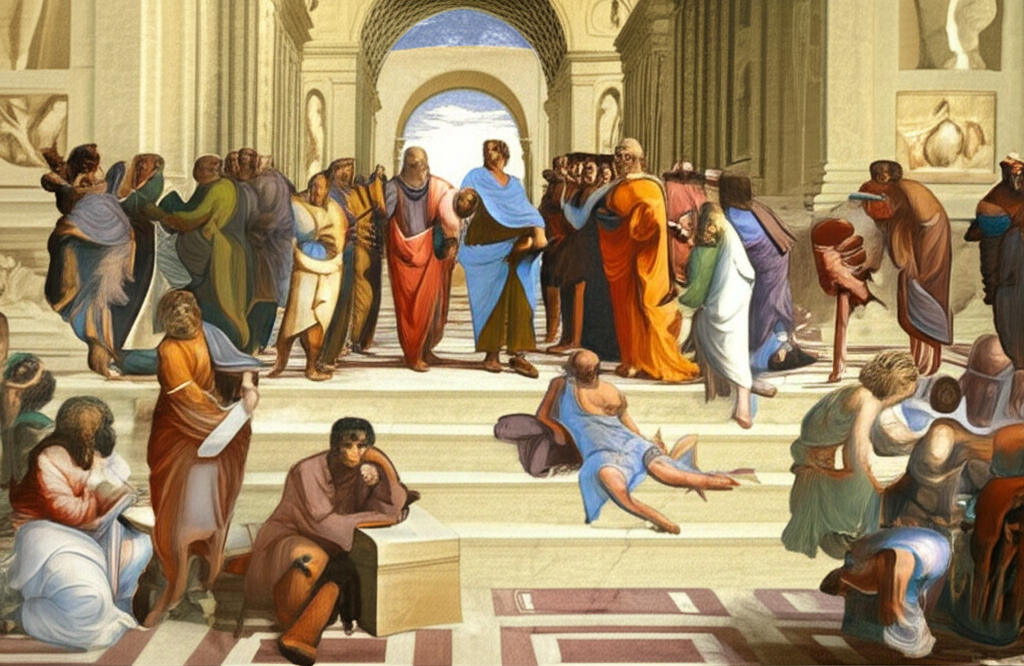
The earliest philosophers in the Great Books of the Western World grappled with the idea of underlying order.
- Plato and the Forms: For Plato, the truest reality lay not in the ever-changing sensory world, but in an eternal, unchanging realm of Universal Forms or Ideas. Justice, Beauty, and Goodness existed as perfect Principles, acting as blueprints for their imperfect earthly manifestations. To understand the Law of reality was to grasp these transcendent Forms.
- Aristotle and Teleology: Aristotle, while grounded more in the empirical, also saw an inherent order in Nature. He argued that everything has a telos, an intrinsic purpose or end. An acorn's Nature is to become an oak tree; this developmental drive is a kind of Universal Law embedded within its being. His four causes (material, formal, efficient, final) sought to explain the Principles governing existence.
- The Stoics and the Logos: Perhaps most explicitly, the Stoics posited the Logos – a divine, rational Principle or Law that pervades and orders the entire cosmos. Living virtuously, for a Stoic, meant living in accordance with this Universal reason, recognizing that human Nature is part of this larger, rational order.
Medieval Synthesis: Divine Reason and Natural Law
The medieval period saw a profound synthesis of classical thought with theological doctrine, epitomized by Thomas Aquinas.
- Thomas Aquinas and Natural Law: Building on Aristotle, Aquinas argued that Natural Law is humanity's participation in God's eternal reason. Certain moral Principles – such as "do good and avoid evil" – are not merely human conventions, but are universally knowable through reason because they are embedded in our very Nature as rational beings. These Universal Laws provide a moral compass, independent of specific religious revelation, yet ultimately derived from divine order.
The Dawn of Modernity: Unveiling Physical and Moral Laws
The Scientific Revolution and the Enlightenment brought a new emphasis on discoverable, rational laws governing both the physical world and human society.
- Isaac Newton and the Laws of Motion: Newton's groundbreaking work provided a stunning demonstration of Universal Laws governing the physical Nature of the cosmos. His laws of motion and Universal gravitation showed that the same Principles applied to a falling apple and orbiting planets. This success fueled the belief that all of Nature operated according to discoverable, rational Laws.
- Enlightenment Thinkers and Human Rights: Philosophers like John Locke and Immanuel Kant extended the concept of Universal Law to human affairs. Locke spoke of natural rights inherent to all individuals, while Kant sought a Universal Moral Law in his categorical imperative – a Principle that all rational beings would recognize and obey, regardless of their particular circumstances.
Universal and Particular: The Dance of Manifestation
One of the most profound aspects of the Universal Laws of Nature is how they manifest in the Particular. A Universal Law isn't an abstract ideal floating disconnectedly; it is the underlying Principle that gives shape and intelligibility to every specific instance.
- The Universal Law of gravity explains why this particular pen falls to this particular table.
- The Universal Principle of causality dictates that this particular action will have this particular consequence.
- The Universal Law of non-contradiction ensures that this particular statement cannot be both true and false simultaneously.
This relationship highlights that the Universal is not separate from the Particular, but rather its animating force, its governing structure, and the source of its intelligibility.
The Enduring Quest for Principle
The enduring fascination with Universal Laws of Nature speaks to a fundamental human desire for order, meaning, and intelligibility. These Principles offer:
- A Framework for Understanding: They provide a coherent structure for making sense of a complex world.
- A Basis for Morality: They offer a foundation for ethical systems that transcend cultural differences.
- A Sense of Cosmic Coherence: They suggest that the universe is not chaotic but governed by profound, discoverable Laws.
Whether through scientific discovery, philosophical introspection, or spiritual contemplation, the search for these Universal Laws continues to shape our understanding of ourselves and our place within the grand tapestry of Nature. They are the invisible handshake that connects everything, a testament to the profound order that underlies all existence.
Further Exploration:
📹 Related Video: PLATO ON: The Allegory of the Cave
Video by: The School of Life
💡 Want different videos? Search YouTube for: ""Plato Aristotle Universal Particular Philosophy""
📹 Related Video: KANT ON: What is Enlightenment?
Video by: The School of Life
💡 Want different videos? Search YouTube for: ""Natural Law Theory Great Books of the Western World""