

The Enduring Enigma: Unraveling the Universal Laws of Nature
The cosmos, in its breathtaking expanse and intricate dance, often whispers of an underlying order. This order, which we instinctively feel and ceaselessly seek to comprehend, forms the very bedrock of existence: the Universal Laws of Nature. Far from mere scientific formulae, these laws represent the fundamental Principles that govern everything from the celestial ballet of galaxies to the unfolding of a single human thought. This article delves into the profound philosophical inquiry into these omnipresent rules, exploring their historical interpretations, their distinction between the Universal and Particular, and their enduring significance for understanding our place within the grand tapestry of Nature.
The Cosmic Blueprint: What Are Universal Laws?
At its core, the concept of a Universal Law of Nature posits that there are immutable truths, Principles that operate consistently across all times and places, dictating the behavior and structure of reality. These are not human constructs, but rather inherent properties of existence itself, discoverable through reason, observation, and intuition. They represent the very essence of order, providing the framework within which all phenomena, both physical and metaphysical, unfold.
Defining Our Terms: Nature, Law, and Principle
To truly grasp the magnitude of this concept, we must first articulate its foundational components:
- Nature: In philosophy, Nature transcends the mere physical environment. It encompasses the inherent character, essence, and fundamental constitution of things. From Aristotle's Physics, where Nature is understood as the Principle of motion and rest inherent in a thing, to the Stoic concept of a rational cosmos, Nature denotes the intrinsic order and governing force of reality.
- Law: A Law, in this context, is more than a societal rule. It signifies a statement of an order or relation of phenomena that is invariable under given conditions. It implies a necessity, an unbreakable connection between cause and effect, or a consistent pattern of behavior.
- Principle: A Principle is a fundamental truth or proposition that serves as the foundation for a system of belief or behavior or for a chain of reasoning. It is the originating cause or motive, the underlying essence from which all else derives.
The Universal Laws of Nature thus refer to those foundational Principles inherent in the very Nature of things, which operate as immutable Laws across all reality.
The Dance of Universal and Particular
One of the most profound philosophical challenges lies in reconciling the Universal nature of these laws with the Particular diversity of phenomena we observe. How can a single, unchanging law account for the myriad forms and behaviors in the world?
Consider the Law of gravity: it is Universal, applying equally to an apple falling from a tree and a planet orbiting a star. Yet, the Particular manifestations—the speed, the impact, the orbital trajectory—are distinct. Philosophers, from Plato's Forms to Aristotle's emphasis on individual substances embodying universal essences, have grappled with this relationship. The Universal Law provides the overarching Principle, while the Particular conditions and specific properties of individual entities determine its unique expression. It is through the Particular that we discern the Universal.
Echoes Through History: Great Minds on Universal Laws
The quest to understand the Universal Laws of Nature has been a central pillar of Western thought, as evidenced in the Great Books of the Western World.
Ancient Wisdom: Order and Reason
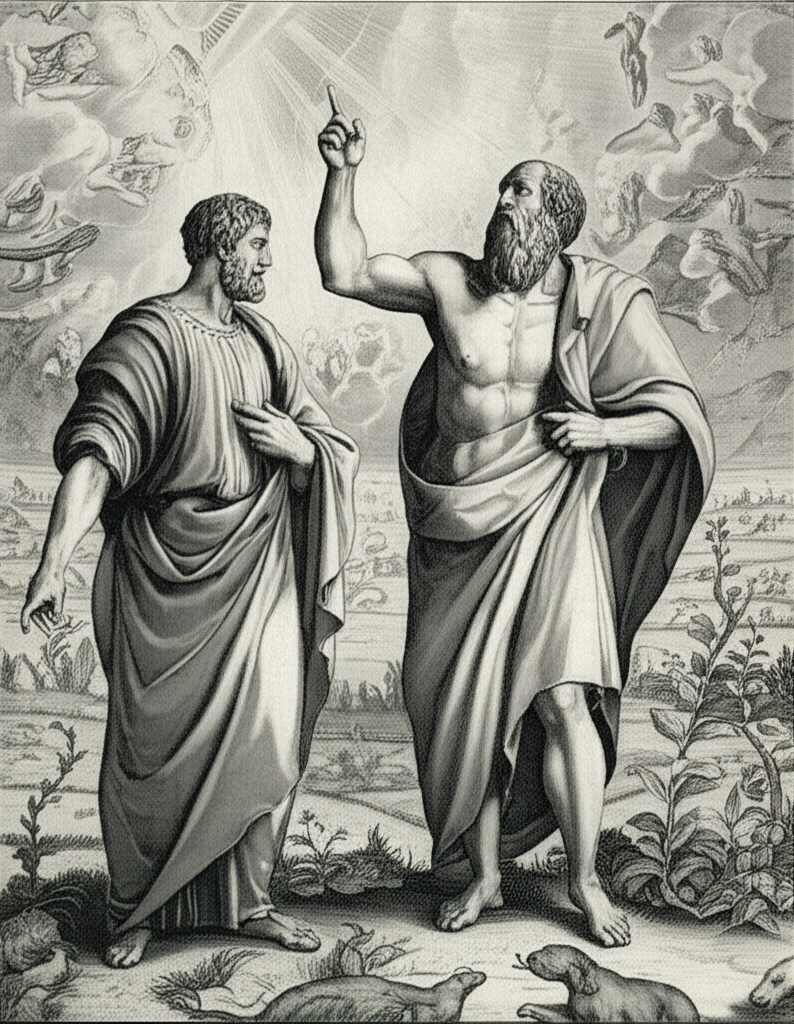
- Plato (c. 428–348 BCE): In works like the Republic and Timaeus, Plato posited a realm of perfect, unchanging Forms or Ideas. These Forms, such as Justice or Beauty, are the Universal Principles that give rise to the imperfect Particulars we perceive. The cosmos itself, for Plato, was structured according to rational, mathematical Principles.
- Aristotle (384–322 BCE): While rejecting Plato's separate realm of Forms, Aristotle, in his Physics and Metaphysics, still emphasized the inherent order of Nature. He saw each entity possessing an intrinsic "telos" or purpose, and acting according to its Nature. His concept of the "unmoved mover" as a first Principle underscores a foundational Law of motion and causation.
- Stoicism (c. 3rd century BCE – 3rd century CE): For Stoics like Epictetus and Marcus Aurelius, the cosmos was governed by an all-pervading divine reason, or Logos. This Logos constituted the Universal Law of Nature, dictating fate and providing a rational order that humans should align themselves with. Virtue, for them, was living in accordance with this natural, rational Principle.
Medieval Synthesis: Divine and Natural Law
- Thomas Aquinas (1225–1274): Drawing heavily on Aristotle, Aquinas, in his Summa Theologica, articulated the concept of Natural Law. This was understood as humanity's participation in the eternal Law of God, a Universal Principle imprinted on human reason. Through Natural Law, humans could discern fundamental moral truths and guide their actions in accordance with divine order.
The Enlightenment and Beyond: Reason and Observation
- Isaac Newton (1642–1727): Though a scientist, Newton's Philosophiæ Naturalis Principia Mathematica laid the groundwork for modern physics by articulating Universal Laws of motion and gravitation. These were seen as immutable Principles governing the physical Nature of the universe, discoverable through mathematical reason and empirical observation.
- John Locke (1632–1704): In his Two Treatises of Government, Locke argued for Natural Law as the basis for inherent human rights, such as life, liberty, and property. These rights were not granted by governments but derived from the very Nature of humanity, operating as Universal Principles of justice.
- Immanuel Kant (1724–1804): Kant, in his Groundwork of the Metaphysics of Morals, sought to establish Universal Laws of morality through his Categorical Imperative. This Principle demanded that one act only according to a maxim that could be willed to become a Universal Law, thereby grounding ethics in pure reason rather than particular desires.
The Enduring Quest
The pursuit of these Universal Laws of Nature is more than an academic exercise; it is an intrinsic human endeavor to make sense of our world and our existence. Whether through the equations of physics, the tenets of morality, or the deep reflections of metaphysics, humanity continually strives to uncover these fundamental Principles. They offer not just understanding, but also a sense of stability and coherence in an ever-changing world.
Ultimately, the Universal Laws of Nature remind us that despite the bewildering array of Particulars that constitute our experience, there is an underlying unity, a grand design, a set of immutable Principles that bind all things together. Our journey of discovery is an ongoing dialogue with this profound cosmic order, a testament to the enduring human spirit of inquiry.
Further Exploration:
- YouTube: The Philosophy of Natural Law Explained
- YouTube: Plato's Theory of Forms: A Beginner's Guide
📹 Related Video: What is Philosophy?
Video by: The School of Life
💡 Want different videos? Search YouTube for: "The Universal Laws of Nature philosophy"