

Unveiling the Enduring Fabric: The Universal Laws of Nature
For centuries, humanity has gazed upon the cosmos and the intricacies of life, seeking to understand the underlying order that governs all existence. This quest inevitably leads us to the profound concept of The Universal Laws of Nature. These are not mere human constructs or societal agreements, but rather the fundamental, immutable principles that dictate how reality operates, from the grand cosmic dance of galaxies to the subtle interactions within an atom. They represent the bedrock upon which all phenomena are built, offering a framework for comprehension and prediction. Our journey into these laws is a philosophical endeavor, challenging us to discern the Universal regularities from the Particular manifestations, to grasp the very Law that defines Nature itself, and to identify the foundational Principle guiding the universe.
What Do We Mean by "Law" in Nature?
When we speak of a "law" in the context of nature, we are not referring to a legislative decree that can be broken or amended. Instead, a natural law describes an observed regularity or a fundamental truth about how the world is. It is a statement of an invariant relation or sequence of phenomena. Philosophically, this distinction is crucial:
- Descriptive Laws: These are statements that describe observed regularities in nature, such as Newton's laws of motion or the law of gravity. They tell us how things happen.
- Prescriptive Laws: These are often associated with moral or ethical laws, suggesting how things should happen. While some philosophers, particularly in ancient and medieval thought, sought to derive prescriptive laws from natural order (Natural Law theory), the primary focus of "Universal Laws of Nature" typically leans towards the descriptive.
The search for these laws is an attempt to articulate the inherent Principle of order embedded within the fabric of Nature, allowing us to move beyond mere observation to a deeper understanding of cause and effect.
The Dance of the Universal and the Particular
One of the most compelling aspects of studying these laws is grappling with the relationship between the Universal and Particular. A universal law, by definition, applies everywhere and always. Yet, we experience the world through particular events, objects, and situations.
Consider the Law of gravity. It is a Universal principle governing attraction between masses. However, its manifestation is Particular: an apple falls from a specific tree, a planet orbits a specific star, and a feather drifts differently than a stone due to air resistance. The universal law remains constant, but its observable effects are shaped by the specific conditions and properties of the particulars involved. This duality is a cornerstone of philosophical inquiry, explored by thinkers from Plato and Aristotle in the Great Books of the Western World, who grappled with forms and substances, universals and individuals.
Characteristics of Universal Laws
While specific laws vary, they generally share certain characteristics that elevate them to the status of "universal principles":
- Invariance: They do not change over time or space. The laws of physics observed today are believed to have been the same billions of years ago and will remain so in the distant future, across the vast expanse of the cosmos.
- Objectivity: Their validity does not depend on human belief, observation, or interpretation. They exist independently of our consciousness.
- Predictability: If we understand a universal law and the initial conditions of a system, we can predict its future behavior with a high degree of accuracy.
- Comprehensiveness: Ideally, they apply to all relevant phenomena within their domain, leaving no exceptions or arbitrary deviations.
- Simplicity (often): Despite the complexity of their manifestations, the underlying laws themselves are often expressed with remarkable elegance and simplicity, a testament to the beauty of Nature's inherent design.
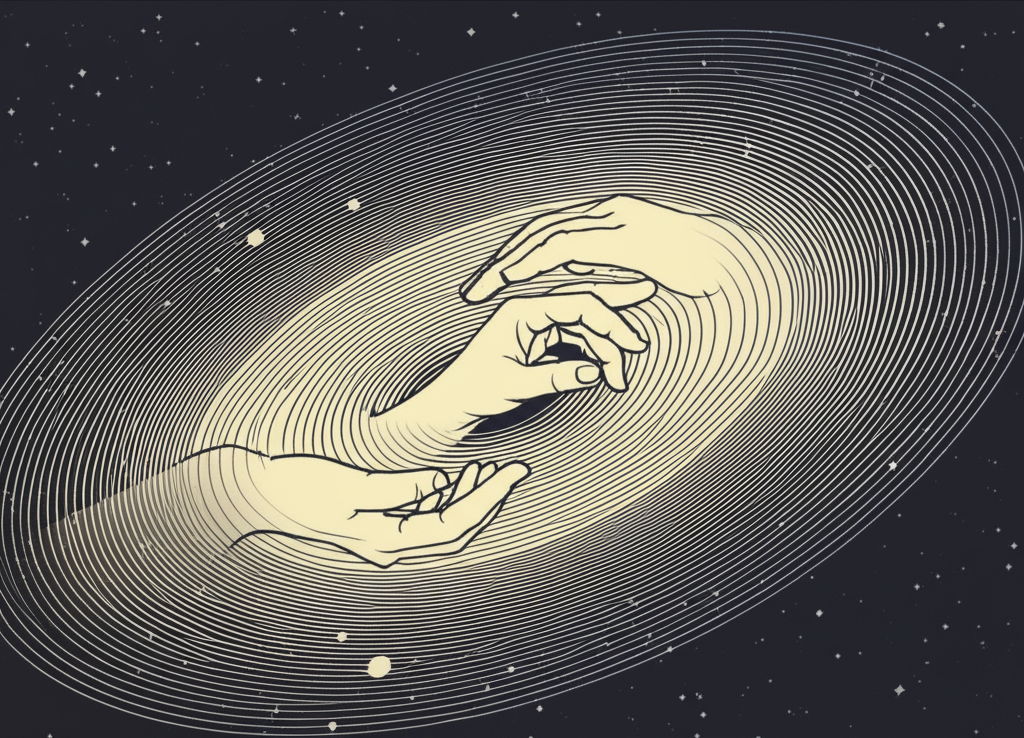 reach towards glowing threads that weave across a dark, star-filled background, connecting celestial bodies, microscopic structures, and abstract symbols of mathematical equations. The threads converge at a central, luminous point, symbolizing a unified, underlying order.)
Beyond Physics: Moral and Metaphysical Principles
While often associated with the hard sciences, the concept of Universal Laws of Nature extends beyond the purely physical. Philosophers, again drawing from the rich tradition found in the Great Books, have explored whether there are universal moral laws, ethical Principles, or even metaphysical laws governing existence itself.
- Moral Law: Can reason discern universal ethical imperatives that apply to all rational beings? Thinkers like Kant certainly believed so, positing a categorical imperative as a universal moral law.
- Metaphysical Law: Are there fundamental laws governing causality, identity, or the very structure of being that transcend empirical observation? The principle of non-contradiction, for instance, is often seen as a fundamental metaphysical Principle.
These inquiries push the boundaries of what we understand by "law," moving from describing how things are to exploring how they must be or should be.
The Enduring Quest for Understanding
The pursuit of the Universal Laws of Nature is an ongoing human endeavor. It is a testament to our innate curiosity and our desire to find meaning and order in a seemingly chaotic world. From the ancient Greeks who sought the logos to modern physicists probing the quantum realm, the search for these foundational Principles continues to shape our understanding of the universe and our place within it. It is a journey that compels us to look beyond the immediate, the Particular, and to grasp the profound, unchanging Law that underpins all of Nature.
YouTube: "What are the Laws of Nature?"
YouTube: "Great Books of the Western World Philosophy"
📹 Related Video: What is Philosophy?
Video by: The School of Life
💡 Want different videos? Search YouTube for: "The Universal Laws of Nature philosophy"