

The Immutable Language: Unveiling the Universal Laws of Mathematics
Mathematics, often regarded as the purest of sciences, stands as a testament to profound, immutable truths that transcend culture, time, and even the physical universe as we know it. This article explores the philosophical underpinnings of "The Universal Laws of Mathematics," arguing that these laws are not merely human constructs but rather fundamental principles that govern existence, bridging the abstract with the concrete. We delve into how these Universal truths manifest in the Particular, examining their nature as a unique form of Law that underpins our understanding of reality, drawing insights from the enduring wisdom of the Great Books of the Western World.
The Platonic Echo: Mathematics as Pure Form
From the earliest philosophical inquiries, thinkers have grappled with the peculiar nature of mathematical truths. Unlike empirical observations, which are subject to change and interpretation, mathematical statements often possess an undeniable, self-evident quality. This led ancient philosophers, most notably Plato, to posit that mathematical entities—numbers, shapes, and their relationships—exist independently of our minds, residing in a realm of perfect, eternal Forms.
- The Universal Nature of Mathematical Objects: Consider the concept of a perfect circle. No physical circle we draw or observe is ever truly perfect; it will always have minute imperfections. Yet, the idea of a perfect circle, defined by a single point equidistant from all points on its circumference, is universally understood and forms the basis of countless geometric proofs. This ideal circle is a Universal concept, its properties holding true regardless of any particular manifestation.
This perspective suggests that the Laws of Mathematics are not invented but discovered. They are the inherent structure of this ideal realm, and our mathematical endeavors are merely attempts to articulate these pre-existing principles. Euclid's Elements, a foundational text referenced in the Great Books, beautifully illustrates this. His axioms and postulates, though seemingly simple, are the foundational principles from which an entire universe of geometric truths is deductively derived, truths that are demonstrably Universal.
From Abstract Principles to Concrete Particulars: The Unreasonable Effectiveness
While mathematical Laws might appear to dwell in a realm of pure abstraction, their profound impact on our understanding and manipulation of the physical world is undeniable. It is in this application that the interplay between the Universal and Particular becomes most apparent.
How Universal Mathematical Laws Manifest in Particular Phenomena:
| Universal Mathematical Law/Principle | Particular Physical Manifestation | Philosophical Implication |
|---|---|---|
| Arithmetic (Number Theory) | Counting objects, calculating finances, quantifying scientific data | Fundamental order, logical consistency in observable reality |
| Geometry (Euclidean) | Architecture, engineering, celestial mechanics, mapping | Spatial relationships are inherently structured; design principles |
| Calculus (Rates of Change) | Physics (motion, forces), economics (growth rates), biology | Dynamic processes follow predictable, quantifiable patterns |
| Symmetry (Group Theory) | Crystal structures, particle physics, biological forms | Underlying aesthetic and structural harmony in nature |
The astonishing accuracy with which mathematical models describe and predict natural phenomena has led many, including physicist Eugene Wigner, to ponder the "unreasonable effectiveness of Mathematics." Why should a discipline rooted in abstract thought so perfectly describe the particular workings of the cosmos, from the subatomic to the galactic? This suggests a deep, inherent connection—a fundamental set of Laws that govern both the mathematical realm and the physical one.
The Nature of Mathematical Law: Discovery or Invention?
The question of whether mathematical Laws are discovered or invented is a perennial philosophical debate.
- Discovery (Platonism/Realism): This view holds that mathematical objects and their Laws exist independently of human thought. We merely uncover these pre-existing truths. The feeling of certainty and universality often associated with mathematical proofs supports this perspective. The Principle of non-contradiction, for instance, seems to be a Universal truth rather than a human convention.
- Invention (Formalism/Constructivism): This view argues that Mathematics is a human creation—a system of symbols, axioms, and rules we devise. While powerful and consistent, its applicability to the physical world is a happy coincidence or a result of our structuring our observations through mathematical lenses.
Henry Montgomery, drawing from the Great Books, would likely lean towards the former, or at least acknowledge the compelling arguments for it. The very fact that different cultures, across millennia, have arrived at the same mathematical principles—whether Pythagoras's theorem or the properties of prime numbers—lends credence to the idea of a Universal underlying structure. These are not merely cultural artifacts but fundamental Laws that dictate the very fabric of logical possibility.
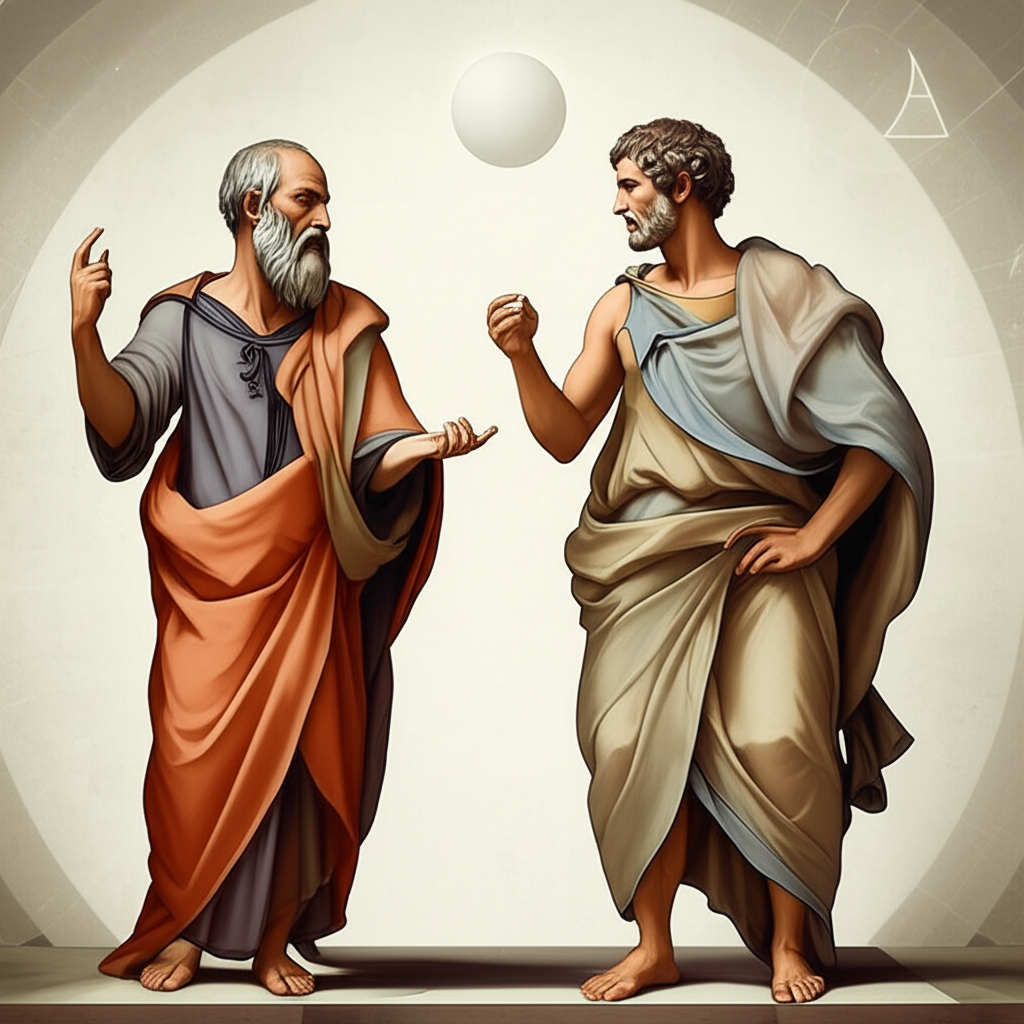 and a starry night sky, symbolizing the connection between ideal forms and the physical cosmos. Light emanates from the geometric forms, subtly illuminating their debate.)
The Enduring Significance of Mathematical Principles
The Universal Laws of Mathematics are more than just tools for calculation; they are a profound window into the nature of reality itself. They reveal a foundational order, a set of principles that govern existence whether we are aware of them or not. From the elegant simplicity of a prime number to the complex equations describing quantum mechanics, Mathematics provides the language through which we can articulate and comprehend these Universal truths.
As we continue to explore the frontiers of knowledge, Mathematics remains our most reliable guide, demonstrating how abstract thought can illuminate the most particular aspects of our world. It is a testament to the power of pure reason and a constant source of wonder, inviting us to contemplate the deep, immutable Laws that bind the cosmos.
📹 Related Video: PLATO ON: The Allegory of the Cave
Video by: The School of Life
💡 Want different videos? Search YouTube for: "Philosophy of Mathematics Platonism vs Formalism"
📹 Related Video: KANT ON: What is Enlightenment?
Video by: The School of Life
💡 Want different videos? Search YouTube for: "The Unreasonable Effectiveness of Mathematics Wigner"