

The Unseen Hand: A Summary of Mathematical Universals
The "Universal Laws of Mathematics" represent a profound philosophical enigma: principles that govern not just our observable universe, but seemingly any conceivable reality. This article delves into the nature of these immutable Laws, exploring how Mathematics acts as a language for understanding both the Universal and the Particular, and examining the foundational Principles that underpin all existence, as contemplated by some of the greatest minds in Western thought. We will ponder whether these laws are discovered truths inherent to the cosmos or ingenious human constructs, and reflect on their profound implications for our understanding of reality.
The Grand Tapestry of Number: Unveiling Mathematical Law
From the elegant spirals of a nautilus shell to the grand ballet of celestial bodies, an unseen hand seems to orchestrate the cosmos. This hand, we contend, is none other than the immutable grip of mathematical Law. For centuries, philosophers and scientists alike have marvelled at the uncanny effectiveness of Mathematics in describing, predicting, and even dictating the fabric of existence. It is not merely a tool for calculation but a profound philosophical lens, offering a glimpse into the very Principles by which reality is constituted. As Henry Montgomery, I find myself perpetually drawn to this profound mystery: Why does the universe obey mathematics, and what does this obedience tell us about the nature of truth itself?
From the Particular to the Universal: The Essence of Mathematical Truth
The distinction between the Universal and the Particular has long vexed philosophers, yet in Mathematics, this distinction often dissolves into a harmonious whole. While we might draw a particular triangle on a blackboard, its properties—the sum of its angles equalling 180 degrees, the Pythagorean theorem—are universal. They hold true for every conceivable triangle, regardless of its size, orientation, or location in space or time. These are not contingent facts; they are absolute Laws, transcending individual instances.
Consider the following characteristics of these universal mathematical laws:
- Invariance: They remain constant across all contexts, cultures, and observers.
- Necessity: They cannot be otherwise; their negation leads to logical contradiction.
- Applicability: They describe phenomena in the physical world with astonishing accuracy.
- Coherence: They form an interconnected, self-consistent system of truths.
This transcendence from the specific to the general is a hallmark of mathematical thought, allowing us to grasp abstract Principles that govern the concrete world.
The Language of Reality: Mathematics as a Governing Principle
More than a mere tool for measurement or a system of abstract symbols, Mathematics is arguably the ultimate language of Principle. It allows us to articulate the fundamental structures and relationships that underlie all phenomena. When we describe gravity with equations or predict the trajectory of a planet, we are not just observing; we are engaging with the mathematical Laws that constitute the universe's operational code. These Principles are not invented by us to make sense of the world; they appear to be discovered, inherent to the world itself, waiting to be unveiled. The predictive power of Mathematics—its ability to foretell phenomena before they are observed—is perhaps the strongest evidence of its fundamental role as a governing Principle.
Echoes Through the Ages: Great Books on Mathematical Law
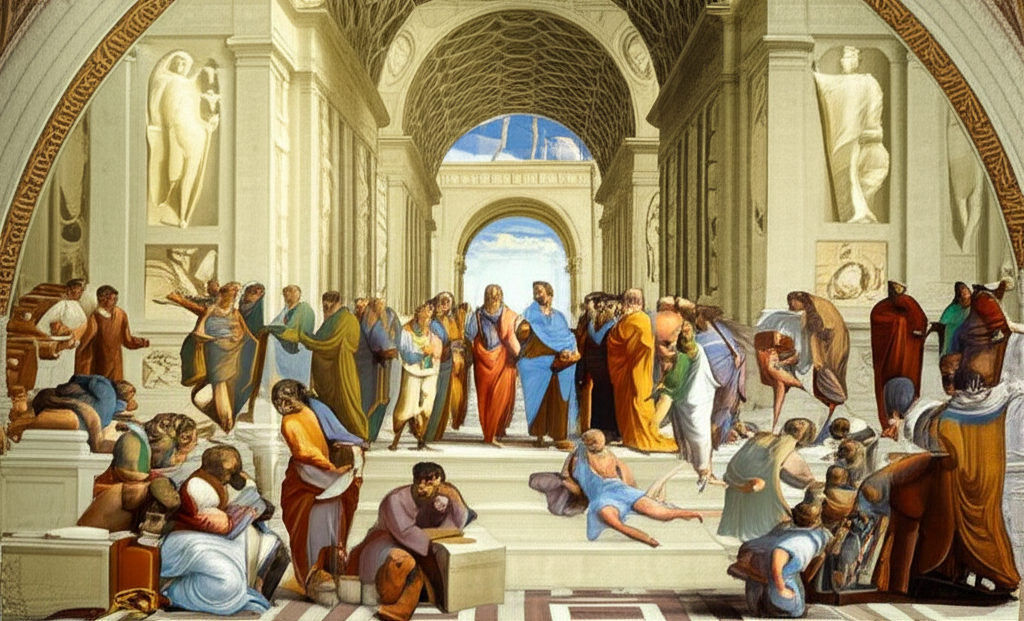
One need only turn to the pages of the Great Books of the Western World to witness the enduring fascination with mathematical truths and their universal implications. From the Pythagoreans, who believed that "all is number," to Plato, who posited a realm of ideal Forms accessible through mathematical reasoning, the classical world recognized Mathematics as a pathway to divine order. Descartes, in his quest for certainty, found immutable truth in the clarity and distinctness of mathematical ideas, using them as a model for all knowledge. Later, Kant grappled with the question of how synthetic a priori judgments, particularly in Mathematics, are possible, suggesting that space and time themselves are structured by our minds according to mathematical intuitions, thus making certain mathematical Laws universally true for experience. These thinkers, each in their own way, affirmed the profound, often mysterious, connection between Mathematics and reality's deepest Principles.
Discovered or Invented? The Enduring Philosophical Quandary
The existence of such Universal Laws compels us to ask a fundamental philosophical question: Do we discover these mathematical truths, as explorers charting an existing landscape, or do we, in some profound sense, invent them, imposing order upon a chaotic reality? Platonists argue for the former, positing a realm of abstract mathematical objects that exist independently of human minds. Formalists, on the other hand, might suggest that Mathematics is a consistent game of symbols and rules, a human construction. The debate between mathematical realism (Platonism) and anti-realism (formalism, intuitionism) is not merely academic; it touches upon the very nature of truth, knowledge, and the relationship between mind and cosmos. Regardless of one's stance, the efficacy and universality of mathematical Laws remain undeniable, a testament to their profound grip on our understanding.
Our Place in the Ordered Cosmos: Implications of Universal Mathematics
The implications of Universal Laws in Mathematics are far-reaching. They suggest an underlying rationality to the universe, a cosmos governed by intelligible Principles that our minds, remarkably, are equipped to comprehend. This elevates human reason, placing us in a unique position to not only observe but also to understand and articulate the deep structure of reality. It fosters a sense of wonder and humility, acknowledging that while we may grasp these Laws, we are also subject to them. Our very capacity for logical thought, the structure of our perception, and our ability to predict future events all seem to be intimately interwoven with these universal mathematical Principles, hinting at a profound congruence between mind and cosmos.
Beyond Calculation: The Profound Mystery of Mathematical Principles
In conclusion, the Universal Laws of Mathematics are far more than mere equations or abstract concepts; they are fundamental Principles that govern the very fabric of existence. They bridge the gap between the Universal and Particular, offering a glimpse into an ordered reality that transcends individual experience. From the ancient insights preserved in the Great Books of the Western World to contemporary physics, Mathematics continues to reveal the profound, often mystical, Laws that orchestrate our universe. The mystery persists: are these laws the blueprint of creation, or the constructs of a uniquely insightful consciousness? Regardless, their power and universality remain a cornerstone of philosophical inquiry and scientific understanding, inviting us to ponder the deepest Principles of being.
📹 Related Video: What is Philosophy?
Video by: The School of Life
💡 Want different videos? Search YouTube for: ""The Unreasonable Effectiveness of Mathematics in the Natural Sciences" philosophy"
📹 Related Video: PLATO ON: The Allegory of the Cave
Video by: The School of Life
💡 Want different videos? Search YouTube for: ""Plato's Forms and Mathematical Objects" philosophy"