

The Unceasing River: Understanding the Universal Law of Change
The world, in its myriad forms, is in a perpetual state of flux. From the grand cosmic dance of galaxies to the subtle shift of a thought within the human mind, nothing truly remains static. This fundamental principle, that Change is not merely an occasional occurrence but a Universal Law governing all existence, is a cornerstone of philosophical inquiry, deeply explored within the pages of the Great Books of the Western World. It is a law that dictates the very Nature of reality, presenting itself in both Universal and Particular manifestations, urging us to understand its relentless current rather than resist its flow.
The Primacy of Flux: From Ancient Greece to Modern Thought
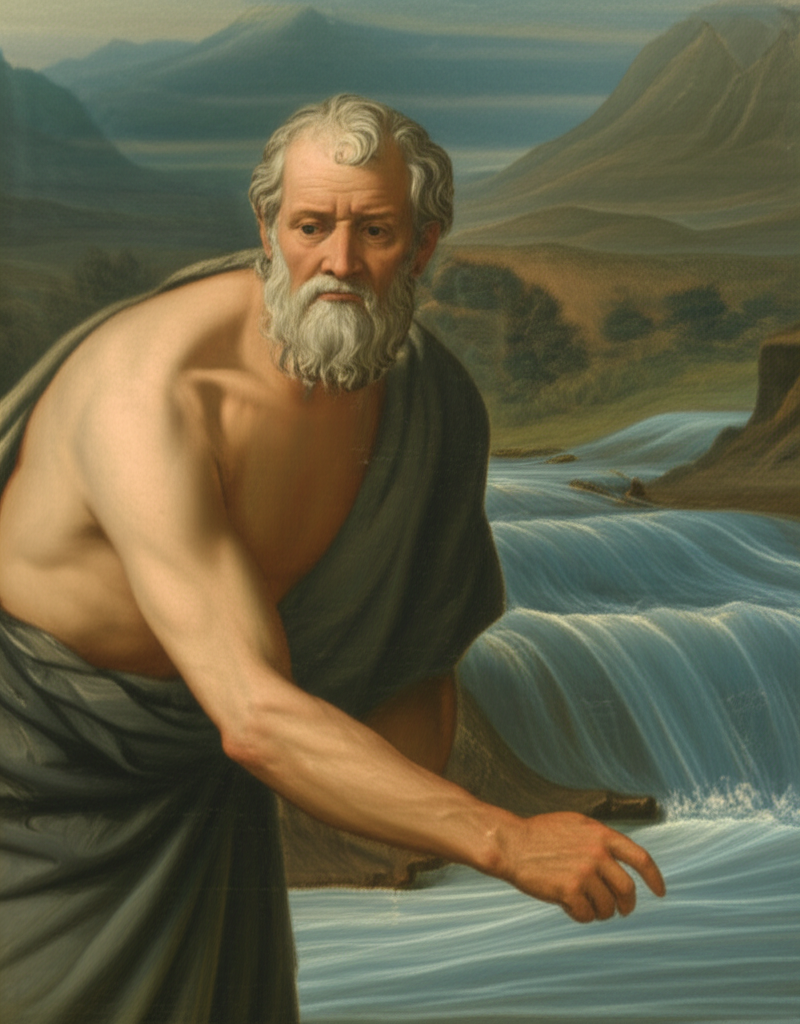
The earliest and most iconic articulation of the Universal Law of Change comes from the Pre-Socratic philosopher Heraclitus of Ephesus. His famous dictum, "Panta Rhei" (everything flows), encapsulates the essence of this principle. He argued that one cannot step into the same river twice, for both the river and the person are constantly changing. For Heraclitus, change was the only constant, the fundamental reality.
However, this radical view was not without its challengers. Parmenides, another giant of early Greek thought, countered that true Being must be eternal and unchanging. Change, for Parmenides, was an illusion of the senses, a deception that obscured the immutable unity of existence. This profound tension between Heraclitus's flux and Parmenides's permanence established a foundational dialectic that has resonated through Western philosophy for millennia. It forced thinkers to grapple with the very definition of reality: Is it defined by its ceaseless transformation, or by an underlying, unchanging essence?
Aristotle's Reconciliation: Potency and Act
It was Aristotle, in his monumental works like Physics and Metaphysics, who offered a sophisticated framework to reconcile these opposing views. Aristotle didn't deny change, but rather sought to understand its mechanisms and categories. He introduced the concepts of Potency (potentiality) and Act (actuality). For Aristotle, change is simply the actualization of a potential. A seed (potential tree) becomes a tree (actualized potential).
Aristotle meticulously categorized different types of change:
- Substantial Change: The coming into being or passing away of a substance itself (e.g., a log burning to ash). This involves a fundamental transformation of identity.
- Accidental Change: Modifications to an existing substance without altering its fundamental identity. These include:
- Alteration: Change in quality (e.g., a leaf changing color from green to yellow).
- Increase/Decrease: Change in quantity (e.g., a plant growing taller).
- Locomotion: Change in place (e.g., a bird flying from one branch to another).
Through this lens, change is not chaotic but orderly, following specific principles inherent in the Nature of things. The Law of Change, therefore, is not merely that things change, but that they change in predictable ways, moving from one state of potentiality to another state of actuality.
The Universal and Particular in Motion
The Universal Law of Change manifests in countless Particular instances. While the principle of change is universal, its specific expressions are diverse. A universal principle, such as gravity, is seen in the particular fall of an apple. Similarly, the universal law of flux is evident in:
- Biological Evolution: The gradual transformation of species over geological time.
- Societal Development: The rise and fall of empires, the evolution of political systems, the shifts in cultural norms.
- Personal Growth: The continuous learning, adapting, and transforming of an individual's character and understanding throughout life.
- Cosmic Cycles: The birth and death of stars, the expansion of the universe, the orbital mechanics of planets.
In each particular case, we observe the operation of the same underlying Law – that existence is dynamic. Plato, in his theory of Forms, posited an unchanging realm of perfect ideas (the universal) that provides a stable blueprint for the ever-changing material world (the particular). Even in Plato's system, the sensible world is characterized by its participation in flux, a reflection of the perfect but static Forms.
Nature's Relentless Current
The concept of change is inextricably linked to Nature. From the moment of the Big Bang to the present, the universe has been in a state of continuous transformation. Geological forces reshape continents; climatic cycles alter ecosystems; biological processes drive growth, decay, and reproduction. The very essence of life, as explored by Darwin and subsequent biologists, is adaptation and change.
The Stoics, another influential school of thought from the Great Books, embraced the Law of Change as an integral part of the natural order. For them, wisdom lay in understanding and accepting what is beyond our control, particularly the inevitability of change. Resisting this universal current, they argued, leads only to suffering. Instead, one should align their will with the Nature of the universe, recognizing that everything has its season and its time to transform.
Embracing the Law: Implications for Life and Philosophy
The Universal Law of Change is more than just an observation; it is a profound philosophical insight that shapes our understanding of reality, knowledge, and ethics. To deny change is to deny the very fabric of existence. To understand it, however, is to unlock a deeper appreciation for the dynamic, evolving Nature of everything around and within us.
Philosophically, this law compels us to:
- Rethink Identity: If everything flows, what constitutes a stable identity for an individual, a nation, or even an idea?
- Embrace Impermanence: Recognize that all things, whether material or conceptual, are subject to transformation and eventual dissolution.
- Cultivate Adaptability: Develop the capacity to adjust to new circumstances, ideas, and realities, rather than clinging rigidly to the past.
- Appreciate the Moment: Value the present, knowing it is fleeting and will soon give way to something new.
The Law of Change is not a decree of chaos but an elegant principle of continuous becoming. It is the rhythmic pulse of the cosmos, the silent engine of evolution, and the fundamental truth that underpins all that is. To live philosophically is to live in harmony with this unceasing river, understanding that while the waters are ever new, the river itself, in its perpetual flow, remains eternally present.
📹 Related Video: What is Philosophy?
Video by: The School of Life
💡 Want different videos? Search YouTube for: ""Heraclitus everything flows philosophy""
📹 Related Video: ARISTOTLE ON: The Nicomachean Ethics
Video by: The School of Life
💡 Want different videos? Search YouTube for: ""Aristotle on Change Potency and Actuality""