

The Unyielding Current: Exploring the Universal Law of Change
Life, in its myriad forms and fleeting moments, presents us with one undeniable truth: change is constant. From the shifting sands of time to the evolution of thought, nothing remains static. This article delves into the philosophical concept of the Universal Law of Change, examining its profound implications for our understanding of reality, human nature, and the very fabric of existence. Drawing from the foundational texts of the Great Books of the Western World, we will explore how ancient thinkers grappled with this pervasive phenomenon, seeking to understand the underlying Law that governs all transformation, both Universal and Particular.
The Unyielding River of Reality: An Introduction to Flux
In the grand tapestry of philosophical inquiry, few concepts are as fundamental and enduring as the notion of change. It is not merely an observation of the world around us, but a profound insight into its very Nature. The air we breathe, the cells that compose our bodies, the societies we build, and the ideas we hold – all are in a perpetual state of becoming, decaying, or transforming. This pervasive dynamism suggests not just a series of random events, but perhaps a Universal Law that dictates the rhythm of existence.
The ancient Greek philosopher Heraclitus famously declared, "Panta rhei" – everything flows. His assertion that one cannot step into the same river twice encapsulates the core idea: the river is constantly renewed by new waters, just as we, as individuals, are never precisely the same from one moment to the next. This primal recognition of Change sets the stage for a deeper philosophical investigation into its character and implications.
Defining the "Law" of Change: More Than Mere Observation
When we speak of a "Law" in this context, we are not referring to a scientific formula or a legislative decree. Rather, it signifies a fundamental, inherent principle governing reality. It's a recognition that Change is not an anomaly but the norm, an intrinsic characteristic of the cosmos. This Law suggests an underlying order to the apparent chaos of transformation, a consistent pattern that allows us to reason about and, to some extent, anticipate the future. It compels us to ask: What drives this constant flux? Is there a stable ground beneath the shifting surface?
This quest for an underlying Law often leads to a tension between the Universal and Particular. If change is universal, how do we account for the particular changes we observe? How does a single, overarching principle manifest in the countless unique transformations of individual entities, from the growth of a tree to the fall of an empire?
The Universal and the Particular in Flux
The philosophical challenge lies in reconciling the Universal Law of Change with the Particular instances we experience. If everything changes, what remains constant enough for us to even identify "things" or "laws"?
- Plato's Enduring Forms: For Plato, the visible world of particulars is indeed in constant flux. However, he posited a realm of eternal, unchanging Forms (e.g., the Form of Beauty, the Form of Justice) that exist independently of the sensible world. These Forms provide a stable, Universal reference point against which the ever-changing particulars can be understood, albeit imperfectly. The particular beautiful object changes, but the universal concept of Beauty does not.
- Aristotle's Categories of Change: Aristotle, a student of Plato, approached Change with a more empirical and systematic lens. He recognized that while things change, they do so within certain defined categories and often retain an underlying substance. He distinguished different types of change, acknowledging that not all transformations are of the same kind. This analytical approach helps us understand how the Universal Law of Change operates through Particular mechanisms.
To illustrate Aristotle's detailed analysis, consider the following categories of change:
| Category of Change | Description | Example |
|---|---|---|
| Substantial | Generation (coming into being) or Corruption (passing away) | An acorn becoming an oak tree; a living thing dying |
| Qualitative | Alteration in qualities | A person's skin tanning; an apple ripening |
| Quantitative | Increase or decrease in size or number | A child growing taller; a population decreasing |
| Local (Place) | Movement from one place to another | A stone falling; a person walking |
These categories demonstrate that while Change is Universal, its manifestations are Particular and can be systematically classified.
Ancient Insights into Dynamic Nature
The Great Books of the Western World are replete with profound reflections on Change and its governing Law.
- Heraclitus: The Ever-Flowing Fire. As mentioned, Heraclitus saw the cosmos as an "ever-living fire, kindling in measures and going out in measures." For him, strife and opposition were inherent to Nature, driving the continuous process of Change. He posited that the underlying Law (Logos) of the universe was precisely this dynamic tension, this constant flux.
- Aristotle: Potentiality and Actuality. Aristotle's metaphysics offers a robust framework for understanding Change. He argued that every entity possesses both potentiality (what it can become) and actuality (what it is). Change is simply the actualization of a potentiality. A seed has the potential to become a tree, and its growth is the process of actualizing that potential. This framework provides a rational explanation for how things transform while retaining their identity, explaining the Law of Change through the inherent Nature of things. His four causes (material, formal, efficient, final) further elucidate why things change and what they change into.
- Plato: The Enduring Forms Amidst Flux. While acknowledging the pervasive Change in the sensible world, Plato's philosophy sought a realm of permanence. His Forms represent an unchanging reality that grounds our knowledge and understanding. The Universal Law of Change applies to the world of appearances, but it is ultimately subservient to the higher, unchanging truths of the Forms.
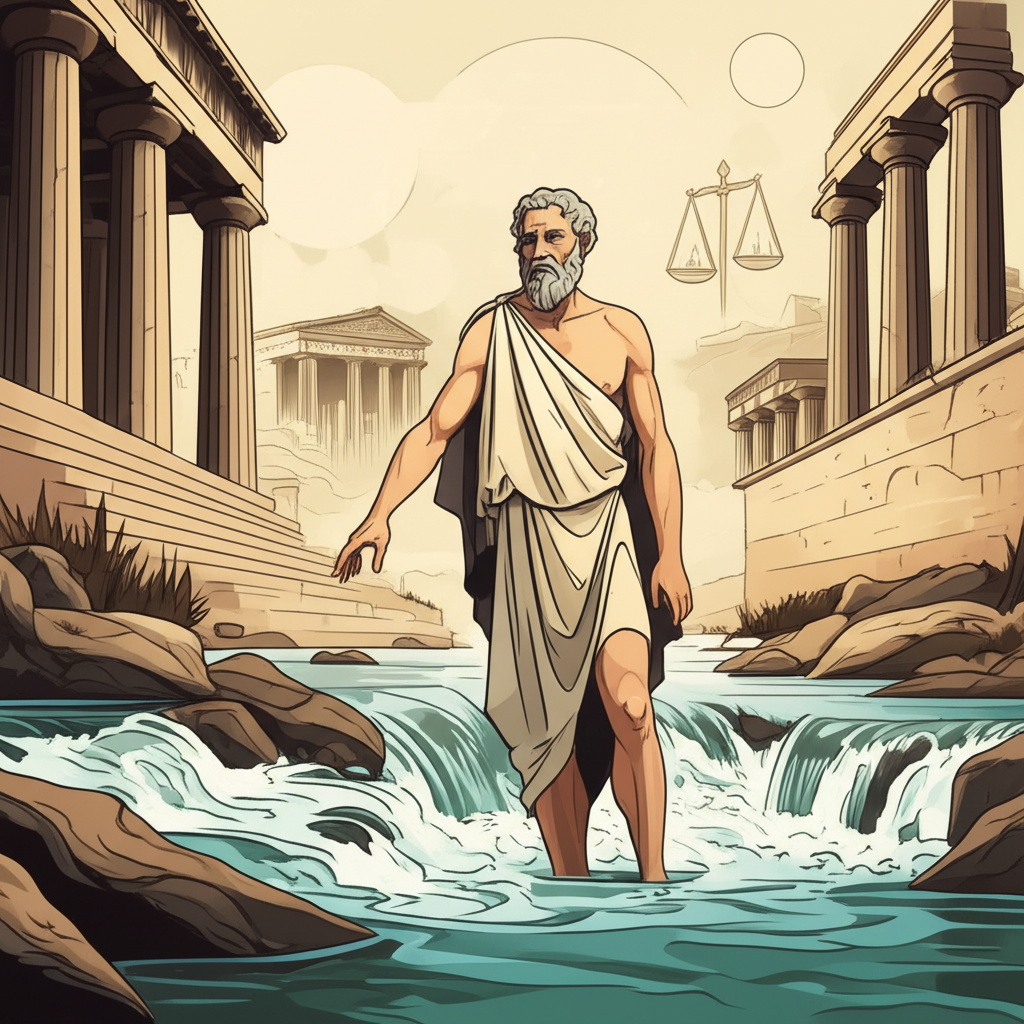 shimmer, suggesting an unchanging realm beyond the earthly flux.)
The Modern Echoes: From Atoms to Dialectics
The quest to understand the Universal Law of Change did not cease with the ancients. Later philosophers and scientists continued this inquiry. Lucretius, in De Rerum Natura, described a universe composed of eternally moving atoms, constantly combining and separating, leading to the creation and dissolution of all things. This atomistic view provides a mechanistic Law for Change, where all transformations are simply rearrangements of fundamental, unchanging particles.
Much later, G.W.F. Hegel introduced the concept of the dialectic, where Change is driven by the interaction of opposing forces (thesis and antithesis) leading to a new synthesis. This process, for Hegel, was the engine of historical, social, and conceptual development, a Universal Law governing the evolution of spirit and ideas.
The Human Condition and the Law of Change
The Universal Law of Change is not merely an abstract philosophical concept; it profoundly impacts the human condition. Our understanding of self, identity, and purpose is inextricably linked to this dynamic reality. We ourselves are beings in flux, constantly learning, adapting, and evolving. The challenge and opportunity lie in how we navigate this inherent impermanence:
- Embracing Adaptability: Recognizing the Law of Change fosters resilience and adaptability, crucial for survival and flourishing in an unpredictable world.
- Seeking Enduring Values: Despite the flux, humanity often seeks stable values, ethical principles, or spiritual truths that can provide a sense of continuity amidst the Particular changes of life. This echoes Plato's search for the Forms.
- Understanding Progress and Decay: The Law of Change helps us understand the cycles of growth, progress, decline, and renewal in civilizations, institutions, and personal lives.
Conclusion: Embracing the Dynamic Truth
The Universal Law of Change stands as one of philosophy's most enduring and impactful insights. From the pre-Socratic observations of Heraclitus to Aristotle's meticulous categorizations and beyond, the Great Books of the Western World offer a rich tapestry of thought on this fundamental principle. It compels us to recognize that while the manifestations are Particular, the Law itself is Universal: everything in Nature is subject to transformation. Understanding this profound truth is not an invitation to despair over impermanence, but rather an encouragement to engage with the dynamic Nature of reality, to find meaning in movement, and to appreciate the intricate dance of becoming that defines all existence.
YouTube Video Suggestions:
- "Heraclitus - Everything Flows: Ancient Philosophy Explained"
- "Aristotle's Metaphysics: Potentiality and Actuality Explained"
📹 Related Video: What is Philosophy?
Video by: The School of Life
💡 Want different videos? Search YouTube for: "The Universal Law of Change philosophy"