

The Unceasing Current: Navigating the Universal Law of Change
Life, as we experience it, is a ceaseless flow. From the subtle shifts in our own consciousness to the grand cosmic dance of galaxies, nothing remains static. This article posits that Change is not merely an observation of phenomena, but a Universal Law that underpins all existence, dictating the very Nature of reality itself. We will explore how this fundamental principle manifests in both the Universal and Particular, drawing on philosophical insights from the Great Books of the Western World to understand its profound implications.
The Immutable Truth of Flux: A Summary
At its core, the Universal Law of Change asserts that impermanence is the defining characteristic of existence. Everything is in a state of becoming, transforming, and evolving. This isn't just an empirical observation but a foundational philosophical tenet, challenging our innate desire for stability and permanence. Understanding this law allows us to better comprehend the transient nature of all things, from the smallest particle to the grandest civilization, and to appreciate the dynamic interplay between the enduring principles of existence and their ever-shifting manifestations.
Panta Rhei: The Ancient Whispers of Constant Motion
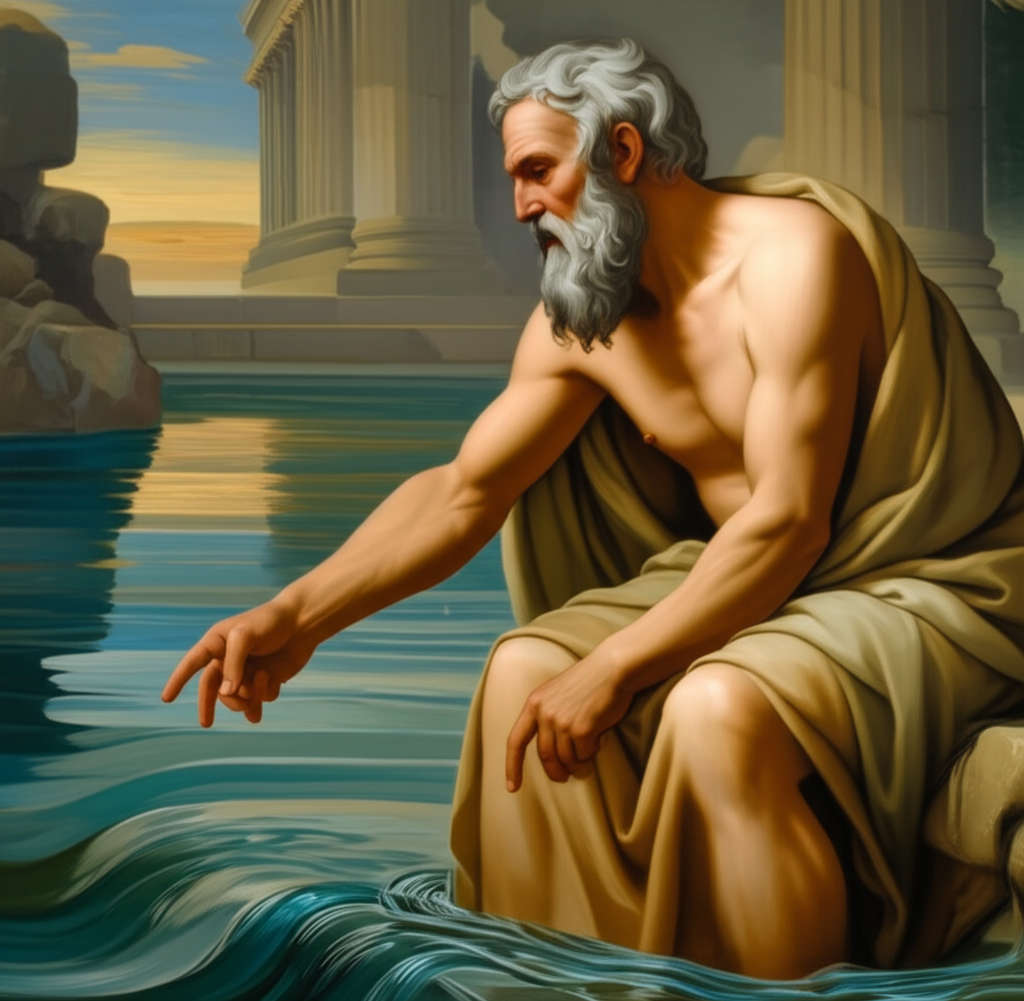
Long before modern science confirmed the dynamic nature of the universe, ancient philosophers grappled with the concept of change. Heraclitus of Ephesus famously declared, "Panta rhei" – "everything flows" – asserting that one cannot step into the same river twice, for both the river and the self have changed. This profound insight, preserved through fragments, established change not as an anomaly but as the very essence of Nature.
This isn't merely a poetic metaphor; it's an assertion of a Universal principle. Whether we look at the geological processes shaping continents, the biological cycles of birth, growth, and decay, or the continuous formation and dissipation of clouds, the evidence for constant flux is overwhelming. The universe, in its grand design, is a testament to motion, transformation, and ceaseless activity.
The Law of Change: Beyond Mere Observation to Inherent Principle
To call change a "law" elevates it beyond a simple observation. A law implies an inherent, governing principle, a rule by which reality operates. While thinkers like Parmenides and Plato sought an unchanging, eternal realm (Parmenides' uncreated, indestructible Being; Plato's perfect Forms), even their arguments implicitly acknowledge the pervasive, if illusory, nature of change in the sensory world.
The Law of Change suggests that:
- Nothing is static: Every entity, from its inception, is on a trajectory of transformation.
- Causality is inherent: Change often occurs as a chain of cause and effect, where one state leads inevitably to another.
- Potentiality and Actuality: As Aristotle explored, objects and beings possess potentiality (what they can become) and actuality (what they are). Change is the process of moving from potentiality to actuality.
This law is not imposed from outside; it is intrinsic to the fabric of existence. It is the engine of evolution, the basis of development, and the reason for both progress and decay.
The Interplay of Universal and Particular: Manifestations of Change
The Universal Law of Change does not operate abstractly; it manifests uniquely in Particular instances. Understanding this interplay is crucial for a complete philosophical grasp of the concept.
Consider the following examples:
| Universal Principle of Change | Particular Manifestations |
|---|---|
| Biological Evolution | Species adapting to environments, genetic mutations, individual growth and aging. |
| Cosmic Dynamics | Star formation and death, planetary orbits, galactic collisions, expansion of the universe. |
| Societal Development | Cultural shifts, technological revolutions, political revolutions, economic cycles. |
| Individual Experience | Learning, emotional development, physical maturation, changes in belief systems. |
In each case, the underlying principle of transformation is universal, yet its expression is highly specific, shaped by context, conditions, and prior states. A tree grows and sheds its leaves, a child learns to speak, a civilization rises and falls – all are unique instances of the same fundamental law at work. This tension between the general and the specific highlights the richness and complexity of reality.
Embracing the Dynamic: Philosophical and Existential Implications
Acknowledging the Universal Law of Change has profound implications for how we understand ourselves and the world. It challenges our desire for stability, our attachment to fixed identities, and our often-futile attempts to halt the inevitable march of time.
- On Knowledge: If everything changes, how can we truly know anything? This question has plagued philosophers from Plato to Hegel. For Hegel, change (the dialectic) was not an obstacle but the very mechanism of truth's unfolding. Knowledge itself is a dynamic process.
- On Ethics: How do our moral frameworks adapt to a changing world? What is good or just when circumstances are in constant flux? This requires a flexible, adaptable ethical reasoning that considers context and consequence.
- On Existence: Embracing change means accepting impermanence, loss, and the cyclical nature of life. It fosters resilience and adaptability, encouraging us to find meaning not in static states, but in the journey, the process of becoming.
The Nature of reality, then, is not a fixed edifice but a perpetually flowing river. To deny this is to deny reality itself. To embrace it is to open oneself to the ceaseless dynamism that defines existence, finding beauty and meaning in the ebb and flow.
📹 Related Video: What is Philosophy?
Video by: The School of Life
💡 Want different videos? Search YouTube for: ""Heraclitus and the Philosophy of Change" "Process Philosophy Explained""