

The Unyielding Logic of Existence: Exploring the Universal Law of Cause and Effect
The Universal Law of Cause and Effect is a foundational principle underpinning our understanding of reality, asserting that every event, or effect, is invariably preceded by a cause. This article delves into the historical and philosophical journey of this immutable Law, examining its universal applicability and the specific, particular manifestations that shape our world, drawing insights from the enduring wisdom of the Great Books of the Western World.
Introduction: The Inexorable Chain of Becoming
From the simplest falling leaf to the grandest cosmic ballet, the fabric of existence appears woven with threads of consequence. Nothing, it seems, simply is without having first come to be. This intuitive observation forms the bedrock of one of philosophy's most enduring and pivotal insights: the Universal Law of Cause and Effect. It is a principle so fundamental that to deny it is, in many ways, to deny the very intelligibility of the world around us. For millennia, thinkers have grappled with its implications, seeking to understand not just that it exists, but how it governs, what it dictates, and where its boundaries lie.
The Ancient Pedigree of a Universal Principle
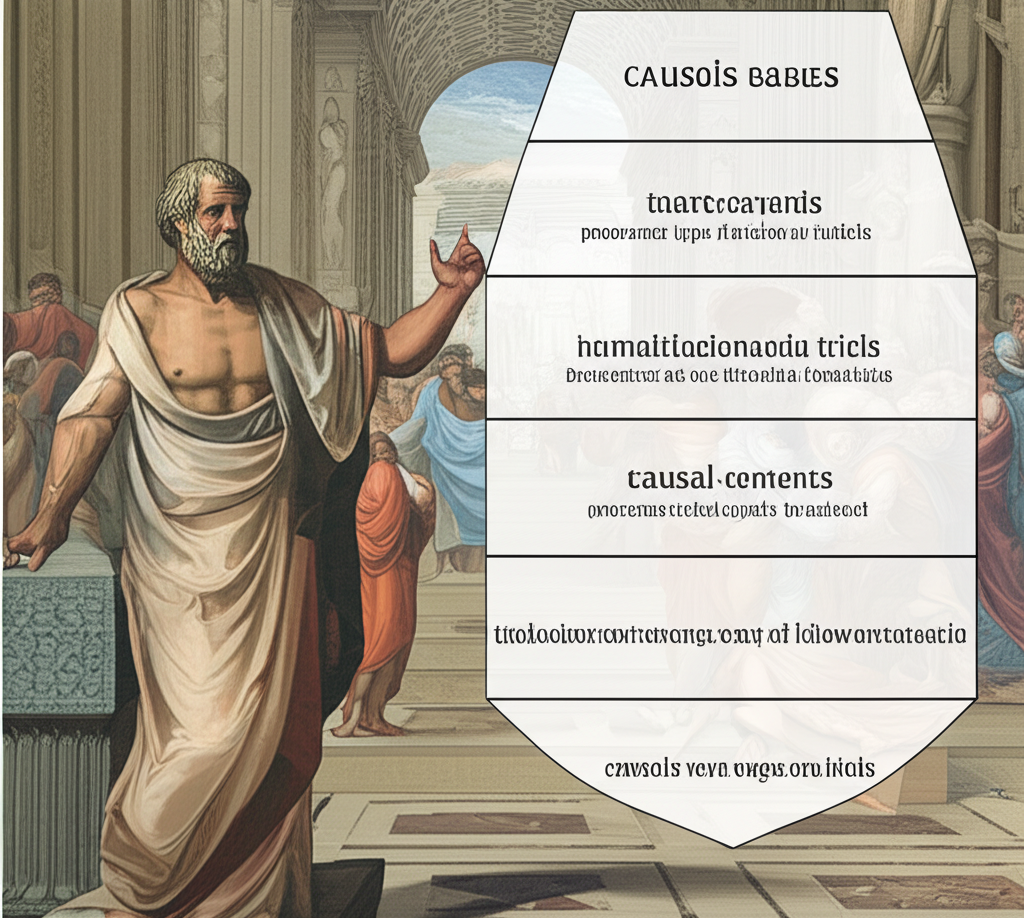
The notion of causality is not a modern invention; it is a thread that runs through the very earliest philosophical inquiries. In the Great Books of the Western World, we encounter its nascent forms within the pre-Socratics' search for primary substances, their attempts to explain change and becoming. Plato, in his Timaeus, grappled with the cause of the cosmos, positing a divine craftsman. Yet, it was Aristotle who perhaps gave the most comprehensive early articulation of causality, differentiating between material, formal, efficient, and final causes. For Aristotle, to truly know something was to know its causes. This classical understanding laid the groundwork for centuries of philosophical and scientific exploration, establishing causality as a non-negotiable Law governing the natural world.
Defining the Law: A Universal and Unwavering Principle
At its core, the Universal Law of Cause and Effect posits that for every effect, there must be a preceding cause. This is not merely a statistical correlation but an assertion of necessary connection. It is a principle that suggests a logical, sequential order to events.
- Necessity: The effect necessarily follows from the cause, given the right conditions.
- Invariability: The same cause, under the same conditions, will always produce the same effect.
- Precedence: The cause always precedes the effect in time, though the interval may be infinitesimal.
This Law is deemed universal because it is believed to apply across all domains of existence – from the physical sciences to human psychology, from the micro-level of quantum interactions (though its interpretation there becomes more nuanced) to the macro-level of celestial mechanics. It provides the rational framework for prediction, explanation, and ultimately, for science itself.
From Universal Truths to Particular Manifestations
While the Law of Cause and Effect is universal, its manifestations are profoundly particular. The way a billiard ball transfers momentum is a specific instance of cause and effect, distinct from the way a political decision leads to social unrest, or how a kind word might alter a mood.
Consider the following:
| Domain of Application | Universal Principle | Particular Manifestation |
|---|---|---|
| Physics | Every force has an equal and opposite reaction. | A thrown ball follows a parabolic trajectory due to gravity and initial velocity. |
| Biology | Organisms adapt to their environment for survival. | A specific species of finch develops a unique beak shape to access a particular food source. |
| Psychology | Human behavior is influenced by past experiences. | A childhood trauma leads to specific adult anxieties or coping mechanisms. |
| Sociology | Social structures evolve in response to societal pressures. | Economic inequality in a specific nation leads to increased crime rates or political unrest. |
Each of these particular instances, diverse as they are, nonetheless operates under the overarching Universal Law. The challenge for philosophers and scientists alike is to identify the specific causes that lead to specific effects within their respective fields, thereby unraveling the intricate web of reality.
The Philosophical Weight: Determinism, Free Will, and Moral Responsibility
The Universal Law of Cause and Effect carries profound philosophical implications, particularly concerning the perennial debates on determinism and free will. If every effect has a cause, and every cause is itself an effect of a prior cause, does this not lead to a chain of events stretching back infinitely, making all future events inevitable?
- Determinism: The view that all events, including human actions, are ultimately determined by causes external to the will. If the universe is a giant causal machine, where does choice fit in?
- Free Will: The capacity of agents to make choices that are not determined by antecedent events. Many argue that genuine moral responsibility requires free will.
- Compatibilism: An attempt to reconcile free will with determinism, suggesting that freedom can exist even in a causally determined world, often by redefining "freedom" as acting without external coercion.
The Great Books offer a rich tapestry of perspectives on these issues. From the Stoics' acceptance of fate to Augustine's struggles with divine foreknowledge and human agency, to Descartes' dualism attempting to carve out a space for a non-physical mind, and Hume's skeptical challenge to the very notion of necessary connection, the principle of causality has been both a foundation and a stumbling block for understanding our place in the cosmos. Kant, in his critique, sought to establish causality as a necessary category of human understanding, a way we must perceive the world, rather than an inherent feature of things-in-themselves.
Conclusion: The Enduring Principle
The Universal Law of Cause and Effect remains an indispensable principle for understanding reality. It is the invisible architecture upon which all scientific inquiry rests and the implicit assumption in our everyday navigation of the world. While its particular manifestations are endlessly varied and its philosophical implications continue to provoke robust debate, the fundamental idea that nothing happens without a cause persists as one of the most powerful and enduring Laws of thought. To truly comprehend our existence, we must continually strive to uncover these causal links, embracing the logical elegance of a universe governed by an unyielding, yet profoundly intricate, principle.
YouTube Video Suggestions:
-
📹 Related Video: ARISTOTLE ON: The Nicomachean Ethics
Video by: The School of Life
💡 Want different videos? Search YouTube for: ""Aristotle's Four Causes explained""
-
📹 Related Video: PLATO ON: The Allegory of the Cave
Video by: The School of Life
💡 Want different videos? Search YouTube for: ""Hume on Causality and Inductive Reasoning""