

The Ineluctable Thread: Unraveling the Universal Law of Cause and Effect
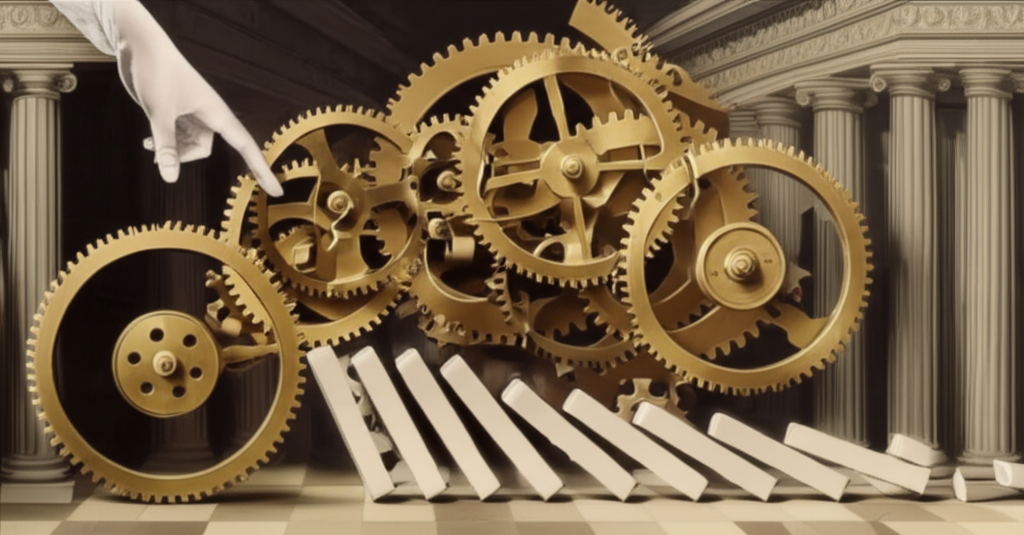
The Universal Law of Cause and Effect stands as one of the most fundamental principles underpinning not only our understanding of the natural world but also the very fabric of philosophical inquiry. Simply put, this Law posits that every effect has a preceding cause, and that given the same cause under the same conditions, the same effect will inevitably follow. It is a bedrock assumption, a principle so deeply ingrained in our perception that its absence would render the cosmos unintelligible, transforming predictable order into arbitrary chaos. This article delves into the historical philosophical engagement with this universal principle, examining how thinkers from the Great Books tradition have grappled with its implications for both the universal order and particular events.
The Bedrock Principle: Defining Causality
At its core, the Universal Law of Cause and Effect asserts that nothing simply "happens." Every phenomenon, every event, every change, is the result of antecedent conditions or forces. This isn't merely an observation; it's presented as a law governing reality itself. From the smallest subatomic interaction to the grandest cosmic ballet, the relationship between cause and effect is presumed to be constant, a universal truth that allows for scientific prediction, logical inference, and a coherent understanding of existence. Without this principle, the very idea of scientific experimentation or moral responsibility would collapse.
Tracing the Lineage: Ancient Roots of Causality
Our journey into the philosophical understanding of causality begins, as so many intellectual voyages do, with Aristotle. In his profound exploration of change and motion, as documented in the Great Books of the Western World, Aristotle articulated a comprehensive framework for understanding the diverse ways in which something can be a cause. He didn't merely ask if something had a cause, but how it was caused, identifying four distinct types of causation that offer a more nuanced perspective than our modern, often simplified, understanding.
Aristotle's Four Causes:
| Cause Type | Description | Example (A Bronze Statue) |
|---|---|---|
| Material Cause | That out of which a thing is made. | The bronze itself. |
| Formal Cause | The essence or nature of a thing; its shape or structure. | The specific design or form of the statue (e.g., a depiction of Zeus). |
| Efficient Cause | The primary source of the change or rest; the agent that brings something about. | The sculptor who shapes the bronze. |
| Final Cause | The end, purpose, or goal for which a thing exists or is done. | The purpose of the statue, such as honoring a deity or beautifying a space. |
These distinct categories illustrate that the principle of causation is not monolithic but operates through various modes, each contributing to the complete understanding of any given particular effect.
The Skeptical Interrogation: Hume's Challenge
Centuries later, the Enlightenment philosopher David Hume, also a pivotal figure in the Great Books, launched a profound challenge to the certainty of the Universal Law of Cause and Effect. Hume, an empiricist, argued that we never actually perceive a "necessary connection" between a cause and its effect. What we observe, he contended, is merely a constant conjunction of events: one event (the cause) consistently preceding another (the effect). We see the billiard ball strike another, and then the second ball moves. But we do not see the power or force that compels the second ball to move.
Hume's argument was revolutionary: our belief in causality, he suggested, is not derived from reason or sensory experience of necessity, but from habit and custom. When we repeatedly observe event A followed by event B, our minds form an expectation that A will always be followed by B. This psychological expectation, however, does not confer a universal or objective law of necessary connection upon the world itself. Hume's skepticism forced philosophers to re-evaluate the very foundation of scientific and philosophical knowledge.
Reclaiming Necessity: Kant's Transcendental Insight
Immanuel Kant, deeply influenced by Hume's challenge, sought to rescue the Universal Law of Cause and Effect from mere psychological habit. In his monumental Critique of Pure Reason, another cornerstone of the Great Books, Kant argued that causality is not an empirical principle derived from experience, but rather a fundamental category of the understanding, a transcendental condition for the possibility of experience itself.
For Kant, the mind is not a passive recipient of sense data, but an active organizer. We don't just perceive raw sensations; we structure them according to innate concepts, or categories, one of which is causality. Thus, the principle that every event has a cause is not something we learn from observing the world, but something we impose upon the world in order to make sense of it. It is a universal and necessary law because it is a condition of our knowing, not merely a feature of the world-in-itself. This shifted the locus of the universal law from external reality to the structure of the human mind.
Universal Law, Particular Manifestations
The ongoing philosophical dialogue surrounding the Universal Law of Cause and Effect highlights its profound implications. While the law itself is universal—applying to all phenomena—its manifestations are always particular. Each specific event, from the falling of an apple to the rise of a civilization, represents a unique confluence of causes leading to a specific effect. Understanding these particular causal chains is the work of science, history, and everyday reasoning. The philosophical challenge lies in reconciling the seemingly absolute nature of the universal principle with the contingent and varied nature of particular events.
The exploration of causality continues to be a vibrant field, touching upon questions of free will, determinism, scientific explanation, and the very nature of reality. Whether viewed through an Aristotelian lens, subjected to Humean skepticism, or understood via Kantian synthesis, the Universal Law of Cause and Effect remains an ineluctable thread weaving through the tapestry of existence, demanding our continuous philosophical reflection.
📹 Related Video: ARISTOTLE ON: The Nicomachean Ethics
Video by: The School of Life
💡 Want different videos? Search YouTube for: ""Aristotle Four Causes Explained" "Hume Kant Causality Debate""