

The Unseen Hand of Necessity: Exploring the Universal Law of Cause and Effect
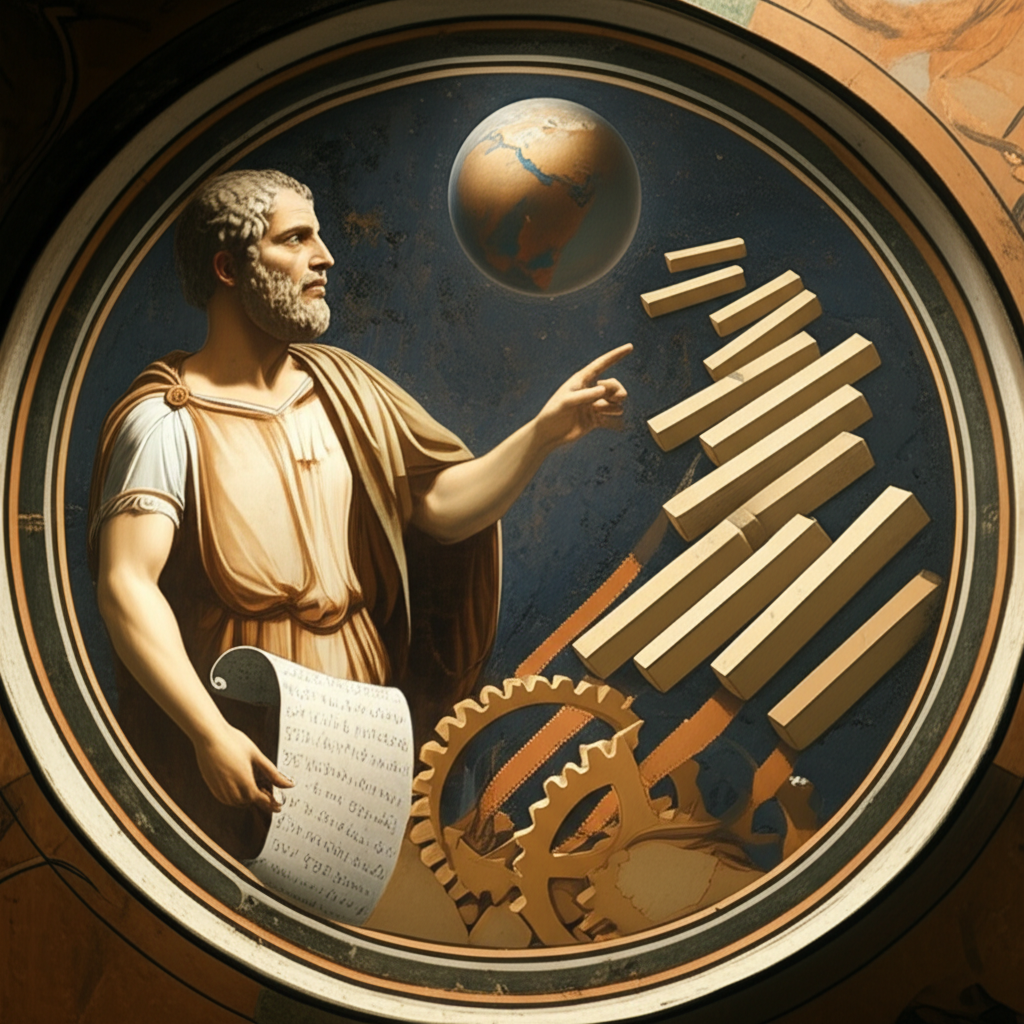
At the heart of all existence, from the grand cosmic dance to the most fleeting thought, lies an undeniable truth: the Universal Law of Cause and Effect. This foundational Principle dictates that every event, every phenomenon, is the inevitable outcome of prior conditions, and in turn, becomes a cause for subsequent events. It is a constant, unwavering thread woven through the fabric of reality, shaping our understanding of the world and our place within it, a law that underpins all rational inquiry and serves as a bedrock for scientific discovery and philosophical contemplation.
The Inescapable Principle: Defining Cause and Effect
To speak of cause and effect is to acknowledge a fundamental relationship between events, where one event (the cause) brings about another (the effect). This Law is not merely an observation but a profound Principle that posits an inherent, often sequential, connection. It asserts that nothing happens without a reason, and every action, every change, is traceable to an antecedent condition. Without this Principle, the universe would be a realm of utter randomness, devoid of predictability or meaning. Our ability to learn, to plan, to predict, and to construct knowledge hinges entirely upon the consistent operation of this Law.
Universal and Particular Manifestations
While the Law itself is universal – applying across all domains and scales, from the subatomic to the galactic – its manifestations are profoundly particular. Every specific cause generates a specific effect, yet all these individual instances are governed by the overarching universal framework.
Consider these distinctions:
- Universal Law: The principle that every event has a cause.
- Particular Manifestation: A specific event, such as a ball falling to the ground, is caused by gravity and the act of releasing it.
This interplay between the universal and particular allows us to formulate general scientific laws based on repeatable observations of particular events. For instance:
- Universal Principle: Energy conservation.
- Particular Effect: A car stopping due to friction converts kinetic energy into heat.
- Universal Principle: The Law of unintended consequences.
- Particular Effect: A new policy designed to solve one problem inadvertently creates several new ones.
- Universal Principle: Biological adaptation.
- Particular Effect: A specific species evolving longer necks to reach higher foliage.
A Philosophical Lineage: Tracing the Principle Through the Ages
The profound implications of this Law have occupied the greatest minds throughout history, thinkers whose works fill the pages of the Great Books of the Western World. Their inquiries have shaped our understanding of causality itself:
-
Aristotle: The ancient Greek philosopher, whose works are cornerstones of Western thought, meticulously categorized four types of causes:
- Material Cause: What something is made of (e.g., bronze for a statue).
- Formal Cause: The form or essence of a thing (e.g., the shape of the statue).
- Efficient Cause: The primary source of the change or rest (e.g., the sculptor).
- Final Cause: The purpose or end for which a thing exists (e.g., the statue's purpose as a work of art).
Aristotle's framework provided a comprehensive way to understand the "why" of existence, extending far beyond simple sequential events.
-
David Hume: The Scottish empiricist, in the 18th century, critically challenged the notion of a necessary connection between cause and effect. He argued that we only ever observe "constant conjunction" – one event consistently following another – but never the inherent force or principle that compels the effect. For Hume, our belief in necessity is a psychological habit, not an empirical observation.
-
Immanuel Kant: Responding to Hume's skepticism, the German philosopher posited that causality is not merely derived from experience but is an a priori category of human understanding. For Kant, the mind actively imposes the principle of cause and effect onto sensory data, making it a necessary condition for us to experience an objective, intelligible world.
These differing perspectives underscore the enduring complexity and philosophical depth of the Universal Law of Cause and Effect.
The Mechanics of Consequence: How Cause and Effect Operates
Understanding how this Law operates involves recognizing several key aspects:
| Aspect of Causality | Description | Philosophical Implication |
|---|---|---|
| Antecedence | The cause precedes the effect in time. | Forms the basis for prediction, planning, and historical analysis. |
| Contiguity | Often, cause and effect are spatially or conceptually close. | Helps identify direct links, though "action at a distance" (e.g., gravity) remains a complex topic. |
| Necessity | Given the cause, the effect must follow (the most debated aspect by Hume). | Foundation for scientific laws and the philosophical debate on determinism versus free will. |
| Proportionality | The effect is often proportional to the cause in magnitude or intensity. | Essential for quantitative sciences and engineering, allowing for precise calculations. |
| Sufficiency | The cause provides sufficient conditions for the effect to occur. | Implies that the cause is enough, on its own or with other conditions, to produce the effect. |
Implications Across Disciplines
The Universal Law of Cause and Effect is not confined to abstract philosophical discourse; its implications permeate every aspect of human inquiry and existence:
- Science: It is the bedrock of the scientific method. Scientists formulate hypotheses about causes, design experiments to isolate variables, and observe the resulting effects to establish scientific laws and theories.
- Ethics and Morality: Our understanding of responsibility hinges on this Principle. Actions (causes) have moral consequences (effects), leading to notions of praise, blame, justice, and accountability.
- Free Will vs. Determinism: If every event is caused, does this mean human choices are merely predetermined effects of prior causes? This profound philosophical dilemma, explored extensively in the Great Books, directly stems from the Law of Cause and Effect.
- Personal Development: Recognizing that our habits, decisions, and efforts (causes) lead to specific outcomes (effects) empowers individuals to take agency over their lives and strive for desired results.
Conclusion
The Universal Law of Cause and Effect stands as an immutable Principle at the core of reality. From the ancient insights of Aristotle to the critical inquiries of Hume and the synthetic philosophy of Kant, the greatest minds have grappled with its implications. It guides our scientific endeavors, shapes our ethical frameworks, and challenges our understanding of free will. This Law, in its universal applicability and particular manifestations, remains the indispensable framework through which we comprehend the intricate, interconnected tapestry of existence, urging us always to look beyond the immediate and understand the antecedent causes that shape our world.
Suggested Viewing
-
📹 Related Video: ARISTOTLE ON: The Nicomachean Ethics
Video by: The School of Life
💡 Want different videos? Search YouTube for: "David Hume on Causation Explained"
2. ## 📹 Related Video: ARISTOTLE ON: The Nicomachean Ethics
Video by: The School of Life
💡 Want different videos? Search YouTube for: "Aristotle Four Causes Philosophy"