

The Dance of Universals and Particulars: Crafting Meaningful Definitions
The act of defining is fundamental to human thought and communication, yet it grapples with one of philosophy's oldest and most persistent puzzles: the relationship between the universal and particular. This article explores how philosophers, from the ancient Greeks to later thinkers within the Great Books of the Western World tradition, have wrestled with incorporating these distinct aspects into coherent definitions. Understanding this interplay is crucial for clear logic, allowing us to move beyond mere observation to grasp the underlying idea or essence of things.
The Core Challenge of Definition: Bridging the Divide
At its heart, the problem of universal and particular in definition arises because we encounter a world of individual, concrete things (particulars) – like this specific dog, Fido – but we often define them using general concepts (universals) – like "dog" or "mammal." How can a definition accurately capture Fido's dog-ness without getting lost in the unique details of Fido's floppy ears, while also distinguishing him from a cat?
- Particulars: These are individual, concrete entities that exist in specific times and places. They are unique and distinct. (e.g., Socrates, this particular red apple, the chair I'm sitting on).
- Universals: These are general concepts, properties, or relations that can be predicated of many particulars. They represent shared characteristics or essences. (e.g., humanity, redness, chair-ness).
The challenge for definition, then, is to articulate the universal concept in a way that truly applies to all relevant particulars, without being so abstract as to lose meaning, nor so specific as to exclude legitimate instances.
Aristotle's Logical Framework: Genus and Species
One of the most profound contributions to understanding definition comes from Aristotle, whose works like Categories and Posterior Analytics lay the groundwork for formal logic. For Aristotle, a proper definition identifies a thing's genus (its broader class) and its differentia (what distinguishes it within that class). This method inherently relies on combining a universal (the genus) with a particularizing characteristic (the differentia).
Consider the classic example: "Man is a rational animal."
- Animal: This is the genus, a broad universal category that man shares with many other living beings.
- Rational: This is the differentia, the specific quality that distinguishes man from other animals.
This structure of definition allows us to apply a universal concept ("animal") while refining it with a more specific, though still universal, characteristic ("rational") to pinpoint the particular kind of being we are defining. It provides a logical framework for understanding how a specific idea fits into the broader tapestry of existence.
Here's how Aristotle's method structures definitions:
| Component | Description | Example (for "Man") |
|---|---|---|
| Genus | The broader, more general class to which the thing belongs (a universal). | Animal |
| Differentia | The specific quality or characteristic that distinguishes it within its genus. | Rational |
| Species | The defined term itself, resulting from the combination (a more specific universal). | Man |
This logical approach ensures that our definitions are neither too broad nor too narrow, allowing for precise communication and reasoning.
Plato's Realm of Ideas: The Universal Archetypes
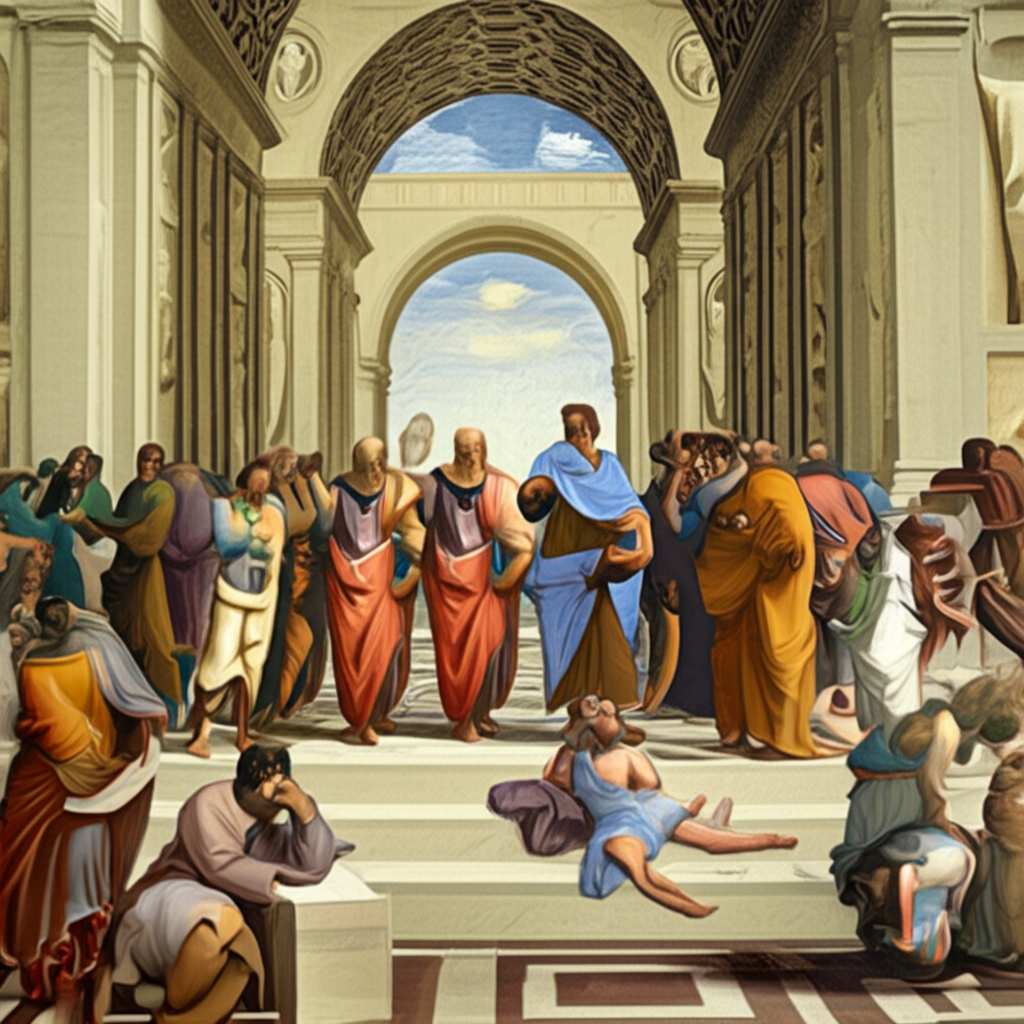
While Aristotle focused on universals within particulars, his teacher Plato offered a different, yet equally influential, perspective in works like Phaedo and Republic. For Plato, the true universals existed as perfect, immutable Forms or Ideas in a transcendent realm, separate from the imperfect particulars we encounter in the sensory world. For instance, there isn't just a "beautiful person" or a "beautiful flower," but an eternal Form of Beauty itself, which all particular beautiful things merely "participate" in or "imitate."
From this perspective, a definition wouldn't just describe the characteristics of particulars, but would strive to grasp the essence of the universal Form itself. The challenge here is how our minds, immersed in the particular, can access and define these perfect, universal Ideas. Plato's theory suggests that true knowledge (and thus true definition) involves recollecting these Forms.
The Enduring Debate: From Medieval Scholastics to Modern Thought
The tension between the universal and particular in definition continued to animate philosophical discourse for centuries. Medieval Scholastics, heavily influenced by Aristotle, debated the "problem of universals" – whether universals existed independently (realism), only in the mind (conceptualism), or merely as names (nominalism). Thinkers like Thomas Aquinas, drawing on Aristotle, argued for a moderate realism where universals exist in God's mind (before creation), in things (during creation), and in our minds (after abstraction).
Later, Enlightenment philosophers like John Locke, in his Essay Concerning Human Understanding, explored how we form "abstract ideas" by stripping away the particular circumstances from individual experiences to arrive at general concepts. David Hume, on the other hand, was more skeptical, arguing that all our knowledge stems from particular sense impressions, making the existence of truly universal ideas problematic.
Regardless of their stance on the ultimate reality of universals, each philosopher grappled with the same fundamental question: how do we define concepts that seem to apply to many different things, and what is the relationship between that universal concept and the individual instances we encounter?
Why This Matters: The Power of Precise Definition
Understanding the interplay of the universal and particular is not merely an academic exercise; it has profound implications for clear thinking, effective communication, and the very structure of our knowledge.
- Clarity in Argument: Ambiguous definitions can derail any logical argument. By carefully delineating the universal and particular aspects of our terms, we ensure everyone is on the same page.
- Scientific Classification: Biology, for example, relies heavily on defining species (particular universals) within genera (broader universals), using a rigorous system that mirrors Aristotle's logic.
- Legal Reasoning: Laws are often framed in universal terms, but their application requires careful consideration of particular cases, demanding precise definitions to ensure justice.
- Moral Philosophy: Defining concepts like "justice," "goodness," or "freedom" requires us to articulate universal principles while acknowledging their manifestation in particular situations.
Conclusion: Defining Our World, One Concept at a Time
The universal and particular remain a cornerstone of philosophical inquiry into definition. From Aristotle's logic of genus and differentia to Plato's transcendent Ideas, and through centuries of debate, philosophers have sought to understand how we can create meaningful boundaries for the concepts that structure our world. By appreciating this intricate dance, we equip ourselves with the tools for more precise thought, clearer communication, and a deeper understanding of the reality we inhabit.
YouTube Suggestions:
-
📹 Related Video: PLATO ON: The Allegory of the Cave
Video by: The School of Life
💡 Want different videos? Search YouTube for: ""Plato Theory of Forms Explained" or "Aristotle Universals and Particulars""
-
📹 Related Video: What is Philosophy?
Video by: The School of Life
💡 Want different videos? Search YouTube for: ""Problem of Universals Explained Philosophy" or "Logic Definition Genus Differentia""