

The Dance of Abstraction: Unpacking the Universal and Particular in Definition
Defining anything — be it a concept, an object, or an action — immediately plunges us into one of philosophy's most enduring and fundamental debates: the relationship between the Universal and Particular. At its core, Definition is the art of capturing the essence of something, but this essence often exists as a general Idea (a universal) that manifests in countless specific instances (particulars). How we bridge this gap, how Logic allows us to move from the unique to the general and back again, is crucial not just for philosophical clarity but for everyday understanding. This article explores this intricate interplay, drawing insights from the rich tradition of thought found in the Great Books of the Western World.
The Enduring Question of Definition
From the Socratic dialogues seeking to define "justice" or "piety" to the sophisticated logical systems of Aristotle, the quest for precise Definition has always been central to philosophical inquiry. Why is it so challenging? Because every attempt to define something forces us to confront the distinction between what something is in its general nature and what it is as a specific, individual entity. We grapple with how a single, overarching Idea can apply to a multitude of diverse particulars without losing its meaning or becoming overly vague.
Universals: The Abstract Blueprints of Reality
At the heart of our discussion are Universals. These are the general concepts, properties, or relations that can be predicated of many individual things. Think of "humanity," "redness," "triangularity," or "justice." When we speak of a "human being," we invoke a universal concept that applies equally to Socrates, Chloe, and a person we've never met.
- Plato's Forms: Perhaps the most famous articulation of universals comes from Plato, who posited the existence of perfect, unchanging Forms or Ideas in a separate realm. For Plato, the Idea of "Beauty" exists independently of any beautiful object; individual beautiful objects merely participate in or imperfectly reflect this perfect Form. This approach, deeply explored in works like The Republic, suggests that true knowledge (episteme) is of these universals, not of the fleeting particulars.
- Shared Meaning and Logic: Universals are what allow for shared understanding and communication. Without the universal Idea of "tree," every individual tree would be a unique and incomparable entity, rendering language and Logic impossible. They provide the categories and classifications necessary for systematic thought.
Particulars: The Tangible Instances
In stark contrast to universals are Particulars. These are the individual, concrete entities that exist in specific times and places. Socrates is a particular human being. This specific red apple on my desk is a particular instance of redness and apple-ness. Every unique event, object, or person is a particular.
- Individuality and Experience: Particulars are what we directly encounter through our senses. They are unique, often transient, and subject to change. Our experience of the world is primarily an experience of particulars.
- The Challenge for Definition: The challenge arises because a Definition aims for the general, the universal essence. How do we define "Socrates" without simply listing his individual attributes, and how does that relate to the universal Definition of "human"?
The Interplay in Definition: A Logical Necessity
The crucial point is that universals and particulars are not entirely separate but are deeply intertwined, especially within the act of Definition. Logic, particularly as systematized by Aristotle in works like the Organon, provides the tools to navigate this relationship. Aristotle, while disagreeing with Plato's separate realm of Forms, still recognized the reality of universals, viewing them as immanent in particulars.
- Genus and Differentia: Aristotle's method of Definition relies on identifying the genus (the broader universal category) and the differentia (the specific characteristic that distinguishes the particular being defined from other members of that genus).
- For example, to define "human," we might say "a rational animal."
- "Animal" is the universal genus – a broad category that includes many particulars.
- "Rational" is the particularizing differentia – what distinguishes humans from other animals.
- For example, to define "human," we might say "a rational animal."
- Bridging the Gap: This method effectively bridges the universal and particular. The Definition itself is a universal statement, applicable to all particulars that fit the criteria, yet it is constructed by identifying a universal category and then narrowing it down with a specific, distinguishing feature.
Table: Universal and Particular in Definition Examples
| Term to Define | Universal Aspect (Genus) | Particularizing Aspect (Differentia) | Full Definition |
|---|---|---|---|
| Human | Animal | Rational | Rational Animal |
| Chair | Piece of Furniture | Designed for sitting | Furniture designed for sitting |
| Democracy | Form of Government | Rule by the people | Government by the people |
| Justice | Virtue | Giving each their due | The virtue of giving each their due |
The Idea in Mind: Grasping Abstraction
How do we come to grasp these universals, these abstract Ideas, in our minds? This question has fueled debates between empiricists and rationalists throughout the history of philosophy.
- Empiricist View (e.g., Locke, Hume): From the perspective of thinkers like John Locke (An Essay Concerning Human Understanding), universals are formed through abstraction from particular experiences. We encounter many individual red objects, and through a process of comparison and generalization, we abstract the common quality of "redness" to form the universal Idea.
- Rationalist View (e.g., Descartes, Kant): Conversely, rationalists like René Descartes or Immanuel Kant (Critique of Pure Reason) might argue that some universal Ideas or categories of understanding are either innate or necessary structures of the mind, allowing us to organize and make sense of our particular experiences. We possess an inherent capacity for Logic and universal thought.
Regardless of their origin, these Ideas in our minds are the tools we use to categorize the world, to make sense of its dizzying array of particulars, and to formulate coherent Definitions.
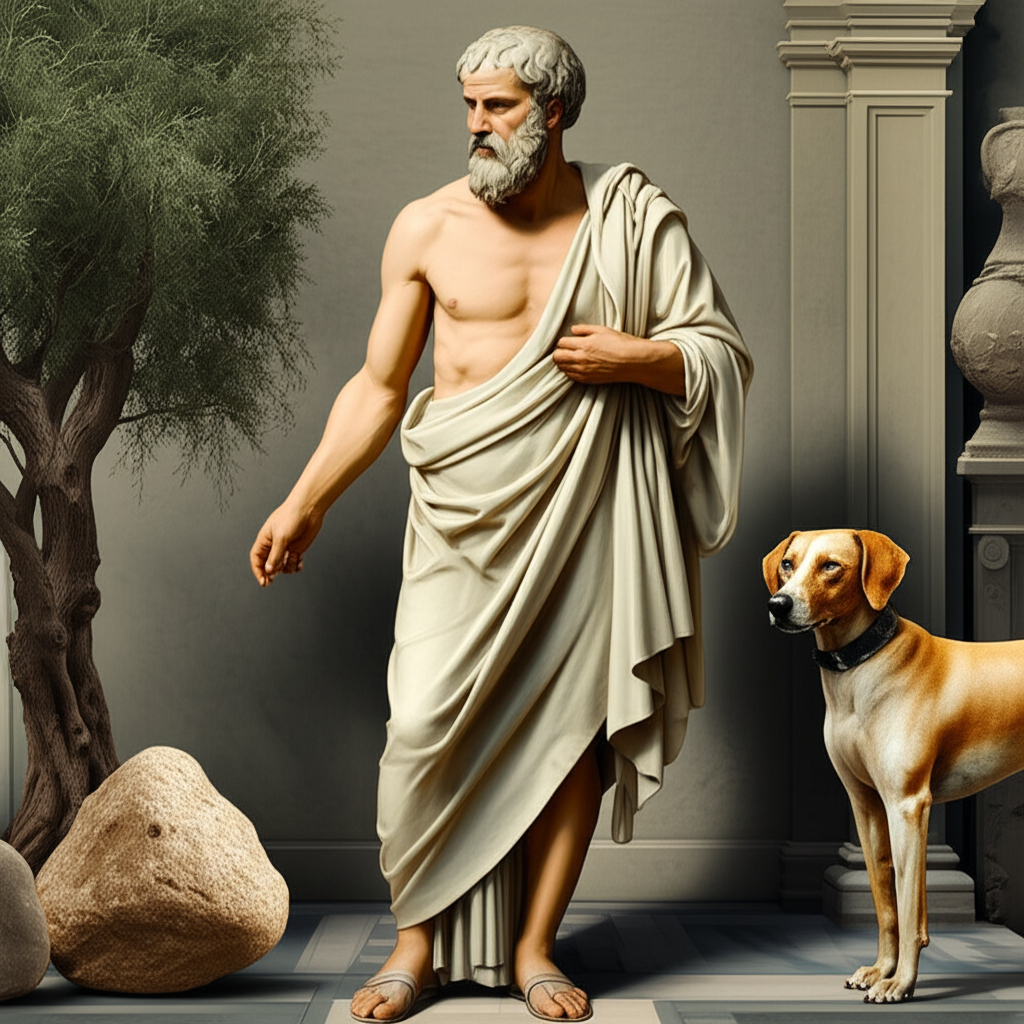 are depicted. On the other side, abstract symbols and geometric shapes (a perfect circle, a mathematical equation, the word "truth") float. The philosopher gestures towards both, illustrating the conceptual bridge between the concrete world of particulars and the abstract realm of universals, emphasizing the act of defining.)
A Continuous Philosophical Endeavor
The distinction between the Universal and Particular remains a cornerstone of philosophical inquiry, deeply influencing metaphysics, epistemology, and ethics. Understanding this dynamic is not merely an academic exercise; it is fundamental to how we think, communicate, and construct knowledge. Every time we attempt a Definition, engage in a logical argument, or strive to understand a complex Idea, we are participating in this ancient and ongoing philosophical dance, seeking to find the universal in the particular and to apply the universal to the particular with precision and clarity.
📹 Related Video: What is Philosophy?
Video by: The School of Life
💡 Want different videos? Search YouTube for: ""The Problem of Universals Explained - Philosophy Core Concepts""
📹 Related Video: ARISTOTLE ON: The Nicomachean Ethics
Video by: The School of Life
💡 Want different videos? Search YouTube for: ""Aristotle's Logic and the Art of Definition""