

The Universal and Particular in Definition: A Philosophical Lens
Understanding how we define things—how we draw boundaries around concepts—hinges on a fundamental philosophical distinction: the universal and the particular. This article explores how our very capacity for definition relies on grasping universal qualities, even as we grapple with the unique, irreducible nature of particular instances. It's a journey into the heart of logic and the formation of ideas that has captivated thinkers for millennia, from Plato to Aristotle and beyond, forming a cornerstone of the Great Books of the Western World.
The Enduring Challenge of Definition
Have you ever stopped to truly consider what it means to define something? It seems so straightforward, yet it's an act laden with profound philosophical implications, an intellectual endeavor that underpins all knowledge. At the core of this endeavor lies a timeless philosophical problem: the relationship between the universal and the particular. How do we categorize the world, speak about shared experiences, or even think coherently, without first grappling with these foundational concepts?
Unpacking the Core Dichotomy: Universal vs. Particular
To understand definition, we must first clarify its primary components:
-
The Universal: Imagine trying to explain what a "chair" is. You don't describe every single chair ever made. Instead, you appeal to a shared idea of "chair-ness" – a universal concept. Universals are those shared qualities, general concepts, or categories that can be instantiated by many individual things. "Humanness," "redness," "triangularity," or "justice" are all examples of universals. They represent what is common across multiple distinct entities. Philosophers have debated their nature for centuries: do they exist independently (Plato's Forms), or only in the particulars themselves (Aristotle's immanent forms)? Regardless, our ability to conceive of them is crucial.
-
The Particular: In contrast, a particular is an individual instance, a unique entity that exists in a specific place and time. "Socrates," "this specific red apple on my desk right now," or "that particular triangle I just drew" are all particulars. They are one, distinct thing, irreducible to another. Each particular possesses a unique identity, even if it shares many universal qualities with other particulars.
The interplay between these two forms the very fabric of our intellectual world.
The Indispensable Role of Universals in Definition
Our capacity for definition is fundamentally tied to our grasp of universals. When we define something, we're not listing every single particular instance; instead, we're identifying the universal attributes that characterize it.
Aristotle, a towering figure in the Great Books, laid much of the groundwork for understanding definition through logic. For him, a good definition identifies the genus – the broader universal category something belongs to – and the differentia – the specific universal qualities that set it apart from other members of that genus.
Consider these examples:
| Term to Define | Genus (Universal Category) | Differentia (Distinguishing Universal Quality) | Definition |
|---|---|---|---|
| Human | Animal | Rational | Rational Animal |
| Triangle | Polygon | Three-sided | Three-sided Polygon |
| Chair | Furniture | For sitting, typically with a back and legs | Furniture for sitting |
In each case, the definition relies entirely on universal ideas – "animal," "rational," "polygon," "three-sided," etc. Without these conceptual categories, without our ability to abstract common qualities, forming coherent definitions would be impossible. Our logic relies on these connections.
The Challenge of Particulars: Why Uniqueness Resists Simple Definition
While universals enable definition, particulars often resist comprehensive definition. You can define "humanity" as "rational animality," but can you truly define "Chloe Fitzgerald" in a way that captures every unique nuance, every experience, every fleeting thought?
Particulars are, by their very nature, individual and often defy exhaustive definition through general terms. We can describe particulars using universals (e.g., "Chloe is a rational animal," "Chloe is tall," "Chloe is a writer"), but these are attributes that apply to many. They describe aspects of her particularity, but not the essence of her unique, irreducible existence. The richness of a particular lies in its singularity, which often transcends the neat boundaries of universal categories. This is where the limits of logic in defining the truly unique come into play.
Logic, Language, and the Formation of Ideas
Our ability to form ideas and engage in abstract thought is intrinsically linked to our grasp of universals. Without them, every object, every experience would be an entirely new phenomenon, rendering logic and communication impossible. Language itself relies heavily on universal concepts; when we say "tree," we refer to a universal idea, not just one specific tree we've seen.
The Great Books show us how philosophers like John Locke grappled with how we arrive at these general ideas from particular sensory experiences. He argued that our minds abstract common qualities from various particulars to form these universal concepts, which then become the building blocks of our knowledge and definitions. This process of abstraction is a cornerstone of human cognition and the foundation of all systematic thought.
A Philosophical Legacy from the Great Books
The tension between the universal and particular isn't a new quandary; it's a debate that has shaped Western philosophy. Plato's Forms, existing in a realm beyond our senses, were the ultimate universals, perfect archetypes that particulars merely imperfectly imitated. Aristotle, while grounding his philosophy more in the observable world, still relied heavily on universal categories for understanding and definition, seeing them as inherent in the particulars themselves. This foundational debate echoes through medieval scholasticism, empiricism, and continues to inform contemporary philosophy, underscoring its enduring relevance to our understanding of knowledge and reality.
Conclusion: The Dynamic Dance of Definition
Ultimately, our capacity for definition is a testament to the power of our minds to identify universals amidst the endless variety of particulars. It's a constant negotiation, a dynamic dance between the general and the specific, that allows us to make sense of the world, to communicate effectively, and to build the intricate structures of logic and knowledge that define human inquiry. By understanding this fundamental interplay, we gain a deeper appreciation for the profound act of merely saying, "This is what it means."
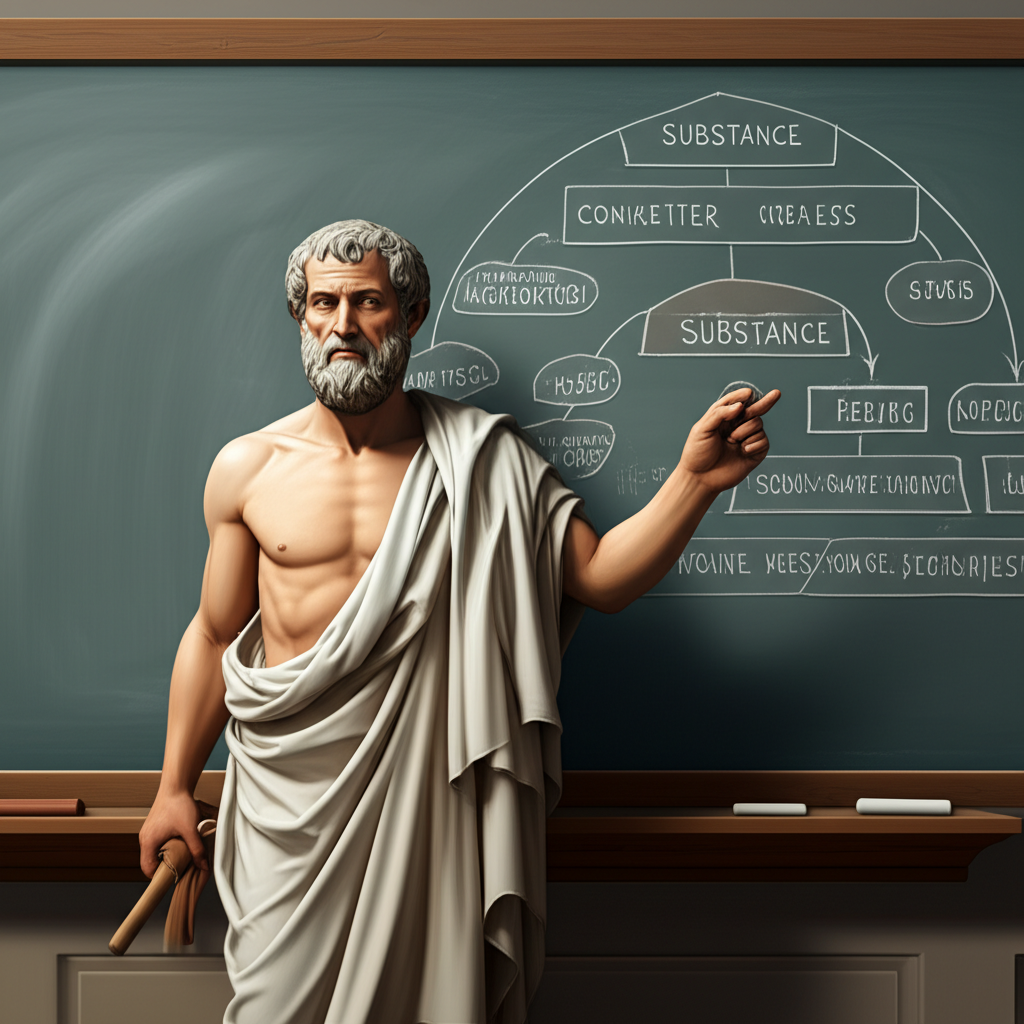 at the top, branching down to more specific universals (e.g., "Living Being," then "Animal," then "Human"), and finally terminating in individual names like "Socrates" and "Plato" at the base, visually representing the relationship between universals and particulars in logical definition.)
YouTube Video Suggestions:
-
📹 Related Video: ARISTOTLE ON: The Nicomachean Ethics
Video by: The School of Life
💡 Want different videos? Search YouTube for: ""Aristotle categories universals particulars definition""
-
📹 Related Video: PLATO ON: The Allegory of the Cave
Video by: The School of Life
💡 Want different videos? Search YouTube for: ""Plato Forms theory of universals explained""