

The Universal and Particular in Definition: Unpacking the Fabric of Meaning
The intricate dance between the Universal and Particular lies at the heart of how we formulate meaning, particularly through Definition. From the towering philosophical debates of antiquity, enshrined in the Great Books of the Western World, to our everyday attempts to grasp reality, understanding this relationship is crucial. It's about how we use Logic to craft precise descriptions, bridging the abstract Idea of a thing with its concrete manifestations. Without a firm grasp of these foundational concepts, our understanding of the world around us, and our ability to communicate it, remains inherently fuzzy.
The Enduring Quest for Definition
What exactly is a definition? It's more than just a string of words in a dictionary; it's our ambitious attempt to capture the very essence of a thing, to delineate its boundaries, and to articulate what makes it distinct. Why is this so important? Because clear Definition is the bedrock of understanding, rational thought, and effective communication.
Think back to the Socratic dialogues, a cornerstone of the Great Books. Socrates, with his relentless "What is X?" questions, wasn't just being annoying; he was probing for the Universal truth, seeking a Definition that transcended individual instances. He understood that without a shared, clear Idea of concepts like "justice" or "courage," all further discussion was built on shifting sand. This quest for precise Definition is not just an ancient pastime; it's a living, breathing necessity for navigating our complex world.
Unpacking the Universal and Particular
At the core of any Definition lies the interplay of the Universal and Particular. These aren't just abstract terms; they represent fundamental ways we categorize and understand existence.
The Universal: Shared Qualities and Concepts
A Universal refers to a quality, property, or relation that can be instantiated by multiple particular things. It's the general concept that allows us to group disparate items under a single heading. For example, "redness" is a universal; it applies to countless individual objects—a red apple, a red car, a red sunset. "Humanity" is another universal, encompassing every single human being.
Philosophically, the concept of universals has a rich history. Plato, in works like the Republic and Parmenides (found in the Great Books), proposed his theory of Forms or Ideas. For Plato, universals like "Beauty" or "Justice" existed independently of the particular instances we encounter in the world. The Idea of a perfect Circle, for instance, exists in a realm beyond our senses, while any circle we draw is merely an imperfect particular manifestation of that universal Form.
The Particular: Individual Instances
Conversely, a Particular is an individual, concrete instance of a universal. It's the specific, unique entity that possesses or embodies certain universal qualities. So, "this specific red apple" is a particular. "Chloe Fitzgerald" is a particular human being. "That act of justice" is a particular instance of the universal concept of justice.
Aristotle, while disagreeing with Plato on the separate existence of Forms, emphasized the importance of individual substances in his Categories and Metaphysics, also part of the Great Books. For Aristotle, universals exist in particulars, not separately from them. Understanding the particular is crucial, as it is through observing and analyzing particulars that we arrive at our Idea of universals.
Here's a quick overview:
| Concept | Description | Examples | Philosophical Link (Great Books) |
|---|---|---|---|
| Universal | A general quality, property, or concept shared by many particulars. | Humanity, Redness, Triangle, Justice | Plato's Forms (e.g., Republic) |
| Particular | An individual, concrete instance of a universal. | Socrates, This specific red car, My desk | Aristotle's Substances (Categories) |
Definition as a Bridge: Logic in Action
The act of Definition is, in essence, an attempt to build a bridge between the abstract Universal and the concrete Particular. It's how we articulate the specific Idea of something by situating it within a broader category and then distinguishing it from other members of that category. This is where Logic becomes our indispensable tool.
Aristotelian Logic and Definition
The classical approach to Definition, deeply rooted in Aristotelian Logic (as explored in his Prior Analytics and Categories), relies on the principles of genus and differentia.
- Genus: This is the broader, more general Universal category to which the thing being defined belongs. It answers the question, "What kind of thing is it?"
- Differentia: This is the specific quality or characteristic that distinguishes the thing being defined from all other members of its genus. It answers the question, "What makes it different from others of its kind?"
Consider the classic example: "Man is a rational animal."
- Here, "animal" is the genus—a universal category that includes many particulars.
- "Rational" is the differentia—the specific quality that distinguishes humans (particulars) from all other animals.
This logical structure allows for precise Definition. It ensures that our definitions are neither too broad (encompassing things outside the concept) nor too narrow (excluding relevant particulars). The rigorous application of Logic in this manner ensures that our Definitions are clear, non-circular, and appropriate in scope, preventing the kind of semantic drift that can derail meaningful discourse. Our initial Idea of a concept guides our search for its proper genus and differentia.
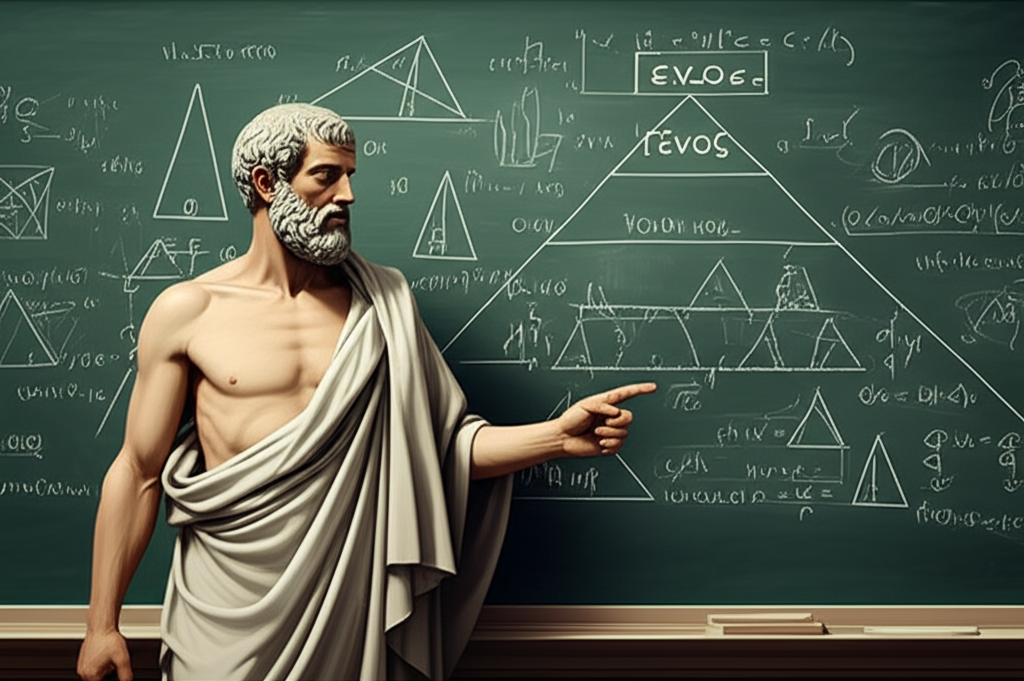 branching down to specific examples (particulars). The background features an ancient library with scrolls, suggesting the pursuit of knowledge and Logic from the Great Books of the Western World.)
The Elusive Nature of the Idea
Before we can formally Define something, we typically hold an Idea of it in our minds. This Idea is an internal representation, a cognitive construct formed through experience, abstraction, and reason. How do we come to form these Ideas? Through repeated encounters with particulars, we abstract common qualities, forming a Universal concept.
The challenge, however, is that different individuals or cultures might form slightly different Ideas of the same phenomenon, leading to variations in Definition. This touches upon the historical "Problem of Universals," a debate that spans centuries in philosophical thought: Do universals exist independently of our minds (realism), or are they merely names or concepts that exist only within our thoughts (nominalism or conceptualism)? While we don't need to resolve this profound debate here, acknowledging it highlights the subjective element that can color even the most objective pursuits of Definition. Our Idea of what something is profoundly shapes how we attempt to Define it.
The Practicality of Precision
Why does this intricate philosophical dance between the Universal and Particular matter beyond the ivory tower? Because the ability to formulate precise Definitions is fundamental to virtually every aspect of human endeavor.
- Clear Communication: Ambiguity in Definition leads to misunderstanding, conflict, and inefficiency. Whether in a casual conversation or a complex legal contract, clear definitions ensure that all parties are operating from the same Idea.
- Scientific Classification: Taxonomy in biology, element classification in chemistry, and diagnostic criteria in medicine all rely on meticulously crafted Definitions that distinguish universals and categorize particulars.
- Legal and Ethical Frameworks: The law, perhaps more than any other field, demands absolute precision in Definition. What constitutes "assault," "contract," or "consent" are matters of life and liberty, requiring careful demarcation of the Universal principles and their application to Particular cases.
- Everyday Understanding: When we say "chair," we have a shared Idea and Definition that, despite the infinite variety of Particular chairs, allows us to recognize and interact with them meaningfully.
The interplay of the Universal and Particular in Definition is not merely an academic exercise; it's the very scaffolding upon which our understanding of the world is built. Through the rigorous application of Logic, guided by our evolving Ideas, we strive to create Definitions that illuminate, rather than obscure. From the profound insights of the Great Books of the Western World to our daily conversations, mastering this philosophical dynamic empowers us to articulate meaning with greater clarity and depth, ultimately fostering a more coherent and comprehensible world.
Explore Further:
📹 Related Video: ARISTOTLE ON: The Nicomachean Ethics
Video by: The School of Life
💡 Want different videos? Search YouTube for: "'Aristotle's Logic Definition Genus Differentia'"
📹 Related Video: What is Philosophy?
Video by: The School of Life
💡 Want different videos? Search YouTube for: "'Problem of Universals Explained Philosophy'"