

The Universal and Particular in Definition: A Philosophical Balancing Act
Summary: At the heart of clear thinking and effective communication lies the act of definition. This article explores the fundamental philosophical distinction between the universal and the particular and how their interplay is absolutely crucial for crafting meaningful definitions. We'll delve into how logic bridges these two concepts, allowing us to categorize the world and articulate our ideas with precision, drawing insights from the profound traditions of the Great Books of the Western World.
The Art of Pinpointing Meaning: Why Definition Matters
Think for a moment about how often we use definitions, whether consciously or not. From explaining a complex scientific term to clarifying a personal value, defining is an essential cognitive act. Yet, it's far more than just looking up a word in a dictionary. Philosophically, definition is the process by which we attempt to capture the essence of a thing, to delineate its boundaries, and to understand its place within the vast tapestry of existence. This endeavor inevitably thrusts us into the fascinating relationship between the universal and the particular.
Unpacking the Core Dichotomy: Universal and Particular
To truly grasp the power of definition, we must first understand its foundational components.
What is a Universal?
A universal refers to a quality, property, relation, or idea that can be instantiated or exemplified by many particular things. It's what multiple individual things have in common. Universals are abstract concepts that allow us to categorize and generalize.
- Examples of Universals:
- Humanity: The shared essence that makes all individual humans "human."
- Redness: The quality common to all red objects (apples, roses, sunsets).
- Justice: The abstract principle that can be applied to various laws, actions, or systems.
- Triangularity: The geometric property shared by all triangles, regardless of size or orientation.
For thinkers like Plato, universals were not just mental constructs but had an independent, perfect existence as Forms or Ideas in a realm beyond our senses. Aristotle, while grounding universals more in the particulars themselves, still recognized their crucial role in our understanding and classification of the world.
What is a Particular?
Conversely, a particular is an individual, specific, and unique entity. It is a single instance of a universal, existing in a specific place and time. Particulars are the concrete objects and experiences we encounter in our daily lives.
- Examples of Particulars:
- Socrates: A specific human being, distinct from all others.
- This specific apple: A single, tangible fruit, unique in its exact characteristics.
- The act of kindness I witnessed yesterday: A singular event, never to be replicated exactly.
- That equilateral triangle drawn on the board: A single instance of triangularity.
Particulars are the "things" that possess or embody the universals. Without particulars, universals would be empty concepts; without universals, particulars would be an incomprehensible chaos of disconnected data.
Definition as a Bridge: Uniting the Two Through Logic
The profound insight, especially articulated by Aristotle, is that definition is the logical act of bringing a particular under a universal by specifying its unique qualities. We define something by placing it into a broader category (a universal) and then differentiating it from other members of that category. This is often referred to as "definition by genus and differentia."
- Genus: The broader, more universal class or category to which the thing belongs.
- Differentia: The specific quality or characteristic that distinguishes the thing from other members of its genus.
Let's illustrate with a classic example:
| Term to Define | Genus (Universal) | Differentia (Particularizing Quality) | Full Definition |
|---|---|---|---|
| Human | Animal | Rational | A human is a rational animal. |
| Chair | Piece of furniture | Designed for a single person to sit | A chair is a piece of furniture designed for a single person to sit. |
| Triangle | Polygon | Having exactly three sides | A triangle is a polygon having exactly three sides. |
This framework, deeply rooted in classical logic, demonstrates how definitions operate by moving from a general idea (the genus) to a more specific identification (the differentia) that singles out the particular kind of thing we are defining. It provides a rigorous method for understanding concepts, ensuring clarity and avoiding ambiguity.
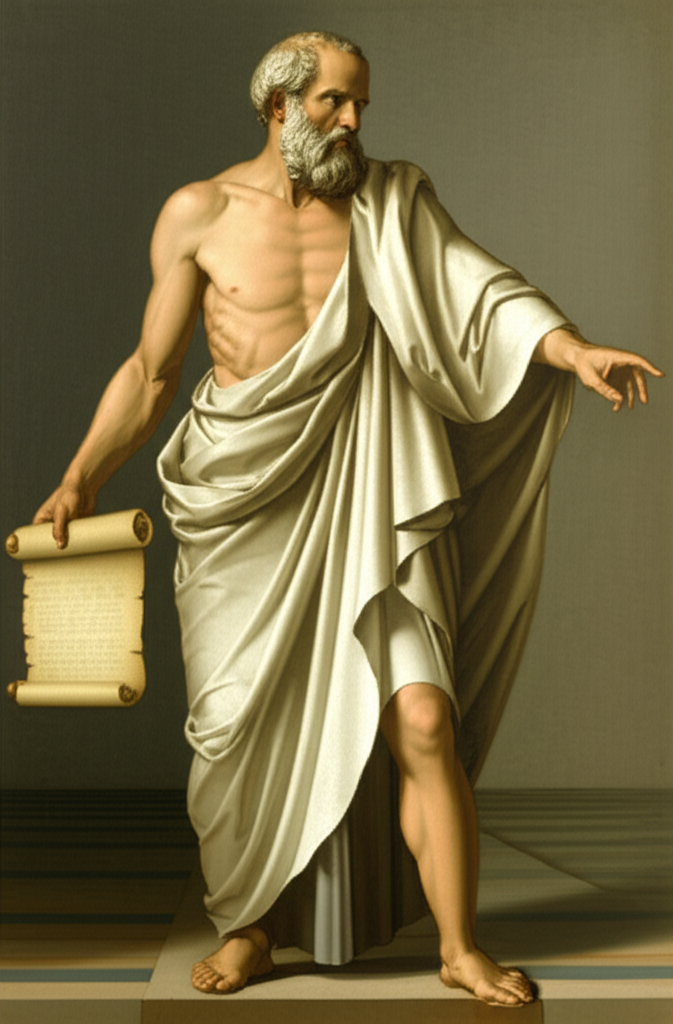 towards a group of diverse, individual objects (representing particulars). Rays of light or lines connect the abstract concept on the scroll to the shared attributes of the various objects, symbolizing the act of definition and categorization.)
The Philosophical Stakes: Why This Matters for Our Ideas
Understanding the interplay of universal and particular in definition is not merely an academic exercise; it underpins the entire edifice of philosophical inquiry and our pursuit of knowledge.
- Clarity of Thought: Precise definitions are the bedrock of coherent arguments. Without them, discussions devolve into semantic squabbles, and genuine understanding becomes elusive. When philosophers debate justice or freedom, they must first agree on what these universal ideas entail.
- Building Knowledge: Our ability to classify, generalize, and predict relies on defining universals. Science, for example, identifies universal laws from particular observations. Law relies on defining universal principles (e.g., "crime," "intent") to apply to particular cases.
- The Problem of Universals: This distinction also gives rise to one of philosophy's most enduring debates: the "Problem of Universals." Do universals exist independently of our minds (Platonic realism), only in our minds as concepts (conceptualism, like Locke's ideas), or merely as names we apply to similar particulars (nominalism)? How we answer this question profoundly influences our metaphysics and epistemology.
Challenges and Nuances in Definition
While the genus-differentia model is powerful, defining is rarely simple.
- Vagueness and Ambiguity: Some concepts resist precise definition (e.g., "art," "love"), leading to ongoing philosophical debate. Their boundaries are fuzzy, and their universal qualities are harder to pin down.
- Essence vs. Accident: What truly defines something? Is "having two legs" essential to being human, or merely accidental? The search for essential definitions is a quest for fundamental truths, often distinguishing between necessary and contingent properties.
- Evolving Definitions: Our understanding of the world changes, and so do our definitions. Consider how the definition of "planet" evolved with new astronomical discoveries, challenging our existing ideas and categories.
Practical Implications: Beyond the Ivory Tower
The ability to navigate the universal and the particular in definition extends far beyond academic philosophy.
- Legal Systems: Lawyers constantly define terms ("contract," "negligence," "person") to apply universal legal principles to particular cases.
- Scientific Inquiry: Scientists define species, elements, and forces to create universal models that explain particular phenomena.
- Ethical Debates: Discussions about "right" and "wrong," "good" and "evil," hinge on our definitions of these universal ideas and how they apply to specific actions.
- Everyday Communication: Misunderstandings often arise because individuals have different implicit definitions of the same terms. Clarifying these definitions is key to effective dialogue.
Conclusion: The Ongoing Quest for Clarity
The interplay between the universal and the particular is not merely a linguistic quirk; it is a fundamental aspect of how we structure our thoughts, communicate our ideas, and make sense of the world. Through the rigorous logic of definition, we strive to bridge the gap between the abstract and the concrete, giving form to our understanding and enabling us to share it. As we continue to grapple with complex concepts, both ancient and modern, a keen awareness of this philosophical balancing act remains our most potent tool for achieving intellectual clarity.
**## 📹 Related Video: ARISTOTLE ON: The Nicomachean Ethics
Video by: The School of Life
💡 Want different videos? Search YouTube for: ""Aristotle on Definition Genus Differentia" or "Problem of Universals Explained Philosophy""**