

Unraveling the Essence: The Universal and Particular in Definition
Summary: At the heart of how we comprehend and categorize the world lies the fundamental distinction between the universal and particular. This foundational concept, deeply explored by ancient philosophers and central to logic, dictates how we form definitions and understand the very nature of reality. From the abstract idea of "humanity" to the concrete individual, this article explores how these two poles of thought interact to shape our knowledge, drawing insights from the timeless texts of the Great Books of the Western World.
The Indispensable Duo: Universal and Particular
Every time we define something, classify an object, or even simply understand a concept, we are implicitly engaging with the interplay of the universal and the particular. These aren't just academic terms; they are the very scaffolding of our intellectual framework, dictating how we move from individual instances to overarching concepts, and back again. Without a grasp of this dynamic, our understanding of knowledge itself would remain incomplete.
The Universal: Grasping the General Essence
The universal refers to the general qualities, characteristics, or forms that can be instantiated by many individual things. It's the shared essence, the common idea that allows us to group distinct particulars under a single concept. Think of "redness," "humanity," or "triangularity." These aren't specific red objects, individual humans, or particular triangles, but rather the abstract qualities or kinds that all red things, humans, or triangles possess.
In philosophy, especially as seen in Plato's Dialogues, the universal often takes on a profound significance, sometimes even an independent existence. For Plato, the true reality lay in the unchanging, perfect Forms (Universals) that exist in a separate realm, of which the objects we perceive in the sensory world are mere imperfect copies. The idea of Justice, for instance, is a universal, a perfect blueprint that no single just act or person can perfectly embody.
- Key Characteristics of Universals:
- Shared qualities or properties
- Abstract concepts or ideas
- Applicable to multiple instances
- Often explored in terms of species and genera in logic
The Particular: Embracing Individuality
In stark contrast to the universal stands the particular. A particular is an individual, specific instance of something. It's this red apple, that human being named Socrates, or this specific equilateral triangle drawn on a page. Particulars are concrete, unique, and exist in a specific time and place. They are the subjects of our sensory experience, the tangible realities we encounter daily.
While universals provide the framework for understanding categories, particulars provide the substance. A universal like "tree" only becomes manifest in the countless particular trees that populate our planet. Without particulars, universals would remain abstract and unmanifested; without universals, particulars would be an incomprehensible jumble of unique, unrelated phenomena.
- Key Characteristics of Particulars:
- Individual entities or instances
- Concrete and specific
- Exist in space and time
- Embody or instantiate universals
The Dance of Definition: How They Intersect
The true power of this distinction emerges when we consider definition. A well-formed definition, particularly in Aristotelian logic, often operates by identifying a particular's genus (its broader universal category) and its differentia (the specific qualities that distinguish it from other members of that genus).
Consider the classic example: "Man is a rational animal."
- "Animal" is the universal genus – the broader category to which man belongs.
- "Rational" is the differentia – the specific quality that distinguishes man from other animals.
Here, the definition bridges the gap between the universal (animal) and the particular (individual man) by specifying a unique universal property (rationality) that applies to all instances of "man." This method allows us to precisely locate a particular within the vast network of universals.
Table: Universal vs. Particular in Definition
| Aspect | Universal | Particular | Role in Definition |
|---|---|---|---|
| Nature | General, abstract, shared essence | Specific, concrete, individual instance | Universal provides the genus (broader category). |
| Existence | Often debated (Plato's Forms, concepts) | Tangible, spatio-temporal | Particulars are what we are defining or classifying. |
| Example | "Chair," "Justice," "Greenness" | This office chair, that specific just act, the green of the grass | "A chair is a piece of furniture (universal genus) designed for sitting (differentia)." |
| Question | What kind of thing is it? What common idea? | Which specific thing is it? | Helps establish the what and how of categorization. |
Historical Perspectives from the Great Books
The tension and relationship between the universal and particular have been a cornerstone of philosophical inquiry since antiquity, profoundly influencing how we approach definition and reality itself.
Plato: The Realm of Forms
In works like Phaedo and Republic, Plato posits a world of perfect, eternal, and unchanging Forms (Universals) that exist independently of our sensory world. For Plato, the idea of "Beauty" itself is more real than any beautiful object we perceive. Particular beautiful objects merely participate in or imitate the Form of Beauty. Understanding, therefore, is a process of recollecting these universals, moving beyond the imperfect particulars.
Aristotle: Universals in Particulars
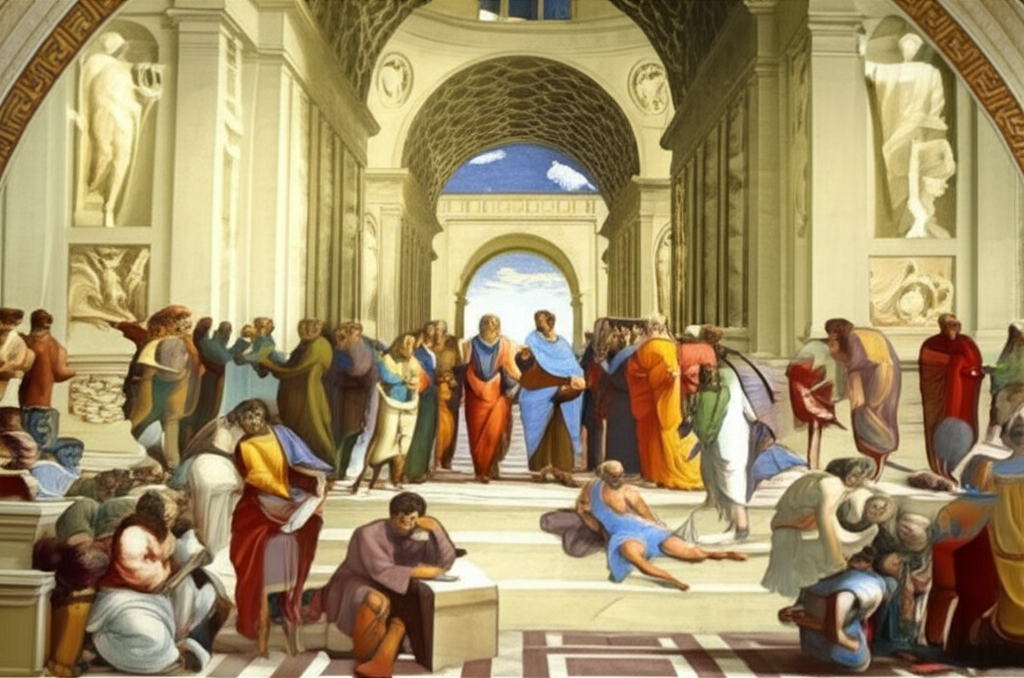
Aristotle, Plato's student, offered a different perspective in texts like Categories and Metaphysics. While acknowledging universals, he argued they do not exist in a separate realm. Instead, universals exist in the particulars. The "humanity" of Socrates is not separate from Socrates; it is inherent in him and other humans. For Aristotle, knowledge begins with observing particulars and then abstracting the universals from them through empirical investigation and logic. His focus on species and genera, and the development of syllogistic reasoning, cemented the universal-particular distinction as central to definition.
The Medieval Debates: Realism vs. Nominalism
This ancient debate continued through the medieval period, becoming known as the "Problem of Universals." Realists, inspired by Plato, argued that universals were truly existent entities (e.g., "humanity" exists independently of individual humans). Nominalists, on the other hand, contended that universals were merely names or mental concepts, with only particulars truly existing. This intense philosophical struggle, found in the writings of figures like Aquinas (a moderate realist) and Ockham (a nominalist), profoundly shaped theological and scientific thought, demonstrating the enduring significance of how we define and understand these fundamental categories.
The Enduring Significance
The distinction between the universal and particular is not just an academic exercise; it underpins how we structure knowledge, communicate effectively, and even design technology. In fields ranging from artificial intelligence (how do machines recognize categories?) to law (how do specific cases relate to universal principles?), this philosophical cornerstone remains profoundly relevant. Understanding this dynamic is crucial for anyone seeking to develop clear thought, precise definition, and a coherent understanding of the world's complexities.
Challenges and Nuances
Despite its utility, the relationship between the universal and particular is not without its difficulties. The "Problem of Universals" persists: Do universals exist independently, or are they merely constructs of the human mind? How do we define universals themselves, and how do we ensure our definitions accurately capture the essence of both the general idea and the specific instance? These are questions that continue to fuel philosophical inquiry, reminding us that even the most fundamental concepts hold layers of profound complexity.
Conclusion: The Foundation of Understanding
From the ancient Greeks to contemporary thought, the interplay of the universal and particular has served as a foundational challenge and tool in philosophy. It is through grasping this dynamic that we learn to move fluidly between the abstract and the concrete, to form robust definitions, and to apply logic to the seemingly chaotic world of experience. By recognizing the shared idea that binds diverse particulars, and the unique identity that distinguishes each one, we refine our understanding, sharpen our intellect, and build a more coherent picture of reality.
YouTube Video Suggestions:
-
📹 Related Video: What is Philosophy?
Video by: The School of Life
💡 Want different videos? Search YouTube for: "The Problem of Universals Explained - Philosophy"
2. ## 📹 Related Video: PLATO ON: The Allegory of the Cave
Video by: The School of Life
💡 Want different videos? Search YouTube for: "Plato's Theory of Forms vs. Aristotle's Metaphysics"