

The Shifting Sands of Being: Evolution and the Elusive Nature of Progress
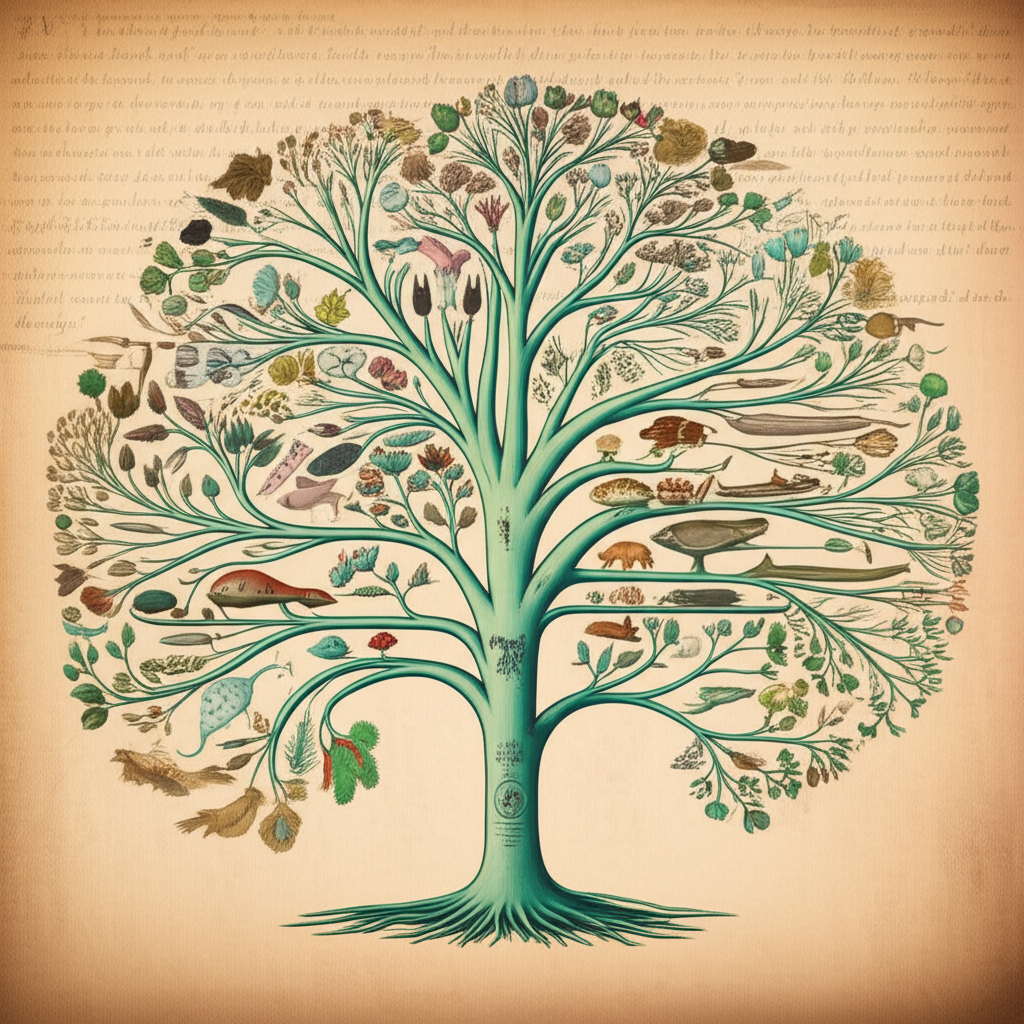
The theory of evolution, a cornerstone of modern science, fundamentally reshaped our understanding of life on Earth, detailing how species change over vast stretches of time. Yet, its relationship to the philosophical concept of progress is complex and often misunderstood. While many instinctively link evolution to an upward march towards improvement, the scientific theory primarily describes a process of adaptation and diversification driven by natural selection, without an inherent teleological aim or a predefined trajectory towards a "better" state. This article explores the nuanced interplay between evolutionary change and the human aspiration for progress, urging us to critically examine where science describes what is, and philosophy grapples with what ought to be.
Evolution: A Scientific Lens on Change
At its heart, the theory of evolution, most famously articulated by Charles Darwin, is a profound explanation for the diversity of life through a process of descent with modification. It posits that all life shares a common ancestor and has diversified over millions of years through mechanisms like natural selection, mutation, and genetic drift.
The Darwinian Revolution
Darwin's observations, meticulously documented in On the Origin of Species, demonstrated that species are not immutable but undergo continuous change. This was a radical departure from earlier, more static views of creation. Evolution describes how organisms adapt to their environments, and those adaptations, if advantageous, are passed on, leading to the gradual transformation of populations and the emergence of new species.
Mechanism Over Teleology
Crucially, Darwinian evolution is a blind, undirected process. Natural selection favors traits that enhance survival and reproduction in a given environment at a given time. It does not operate with foresight or a goal in mind. A species might thrive in one era only to decline in another as environmental conditions change. This mechanistic view of change stands in stark contrast to many pre-Darwinian philosophical systems, which often posited an inherent purpose or telos in nature, guiding development towards a specific end.
The Human Impulse for Progress
Despite the scientific description of evolution as undirected change, the human mind often seeks patterns, meaning, and direction, particularly the idea of progress. This desire is deeply rooted in our intellectual history.
Echoes of Enlightenment Ideals
The Enlightenment, a pivotal era highlighted in the Great Books of the Western World, saw the flourishing of the idea of human progress. Thinkers like Condorcet envisioned humanity's continuous perfectibility through reason and science, believing that society was on an inexorable march towards a better future. This philosophical optimism about human destiny often bleeds into interpretations of biological evolution, leading to the misconception that evolution itself is synonymous with progress, with humans at its apex.
Defining 'Better': A Philosophical Quagmire
The very notion of "better" is fraught with philosophical difficulties. What constitutes progress? Is it increased complexity, greater intelligence, enhanced adaptability, or a higher moral standing?
| Perspective | Definition of "Progress" | Implication for Evolution |
|---|---|---|
| Biological | Enhanced fitness/adaptation to environment | Highly context-dependent; no universal "better" |
| Technological | Increased capability, efficiency, innovation | Human-centric; not a biological imperative |
| Moral/Ethical | Greater justice, compassion, reduced suffering | Aspirational; outside the scope of scientific evolution |
| Complexity | Increased intricacy of organisms/systems | Not a consistent trend; simpler forms can be highly successful |
If an organism becomes more "complex" but less adapted to a changing environment, is that progress? The scientific answer is often no, while a human perspective might still value complexity. This divergence highlights the tension between objective scientific observation and subjective human values.
Where Science Meets Philosophy: Distinguishing "Is" from "Ought"
The most significant philosophical challenge posed by evolution to the concept of progress lies in distinguishing descriptive science from normative ethics.
The Trap of Teleological Thinking
As explored by many philosophers within the Great Books, from Aristotle's concept of telos to later theological arguments, there has been a persistent human tendency to ascribe purpose to natural phenomena. While this provides comfort and meaning, applying it uncritically to evolution can lead to false conclusions, such as "Social Darwinism," which wrongly interpreted natural selection as a justification for social hierarchies or aggressive competition, conflating biological survival with moral superiority. Evolution describes how life changes, not why it should change in a particular moral or social direction.
Evolution's Challenge to Human Exceptionalism
The theory of evolution places humanity firmly within the natural world, a product of the same blind forces that shaped all other species. This can be unsettling for those who view humans as fundamentally separate or uniquely destined for progress. It forces us to reconsider whether our advancements in culture, science, and ethics are truly a continuation of biological evolution, or a distinct, uniquely human endeavor that operates on different principles. The change we see in human societies—technological leaps, moral development—is cultural evolution, a different beast entirely from biological evolution.
Ancient Wisdom, Modern Revelations: A Dialogue Across Eras
Examining the Great Books of the Western World alongside Darwinian thought reveals a fascinating intellectual journey concerning change and purpose.
From Aristotle's Ends to Darwin's Means
Aristotle, a towering figure in the Great Books, posited that all natural things have an inherent telos, an end or purpose towards which they strive. An acorn's telos is to become an oak tree. This teleological view permeated Western thought for centuries. Darwin's science, however, offered a powerful alternative: organisms do not evolve towards a goal, but from ancestral forms, adapting to current conditions. The "means" of natural selection replace the "ends" of inherent purpose in explaining biological change. This shift fundamentally alters philosophical discussions about destiny, design, and the meaning of life.
The Ever-Changing Tapestry of Existence
From Heraclitus's assertion that "everything flows" to the cyclical views of history found in various ancient texts, the concept of change has always fascinated philosophers. Evolution provides a powerful scientific framework for understanding this pervasive reality, demonstrating that change is not merely an external force but an intrinsic aspect of life itself. The challenge, then, is not to deny change, but to understand its nature and to thoughtfully distinguish between the undirected change of biological evolution and our human aspirations for directed progress.
Conclusion: Navigating the Currents of Change
The theory of evolution offers an unparalleled insight into the history and mechanisms of life's change. It is a testament to the power of science to unravel the deepest mysteries of our existence. However, when we seek to understand progress, we step beyond the realm of pure biology into the complex terrain of philosophy, ethics, and human values. Evolution describes a continuous, often meandering, process of adaptation; it does not guarantee a march towards a "better" future.
To truly grapple with "The Theory of Evolution and Progress" means to appreciate the scientific rigor of Darwin's insights while critically examining our own deeply ingrained desire for meaning and direction. It compels us to ask: If evolution is simply change, what then is the source and justification of our belief in progress? The answer lies not in science alone, but in the ongoing, vital dialogue between scientific discovery and philosophical inquiry that has animated human thought for millennia.
📹 Related Video: What is Philosophy?
Video by: The School of Life
💡 Want different videos? Search YouTube for: ""Philosophy of evolution progress debate" "Is evolution progressive?""