

The Theory of Evolution and Progress: A Philosophical Interrogation
The theory of evolution, a monumental achievement of modern science, fundamentally reshaped our understanding of life's change over eons. Yet, its relationship with the deeply human concept of progress remains a vibrant and often contentious philosophical debate. While evolution meticulously describes the mechanisms of biological change through natural selection, it does not inherently dictate a direction towards betterment or a teleological end. This article explores the nuanced interplay between these two powerful ideas, examining how science informs and challenges our philosophical quest for progress.
Unpacking the Concepts: Evolution vs. Progress
To truly grasp the philosophical implications, we must first delineate the terms themselves.
Evolution: A Scientific Framework for Change
At its core, the theory of evolution, famously articulated by Charles Darwin in On the Origin of Species (a cornerstone text within the Great Books of the Western World tradition), is a scientific explanation for the diversity and adaptation of life. It posits that species undergo change over successive generations through a process primarily driven by natural selection.
- Key Principles of Evolution:
- Variation: Individuals within a species exhibit natural differences.
- Inheritance: These variations can be passed down to offspring.
- Selection: Individuals with traits better suited to their environment are more likely to survive and reproduce.
- Time: Over vast periods, these incremental changes accumulate, leading to new species.
It is crucial to note that evolution describes change and adaptation, but does not inherently imply an upward trajectory or a predetermined goal. A trait that is "fit" in one environment might be detrimental in another.
Progress: A Human-Centric Ideal of Improvement
Progress, on the other hand, is a philosophical and cultural concept. It typically refers to a directional movement towards a better state, an improvement, or an advancement in quality, knowledge, or societal well-being.
- Dimensions of Progress:
- Moral Progress: Societies becoming more just, ethical, or compassionate.
- Technological Progress: Advancements in tools, medicine, and infrastructure.
- Intellectual Progress: The accumulation and refinement of knowledge.
- Social Progress: Greater equality, freedom, and human rights.
Historically, philosophers from the Enlightenment onward, such as Condorcet or Hegel (also featured in the Great Books), often embraced a belief in inevitable human progress, driven by reason and historical development.
The Intersecting Paths: Science, Change, and the Illusion of Direction
The advent of Darwinian evolution introduced a profound new lens through which to view change. Before Darwin, many philosophical systems, influenced by classical Greek thought like Aristotle's teleology, saw purpose and direction inherent in nature. The universe, and life within it, seemed to move towards an ideal form or end.
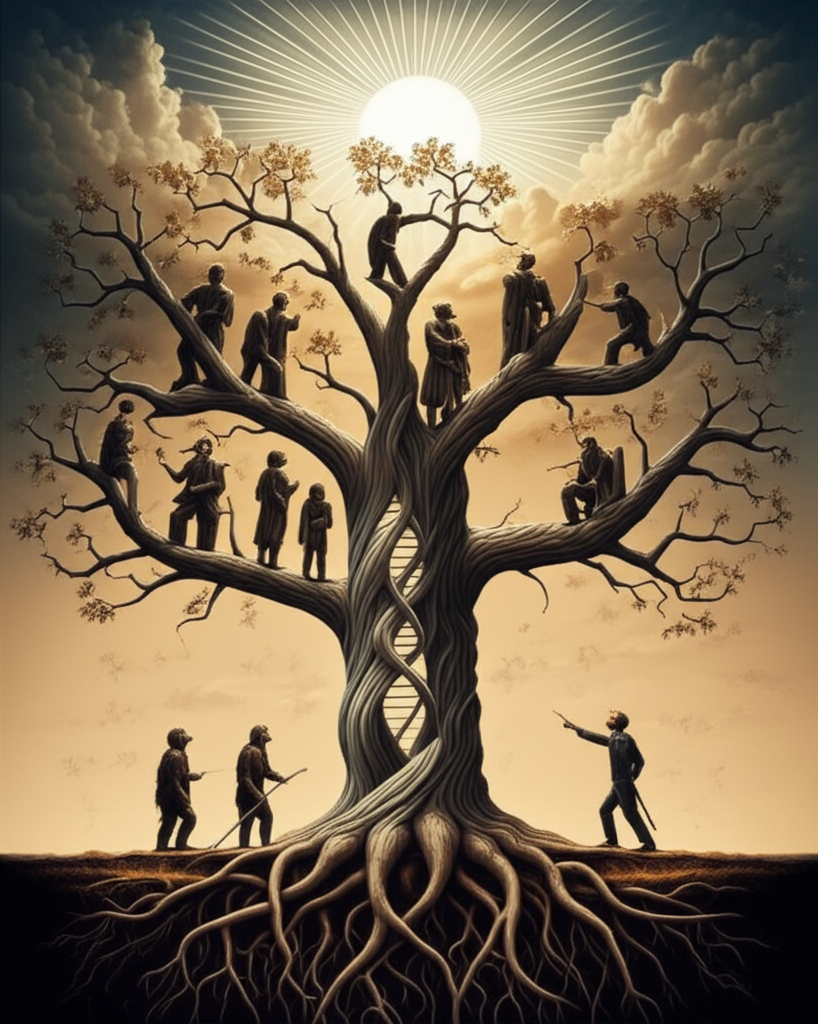
Darwin's theory, while not denying adaptation, presented change as a blind, unguided process. Organisms adapt to their immediate environment; there is no inherent drive towards a "perfect" species, nor is humanity necessarily the pinnacle of an evolutionary ladder. This scientific understanding of change throws a powerful challenge at the uncritical acceptance of progress as an inherent law of nature or history.
The Problem of Teleology
One of the most significant philosophical shifts brought about by evolution was the dismantling of overt biological teleology. If species change randomly and are then selected, rather than changing towards a predetermined goal, then the idea of nature having an inherent "purpose" becomes problematic. This doesn't mean we can't define human progress on our own terms, but it means we can't derive that progress directly from the scientific mechanisms of evolution.
The Allure and Peril of Equating Evolution with Progress
Despite the scientific distinction, the temptation to conflate evolution with progress is strong. The phrase "survival of the fittest" has often been misapplied to social and ethical spheres, leading to problematic ideologies.
- Misinterpretations and Abuses:
- Social Darwinism: This misguided philosophy applied natural selection to human society, arguing that competition and inequality were "natural" and led to societal progress. It often justified economic exploitation and racial hierarchies.
- Eugenics: The attempt to "improve" the human race through selective breeding, based on a flawed understanding of genetics and a dangerous notion of what constitutes "fitness" or "progress."
These historical missteps underscore the importance of philosophical rigor when interpreting scientific theories. Evolution describes a process of change; it does not provide moral prescriptions or dictate what constitutes "good" or "progressive" for humanity.
Reconciling Science and Philosophy: A Call for Deliberate Progress
The theory of evolution compels us to re-evaluate our understanding of progress. Instead of viewing progress as an automatic outcome of change or a pre-ordained destiny, science suggests that progress, particularly in the human sphere, must be a deliberate, ethical, and culturally constructed endeavor.
We, as philosophical beings, are uniquely capable of defining what progress means for us – whether it is greater justice, sustainability, knowledge, or compassion. This definition is not given to us by the blind forces of natural selection, but forged through reflection, debate, and collective action, drawing on the vast intellectual heritage found in the Great Books of the Western World and beyond.
| Aspect | Evolution (Scientific) | Progress (Philosophical) |
|---|---|---|
| Nature | Descriptive process of biological change | Normative ideal of improvement |
| Direction | Undirected, contingent on environment | Directed towards a perceived better state |
| Basis | Natural selection, genetic variation | Human values, ethics, societal goals |
| Goal | Adaptation, survival | Advancement, betterment, flourishing |
In conclusion, the theory of evolution is a profound testament to the power of science to explain the grand tapestry of life's change. However, it is not a blueprint for human progress. Instead, it serves as a powerful reminder that while change is constant, progress is a choice – a continuous, conscious effort to shape our world and ourselves according to our deepest ethical and intellectual aspirations.
**## 📹 Related Video: What is Philosophy?
Video by: The School of Life
💡 Want different videos? Search YouTube for: ""Philosophy of Progress Evolution" or "Is Evolution Progressive Philosophy""**
**## 📹 Related Video: ARISTOTLE ON: The Nicomachean Ethics
Video by: The School of Life
💡 Want different videos? Search YouTube for: ""Darwinian Evolution Philosophical Implications""**