

The Ever-Unfolding Tapestry: Evolution, Progress, and the Human Story
The concepts of Evolution and Progress are often conflated, yet they represent distinct, albeit intertwined, ways of understanding Change. While biological Evolution, as articulated by Darwin, describes a scientific process of adaptation and diversification without inherent directionality towards betterment, Progress is a deeply human, often teleological, aspiration for improvement—moral, social, technological, or intellectual. This article explores the profound philosophical implications of both concepts, tracing their historical development and examining how their interplay shapes our understanding of Science, human agency, and the very nature of our unfolding story, drawing insights from the rich tradition of the Great Books of the Western World.
I. Evolution: A Revolution in Understanding Change
The publication of Charles Darwin’s On the Origin of Species in 1859 fundamentally reshaped our understanding of life. It introduced a powerful scientific mechanism—natural selection—to explain the diversity and adaptation of species.
The Darwinian Shift: From Fixed Forms to Dynamic Flux
Before Darwin, the prevailing view, often rooted in interpretations of classical and religious texts, held that species were largely fixed and immutable, perhaps individually created. Aristotle, in his Historia Animalium, meticulously categorized life, but within a framework that suggested an inherent telos or purpose for each organism, a concept often misinterpreted as a ladder of perfection.
Darwin's theory, however, presented a radical alternative:
- Variation: Individuals within a species exhibit natural variations.
- Heritability: Many of these variations are inheritable.
- Selection: In any given environment, individuals with advantageous variations are more likely to survive and reproduce, passing those traits to the next generation.
- Adaptation: Over vast stretches of time, this process leads to the gradual accumulation of advantageous traits, resulting in new species and the diversification of life.
Crucially, Darwinian Evolution is not inherently progressive in a moral or teleological sense. It does not posit a march towards a "higher" or "better" form of life, but rather a branching, opportunistic process of adaptation to ever-changing environments. A bacterium is just as "evolved" as a human, simply adapted to a different niche. This scientific understanding of Change challenged anthropocentric views and forced a re-evaluation of humanity's place in the natural world.
II. Progress: A Human Aspiration, Not a Biological Guarantee
While Evolution describes natural processes, Progress is a concept deeply embedded in human thought, particularly gaining prominence during the Enlightenment. It speaks to a belief in the possibility, and often the inevitability, of human betterment.
Defining Progress: A Multifaceted Ideal
The idea of Progress is not monolithic; it encompasses various dimensions:
| Dimension of Progress | Description | Key Thinkers / Great Books Connection |
|---|---|---|
| Technological | Advancements in tools, machines, and scientific knowledge that improve material conditions and capabilities. | Francis Bacon (Novum Organum) emphasized empirical Science for human dominion over nature. |
| Moral/Ethical | The development of more just, compassionate, and equitable societies; the refinement of ethical principles and human rights. | Immanuel Kant (Critique of Pure Reason, Perpetual Peace) envisioned moral autonomy and universal peace. |
| Social/Political | The evolution of governance, legal systems, and social structures towards greater freedom, equality, and stability. | Jean-Jacques Rousseau (The Social Contract) on collective will; John Locke (Two Treatises of Government) on natural rights. |
| Intellectual | The accumulation of knowledge, the development of critical thinking, and the expansion of human understanding across various disciplines. | The entire Enlightenment project, valuing reason and empirical inquiry. Plato's pursuit of ideal forms in The Republic can be seen as a form of intellectual aspiration. |
The Enlightenment's Optimism and Its Critics
The 18th century, profoundly influenced by the rise of Science and reason, saw the idea of Progress flourish. Thinkers like Condorcet, in his Sketch for a Historical Picture of the Progress of the Human Mind, articulated a fervent belief in humanity's capacity for indefinite improvement through reason and education. This optimism was fueled by scientific discoveries and technological innovations, leading to the conviction that humanity was on an upward trajectory, moving away from ignorance and superstition towards an enlightened future.
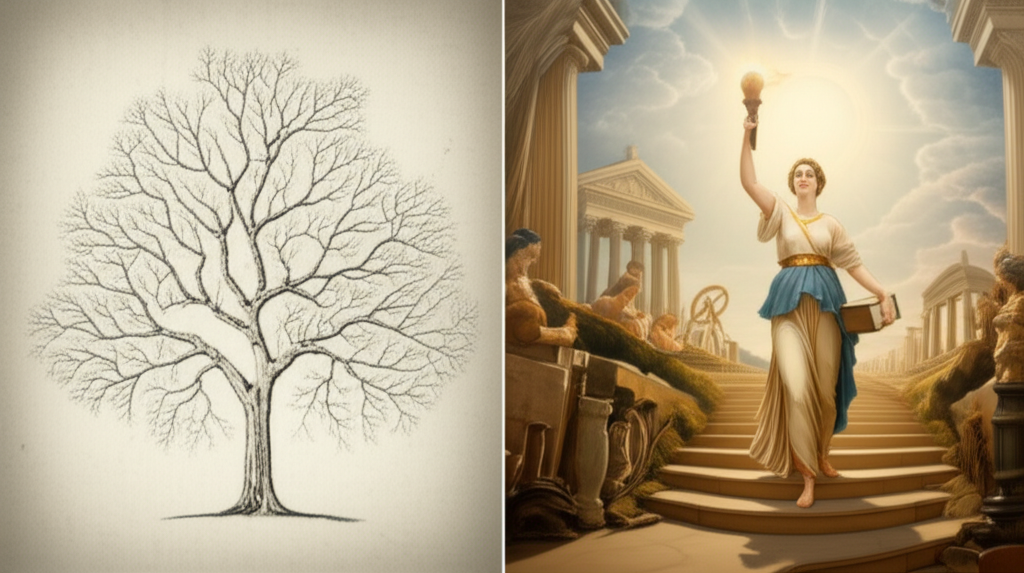
However, this linear view of Progress has faced significant critiques throughout history. The cyclical theories of history, present even in ancient Greek thought (e.g., Polybius), suggested that civilizations rise and fall. Later, figures like Nietzsche questioned the moral foundations of Progress, arguing that it could lead to a weakening of human spirit. The horrors of the 20th century—world wars, genocides, and environmental degradation—further challenged the notion of an inevitable, benevolent march forward, forcing a more nuanced, and often pessimistic, re-evaluation of human Progress.
III. The Interplay: Where Evolution and Progress Converge (and Diverge)
The arrival of Darwinian Evolution often led to a misunderstanding: that biological Evolution itself is Progress, or that it guarantees it. This conflation has profound philosophical implications.
The Misconception of "Evolutionary Progress"
It is a common error to view Evolution as a ladder, with humans at the top, representing the pinnacle of biological Progress. This "scala naturae" (ladder of nature) idea predates Darwin but was often retroactively applied to his theory. However, modern evolutionary Science explicitly refutes this. Evolution is a bush, not a ladder. There is no inherent "higher" or "lower" species; only those more or less adapted to their specific environment.
Grace Ellis's observation: We, as humans, with our innate drive for self-improvement and our capacity for abstract thought, often project our own desires for betterment onto the natural world. This anthropocentric bias can lead us to misinterpret natural Change as purposeful Progress, even when the scientific evidence suggests otherwise. The natural world simply changes; it does not inherently strive for our human ideals of perfection.
Human Agency and Cultural Evolution
While our biological Evolution has shaped our capacities—our large brains, bipedalism, complex social structures—it is our unique ability for cultural Change that drives what we call Progress. Unlike biological Evolution, which operates through genetic inheritance over millennia, cultural Evolution occurs through learning, communication, and innovation, unfolding at a vastly accelerated pace.
- Tools and Technology: From the first flint tools to artificial intelligence, technological Change allows us to reshape our environment and extend our capabilities.
- Ideas and Institutions: The development of philosophical systems, ethical frameworks, legal codes, and political structures reflects a continuous, albeit often challenging, effort to build better societies.
- Knowledge Accumulation: Each generation builds upon the knowledge of its predecessors, leading to an exponential growth in understanding, a concept central to the Enlightenment's faith in Progress.
This distinction highlights humanity's unique position: we are products of biological Evolution, but we are also agents of cultural Change, capable of consciously striving for Progress based on our values and aspirations. This is where the philosophical debate truly ignites: are we merely subject to the forces of Change, or can we direct them towards a chosen future?
IV. Navigating the Future: Ethical Considerations of Change
Understanding the nuanced relationship between Evolution and Progress is crucial for navigating the ethical challenges of our time.
The Responsibility of Science
Science, the engine of much perceived Progress, also presents us with profound ethical dilemmas. Our understanding of biological Evolution has opened doors to genetic engineering, CRISPR technology, and artificial intelligence, offering the potential to actively shape human Change in unprecedented ways.
Key Questions for Ethical Deliberation:
- If we can alter our own Evolution, what are the moral boundaries?
- Whose definition of "better" or "progress" will guide these interventions?
- Do we risk creating new forms of inequality or unintended consequences by directing our own biological Change?
The Great Books provide a rich tapestry for these discussions. Plato's Republic grapples with the idea of shaping human nature for an ideal state, while Aristotle's Nicomachean Ethics explores the pursuit of human flourishing (eudaimonia) within natural limits. These ancient inquiries into human nature and the good life remain profoundly relevant as Science grants us ever greater power to influence our own future.
The Ongoing Debate: Whose Progress?
The concept of Progress remains deeply contested. What one group considers Progress, another might view as degradation or loss. The Industrial Revolution, for instance, brought immense technological Progress but also unprecedented social inequality and environmental destruction.
Ultimately, the journey of understanding Change—both the blind forces of Evolution and the conscious striving for Progress—is perpetual. It demands continuous philosophical inquiry, ethical reflection, and a critical engagement with the lessons of history. Our capacity for Science allows us to understand the mechanisms of Change, but our capacity for philosophy compels us to ask: Change towards what end? And for whose benefit?
Conclusion
The theory of Evolution provides a scientific framework for understanding the biological Change that has shaped life on Earth, operating without inherent directionality towards human ideals of betterment. Progress, by contrast, is a human construct—a philosophical aspiration for improvement across moral, social, technological, and intellectual domains, deeply rooted in our capacity for conscious agency and cultural Change.
The tension and interplay between these two powerful ideas invite us to reflect critically on our place in the cosmos. We are products of Evolution, yet we are also the architects of our own Progress—a challenging, often contradictory, but undeniably hopeful endeavor. As we continue to unravel the mysteries of Science and grapple with the complexities of human Change, the philosophical questions surrounding Evolution and Progress will undoubtedly remain at the heart of our collective human story.
**## 📹 Related Video: What is Philosophy?
Video by: The School of Life
💡 Want different videos? Search YouTube for: "Philosophy of Evolution vs. Progress"**
**## 📹 Related Video: KANT ON: What is Enlightenment?
Video by: The School of Life
💡 Want different videos? Search YouTube for: "Enlightenment Era Views on Human Progress"**