

The Evolving Debate: Unpacking Evolution and the Idea of Progress
The theory of Evolution stands as one of humanity's most profound scientific achievements, fundamentally reshaping our understanding of life's Change over vast stretches of time. Yet, when we couple it with the concept of "Progress," we venture beyond the empirical realm of Science and into the rich, often contentious, landscape of philosophy. This article explores the intricate relationship between biological Evolution – a mechanism of Change – and the human-centric notion of Progress, questioning whether one inherently implies the other.
At its core, Evolution describes the process by which populations of organisms Change over successive generations. Driven by mechanisms like natural selection, genetic drift, and mutation, it explains the incredible diversity and adaptation of life on Earth. However, the idea of Progress introduces a value judgment: a movement towards a "better," more advanced, or more desirable state. The tension lies in whether Evolution, as a blind, mechanistic process, can truly be said to have a direction or goal that aligns with our philosophical definitions of Progress.
Defining Our Terms: Evolution vs. Progress
Before diving into the philosophical implications, it's crucial to distinguish between these two powerful concepts.
Evolution: The Science of Biological Change
Evolution is a scientific theory, meticulously supported by evidence from genetics, paleontology, comparative anatomy, and biogeography. It posits:
- Descent with Modification: All life shares a common ancestor and has diversified over millions of years.
- Natural Selection: Individuals with traits best suited to their environment are more likely to survive and reproduce, passing those advantageous traits to offspring. This leads to adaptation.
- Random Variation: Genetic mutations, which are random, provide the raw material for natural selection to act upon.
- No Inherent Direction or Goal: From a purely scientific perspective, Evolution does not strive towards a particular "perfect" organism or a pre-ordained endpoint. It is an ongoing process of adaptation to ever-Changing environments. A species is "successful" if it continues to thrive and reproduce in its niche.
Progress: A Philosophical Aspiration
Progress, on the other hand, is a concept deeply embedded in human thought and often carries normative weight. It implies:
- Improvement: Movement towards a better, more efficient, more complex, or morally superior state.
- Directionality: A linear or upward trajectory from a less desirable state to a more desirable one.
- Value Judgment: What constitutes "better" or "advanced" is often culturally, historically, and philosophically defined.
- Human-Centricity: Much of our understanding of Progress is tied to human civilization, technology, ethics, and knowledge.
The Great Books and the Idea of Change
Many foundational texts in the Great Books of the Western World grapple with the nature of Change and the possibility of Progress, often predating or reacting to Darwinian thought.
| Philosopher/Concept | View on Change/Progress | Relevance to Evolution |
|---|---|---|
| Aristotle | Teleology: Everything has an inherent telos (purpose or end goal). Development is the unfolding of potential towards this fixed end. | Contrasts sharply with non-teleological Evolution, which sees no inherent purpose for species. |
| Plato | Forms: Reality consists of unchanging, perfect Forms. The material world is imperfect and subject to Change, but these Changes are deviations from ideal archetypes. | Challenges the idea of gradual Evolutionary Change leading to new species, as it implies fixed, ideal essences. |
| Hegel | Dialectical Progress: History is a process of rational Progress through conflict and synthesis, moving towards absolute spirit and freedom. | Offers a model of Progress through Change that is directed and meaningful, but applied to history, not biology. |
| Enlightenment Thinkers | Human Progress: Belief in humanity's capacity for rational improvement in knowledge, ethics, and governance. | A philosophical optimism about human Progress that can be mistakenly projected onto biological Evolution. |
These thinkers often presented models of reality where Change was either cyclical, degenerative, or directed towards a predetermined end. Darwin's theory of Evolution introduced a radical new paradigm: Change that is directional only in its adaptation to local conditions, without an overarching, universal telos.
Is Increased Complexity Progress?
One common argument for Progress within Evolution points to the increasing complexity of life forms over geological time – from simple single-celled organisms to complex multicellular ones, and eventually to species with intricate nervous systems and consciousness.
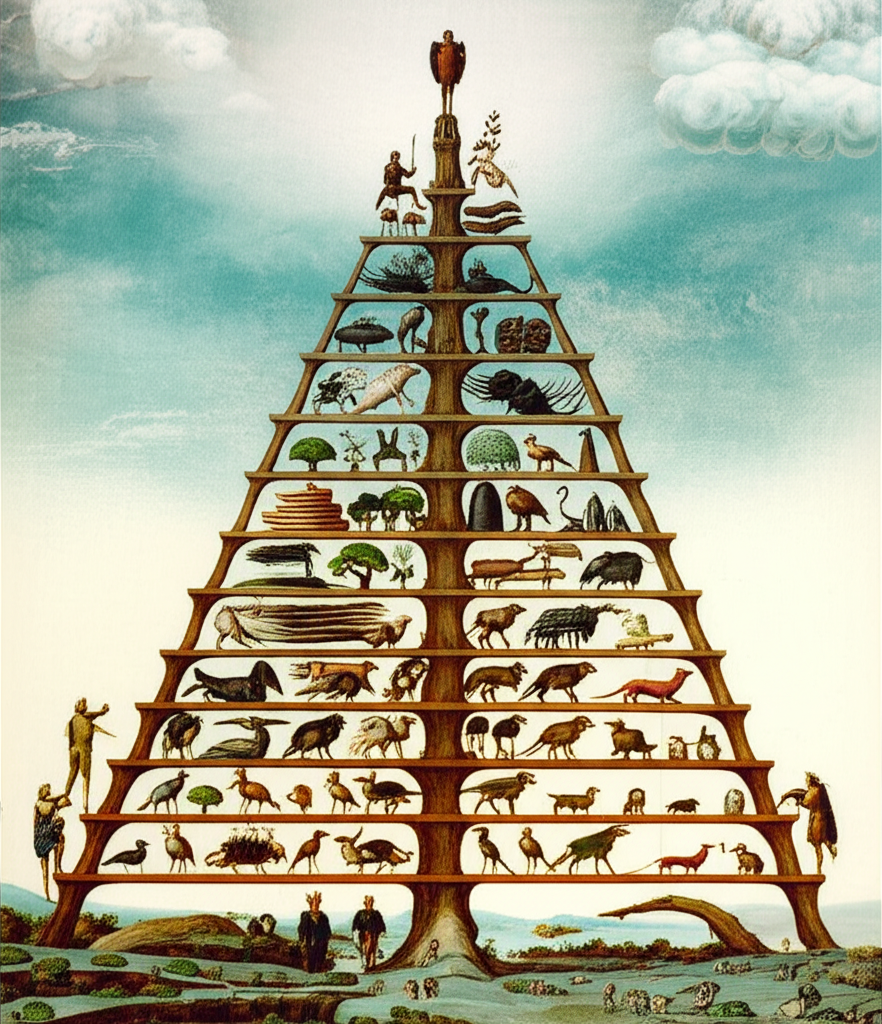 with a modern "Tree of Life" phylogenetic diagram. The Ladder shows a linear progression from minerals to plants, animals, and humans at the apex, while the Tree depicts a branching, non-hierarchical network of interconnected life forms, with no single species at the "top." Subtle scientific instruments and philosophical texts are scattered around the base of the image, suggesting the interplay of disciplines.)
While it's undeniable that Evolution has produced organisms of astonishing complexity, equating complexity with Progress is still a philosophical interpretation, not a scientific conclusion.
- Adaptation, Not Perfection: A bacterium is incredibly "successful" in its highly adapted niche, having persisted for billions of years. Is a human "more evolved" or simply "differently evolved" than a bacterium?
- Loss of Complexity: Evolution can also lead to a reduction in complexity if it confers an adaptive advantage (e.g., parasites losing complex organs they no longer need). Is this "de-Progression"?
- Survival as the Metric: From a scientific standpoint, the only "measure of success" in Evolution is continued survival and reproduction.
The Human Dilemma: Our Own Progress in an Evolving World
Humanity's unique capacity for culture, technology, and abstract thought allows us to actively pursue Progress in ways that no other species can. We build civilizations, develop ethical systems, advance Science, and strive for ideals like justice and equality. This is human progress, a product of our specific evolutionary trajectory, but it is distinct from the undirected process of biological Evolution itself.
The philosophical challenge arises when we try to reconcile our deep-seated desire for meaning and Progress with a scientific understanding of Evolution that offers no inherent cosmic purpose. Does the absence of a pre-ordained Evolutionary telos diminish our own efforts towards Progress? Or does it, conversely, empower us to define our own meaning and goals, making our pursuit of Progress all the more significant?
Science provides the factual framework of Change, describing how life has unfolded. Philosophy, drawing upon the insights of the Great Books and contemporary thought, then grapples with the meaning of that Change and our role within it. The theory of Evolution compels us to critically examine our assumptions about Progress, pushing us towards a more nuanced and humble understanding of our place in the grand narrative of life.
Further Exploration
📹 Related Video: What is Philosophy?
Video by: The School of Life
💡 Want different videos? Search YouTube for: ""Philosophy of Evolution and Progress""
📹 Related Video: KANT ON: What is Enlightenment?
Video by: The School of Life
💡 Want different videos? Search YouTube for: ""Teleology in biology vs. random change""