

Unveiling the Infinite: The Theological Concept of Eternity and God
Summary: The theological concept of Eternity is far more profound than mere endless duration; it describes a fundamentally different mode of existence, intrinsically linked to the nature of God. This article delves into how classical Theology understands Eternity as God's essential attribute, exploring the intricate relationship between the divine, Time, and the very fabric of existence, drawing insights from the enduring wisdom found in the Great Books of the Western World.
Grappling with the Infinite: Beyond Our Temporal Chains
As humans, our lives are inexorably bound by Time. We experience existence sequentially: past, present, future. This temporal linearity shapes our understanding of everything, including our attempts to conceptualize the divine. However, classical Theology posits a God whose Eternity transcends this temporal framework entirely, presenting a profound philosophical challenge and a cornerstone of religious thought. It's not just "a very, very long time"; it's an entirely different dimension of being.
Defining Eternity: A Realm Beyond Chronos
When we speak of Eternity in a theological sense, we must first distinguish it from sempiternity. Sempiternity refers to endless duration, a succession of moments stretching infinitely into the past and future. Think of a line that never ends. Theological Eternity, however, is often understood as atemporality – an existence utterly outside of Time, where all moments are simultaneously present.
Key Distinctions of Theological Eternity:
- Timelessness (Atemporality): Not subject to succession, change, or duration.
- Wholeness and Simultaneity: All of existence is present at once to an eternal being.
- Immutability: An eternal being cannot change, as change implies a before and an after.
- Uncreated and Unending: Having no beginning or end within any temporal sequence.
This concept, deeply explored by figures like St. Augustine and Boethius, suggests that Time itself is a creation, a measure of mutable things. Eternity, conversely, is the measure of immutable being, perfectly possessed by God.
God and Eternity: A Symbiotic Relationship
The very definition of God in classical Theology is inextricably linked to Eternity. God is not merely in eternity; God is Eternity. This isn't just a linguistic flourish; it carries immense implications for understanding divine attributes:
- Omnipresence: If God exists outside Time, then God also exists outside spatial limitations in a unique sense, being simultaneously present to all points in Time and space.
- Omniscience: For an eternal God, all past, present, and future events are simultaneously known. There is no waiting, no anticipation, no discovery. Everything is tota simul – held together at once.
- Immutability: An eternal God cannot change because change requires Time (a "before" and an "after"). God's essence, knowledge, and will are perfectly constant.
- Creator of Time: If God is eternal, then Time itself must be a creation of God, existing for the created order, not as an inherent limitation on the Creator.
The Paradox of Time in a Timeless God
One of the most profound philosophical challenges arising from the theological concept of Eternity is reconciling a timeless God with a temporal world. How does an eternal being interact with events that unfold sequentially?
Consider the following questions that have puzzled philosophers and theologians for centuries:
- Divine Action: How can an eternal God "act" in Time if there is no sequence of events for God? Does God choose to create at a particular moment, or is creation itself an eternal act?
- Providence and Free Will: If God knows all future events simultaneously, does this negate human free will? St. Thomas Aquinas, building on Boethius, argued that God's eternal knowledge doesn't cause future events but rather sees them as eternally present. Our choices remain free from a temporal perspective, even if they are eternally known by God.
- Prayer: If God is immutable and knows all things, does prayer change God's mind or merely align our will with God's eternal plan?
These are not easily resolved, but they highlight the deep conceptual work required to understand the divine nature.
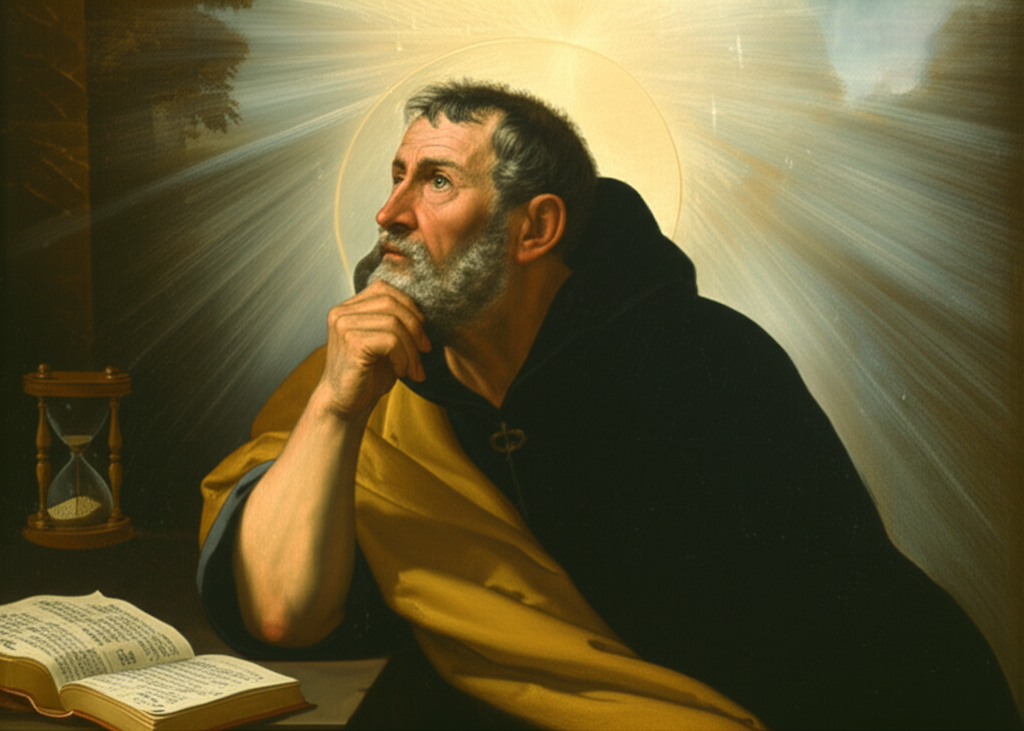
Classical Perspectives on Divine Eternity
The "Great Books" offer rich insights into how thinkers grappled with God's Eternity.
| Philosopher/Theologian | Key Concept of Eternity | Relationship to God |
|---|---|---|
| St. Augustine | Creator of Time | God exists before and beyond Time, creating it with the world. God's knowledge is not sequential. |
| Boethius | Tota simul et perfecta possessio vitae interminabilis (The complete, simultaneous, and perfect possession of endless life) | God's eternity is a present that encompasses all time, viewing past, present, and future as one. |
| St. Thomas Aquinas | Mensura entis immobilis (The measure of immutable being) | Eternity is a distinct mode of duration from Time (measure of mutable being). God is pure actuality, without potential or change. |
These figures, foundational to Western Theology, consistently argue for an Eternity that is qualitative rather than merely quantitative, a state of being that defines God's essence.
Implications for Theology and Human Understanding
Understanding God's Eternity profoundly shapes our theological perspectives. It reinforces the idea of God's absolute sovereignty, unchanging nature, and comprehensive knowledge. It forces us to acknowledge the limits of human language and temporal experience when attempting to grasp the divine.
Ultimately, the theological concept of Eternity invites us to stretch our minds beyond the familiar confines of Time, offering a glimpse into a divine reality that is both utterly transcendent and intimately present in every moment of our lives. It's a concept that continues to inspire awe and intellectual inquiry, reminding us of the vastness of God's being.
📹 Related Video: What is Philosophy?
Video by: The School of Life
💡 Want different videos? Search YouTube for: ""Augustine on Time and Eternity" or "Boethius Consolation of Philosophy Eternity""
📹 Related Video: KANT ON: What is Enlightenment?
Video by: The School of Life
💡 Want different videos? Search YouTube for: ""Aquinas and the Nature of God's Eternity""