

The Theological Argument for Immortality: A Journey Through Faith and Reason
The question of what lies beyond our mortal coil has captivated humanity since time immemorial. Among the myriad responses, the Theological Argument for Immortality stands as a cornerstone of faith, positing that our existence does not cease with the body's decay but continues in some form, often tied to the enduring nature of the Soul and the divine order of the universe. This perspective, deeply embedded in various Religions, offers profound insights into human purpose, justice, and the ultimate destiny of consciousness.
Introduction: The Unyielding Question
For centuries, thinkers have grappled with the ephemeral nature of life. Is our consciousness merely an emergent property of complex biological systems, destined to dissolve when the brain ceases its function? Or is there an essence, a Soul, that transcends the material, a spark of the divine that persists beyond the grave? The theological argument, as explored by many luminaries within the Great Books of the Western World, asserts the latter, grounding its claims not in empirical observation but in the nature of God, divine justice, and the very structure of reality as understood through faith.
Theological Foundations: God, Justice, and Purpose
At its heart, the theological argument for immortality rests upon several interconnected premises concerning the divine:
Divine Providence and the Soul's Destiny
Many theological traditions posit a God who is not only the creator but also a benevolent and just steward of creation. If God is perfectly good and omnipotent, it follows that human life, imbued with consciousness, moral capacity, and a yearning for eternity, must have a purpose that extends beyond its finite earthly span. To imagine a conscious being, capable of love, reason, and spiritual aspiration, created only to be utterly annihilated, seems incongruous with the notion of a perfectly wise and loving Creator. The Soul, in this context, is often seen as a direct endowment from God, inherently sharing in a measure of divine imperishability.
The Imperative of Moral Order
A significant aspect of the theological argument revolves around divine justice. Life often presents a stark imbalance: the virtuous suffer, while the wicked prosper. If there is no ultimate reckoning, no continuation beyond this life, then the moral order of the universe appears arbitrary or even cruel. The promise of Immortality – whether in a heavenly reward or a just punishment – provides a necessary framework for moral accountability, ensuring that ultimately, justice will prevail. This notion is central to the ethical systems of numerous Religions, providing a powerful incentive for virtuous living.
Philosophical Echoes in the Great Books
The theological argument finds robust philosophical support and exploration across the Great Books, intertwining with metaphysical and ethical considerations.
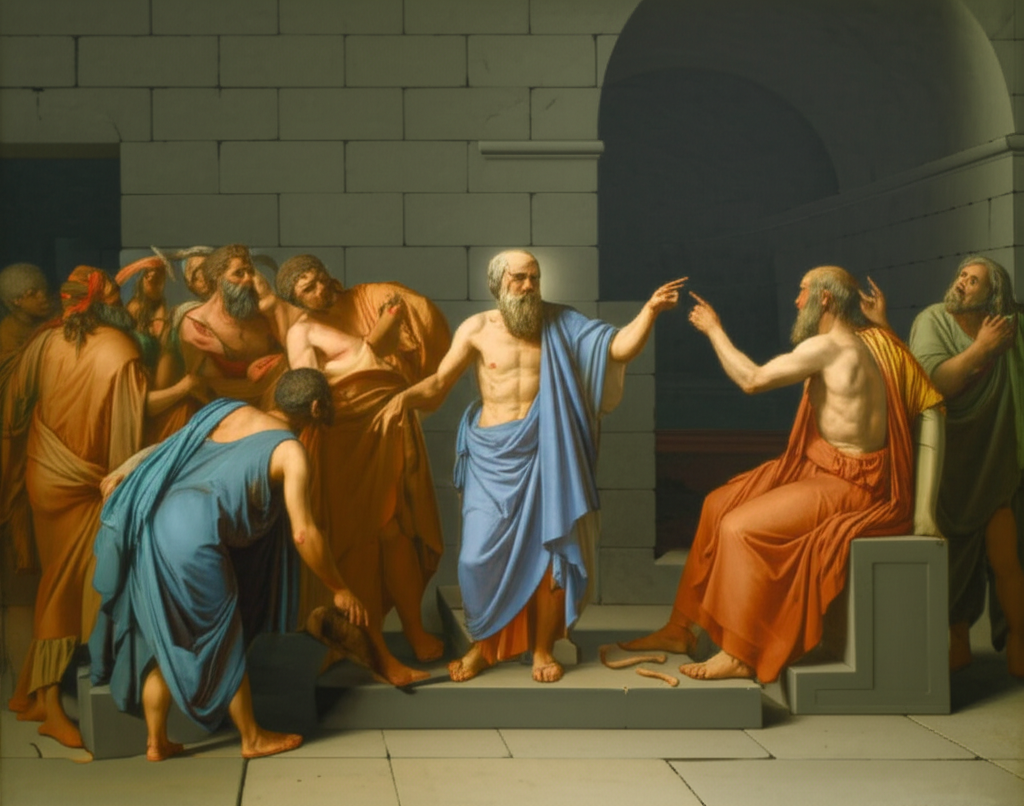
Plato's Phaedo: The Soul's Inherent Immortality
Perhaps one of the earliest and most influential articulations comes from Plato, particularly in his dialogue Phaedo. Through the voice of Socrates, Plato argues for the Soul's immortality based on several points:
- The Argument from Opposites: Life comes from death, and death from life, suggesting a cycle.
- The Argument from Recollection: Our ability to recognize perfect forms (like perfect equality) implies pre-existence of the Soul which apprehended these forms.
- The Argument from Affinity: The Soul is more akin to the invisible, eternal, and divine Forms than to the visible, changing, and mortal body. It is therefore naturally suited to endure.
- The Argument from Life: The Soul is the principle of life; it cannot admit its opposite, death.
Aristotle and the Active Intellect
While Aristotle's view of the Soul (psyche) is more intertwined with the body as its form, he introduces the concept of the "active intellect" (nous poietikos) in De Anima. This aspect of the intellect, responsible for abstract thought, is described as "separable, impassible, and unmixed," hinting at a potential for independent existence and Immortality, distinct from the perishable passive intellect and the body.
Augustine and the Christian Soul
St. Augustine, heavily influenced by Platonic thought but reinterpreting it through a Christian lens in works like Confessions and City of God, firmly establishes the Soul's Immortality as a central tenet of Christian Theology. For Augustine, the Soul is a spiritual substance created by God, designed for communion with Him. Its immortality is not merely a philosophical deduction but a revealed truth, essential for understanding human destiny, redemption, and the ultimate beatific vision.
Descartes' Dualism: Mind and Body Distinction
René Descartes, in his Meditations on First Philosophy, offers a distinct argument for the Soul's immortality through his substance dualism. He argues that the mind (or Soul) and the body are two distinct substances. The mind, being non-extended and indivisible, is fundamentally different from the extended and divisible body. Since the mind has no parts, it cannot cease to exist by falling apart, suggesting its natural Immortality. This distinction provides a powerful philosophical basis for separating the essence of personal identity from physical decay.
Core Concepts Defined
To fully appreciate the theological argument, it is crucial to understand the foundational terms:
| Concept | Definition | Significance in Argument |
|---|---|---|
| Theology | The systematic study of the nature of God and religious belief. | Provides the framework for understanding divine attributes (justice, benevolence) that necessitate immortality. |
| Immortality | The state of endless life or existence; exemption from death. | The central claim of the argument, often tied to the soul's nature and divine purpose. |
| Soul | The spiritual or immaterial part of a human being, often regarded as immortal. | The vehicle of individual consciousness and identity that persists beyond bodily death, a divine endowment. |
| Religion | An organized system of beliefs, practices, rituals, and symbols that relates humanity to spirituality. | The primary cultural and institutional context where the theological argument for immortality is articulated and held. |
The Argument's Appeal and Its Place in Religion
The theological argument for Immortality resonates deeply for several reasons:
- Comfort and Meaning: It offers solace in the face of death and provides a grander narrative for human existence, imbuing life with ultimate meaning and purpose.
- Ethical Imperatives: The belief in an afterlife with divine judgment strongly reinforces moral behavior and accountability, encouraging individuals to live virtuously.
- Continuity of Love and Relationship: It offers hope for reunion with loved ones and the continuation of spiritual relationships beyond earthly bounds.
Across various Religions – Christianity, Islam, Judaism, Hinduism, and others – the concept of an enduring Soul and an afterlife, though differing in specifics, forms a vital component of their Theology, shaping their rituals, ethics, and eschatological visions.
Contemplating the Unseen: Challenges and Enduring Faith
While compelling to believers, the theological argument for Immortality is not without its critics. Materialist philosophies challenge the existence of a non-physical Soul, while empirical science seeks evidence that remains elusive. However, the strength of the theological argument lies not in its scientific verifiability, but in its coherence within a faith-based worldview, its profound psychological and ethical implications, and its capacity to answer humanity's deepest longing for meaning and continuity. It remains a testament to the enduring power of faith to provide answers where reason alone might falter.
Conclusion: An Eternal Inquiry
The Theological Argument for Immortality invites us to consider life not as a fleeting spark, but as a journey with an eternal destination, guided by divine will and justice. Rooted in the profound contemplations of philosophers and theologians throughout history, as preserved in the Great Books of the Western World, it posits an enduring Soul and a purposeful existence that transcends the boundaries of earthly life. This argument, central to many Religions, continues to offer hope, meaning, and a moral compass to countless individuals navigating the mysteries of being and non-being.
📹 Related Video: PLATO ON: The Allegory of the Cave
Video by: The School of Life
💡 Want different videos? Search YouTube for: ""Plato's Phaedo: Arguments for the Immortality of the Soul Explained""
📹 Related Video: What is Philosophy?
Video by: The School of Life
💡 Want different videos? Search YouTube for: ""Aquinas on the Soul and Immortality - Scholastic Philosophy""