

Unpacking the Wild: The State of Nature Hypothesis and Our Social Contract
Summary: The State of Nature Hypothesis is a foundational thought experiment in political philosophy, positing a hypothetical human condition prior to the establishment of any organized government or societal structures. It explores what human life, morality, and social order would be like without the constraints and benefits of a formal State. This intellectual hypothesis serves as a critical lens through which philosophers like Hobbes, Locke, and Rousseau have justified or critiqued the necessity and form of government, offering diverse perspectives on our inherent nature and the origins of political authority.
The Untamed Mindscape: What is the State of Nature?
Welcome back, fellow travelers on the philosophical journey! Today, we're diving into one of the most enduring and provocative concepts in political thought: The State of Nature Hypothesis. It's not about finding a pristine, untouched wilderness on a map; rather, it's a profound intellectual exercise, a mental journey back to a time before laws, before kings, before even the most rudimentary forms of collective government. It asks a simple yet revolutionary question: What would humanity be like without the State?
This hypothesis is less a historical claim and more a philosophical tool. It's a "what if" scenario designed to illuminate our understanding of human nature, the origins of society, and the very justification for political authority. By stripping away the layers of civilization, these thinkers sought to expose the core essence of human interaction and the fundamental reasons we choose to live under a State.
The Genesis of Governance: Why Bother with a Hypothetical Past?
Why, you might ask, would some of the greatest minds in history dedicate themselves to imagining a world that never truly existed in such a pure form? The answer lies in its utility. The State of Nature serves as a baseline, a counterfactual against which we can measure the value and necessity of government. If the State of Nature is utterly unbearable, then almost any State might seem preferable. If it's a paradise lost, then our current government might be seen as a corruption.
The State of Nature hypothesis is, at its core, an attempt to answer fundamental questions about political legitimacy:
- Why do we need a
Stateat all? - What kind of
governmentis best suited for our inherentnature? - What rights and obligations do individuals have before society, and how do they change within it?
The answers to these questions profoundly shaped the Enlightenment and continue to inform debates about individual liberty, social responsibility, and the role of the State today.
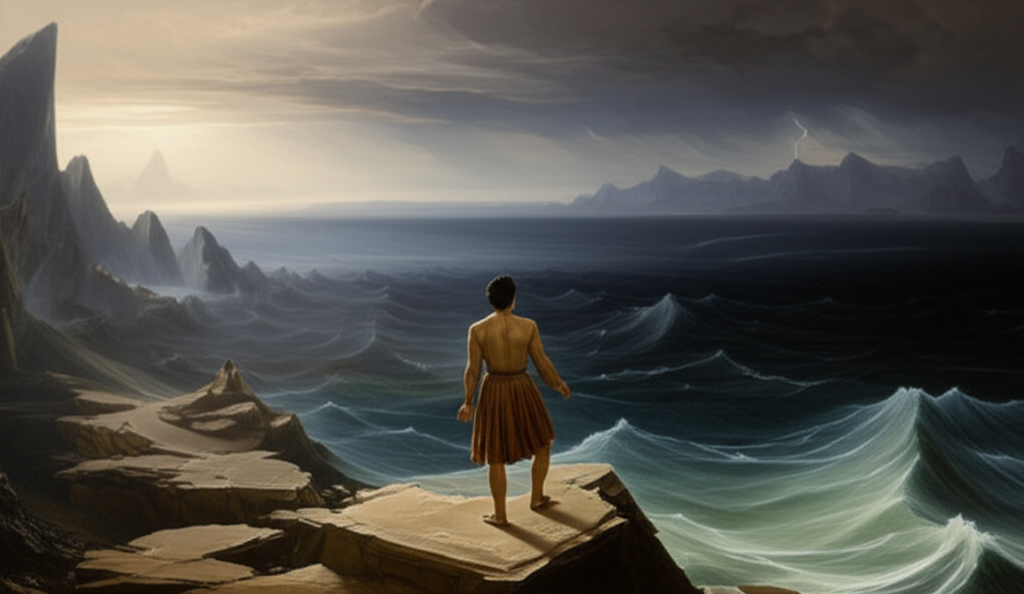
Voices from the Great Books: Three Visions of Humanity's Dawn
The Great Books of the Western World offer us three distinct, yet equally influential, perspectives on the State of Nature. These aren't just academic exercises; they are profound reflections on human nature itself.
1. Thomas Hobbes: The War of All Against All
In his seminal work, Leviathan, Thomas Hobbes paints a stark and terrifying picture of the State of Nature. For Hobbes, without a common power to keep all in awe, life would be:
- Solitary, poor, nasty, brutish, and short.
He argued that in this condition, every individual is driven by self-preservation and the pursuit of power, leading to a constant "war of every man against every man." There is no industry, no culture, no society, because there is no security. Morality as we understand it does not exist; there are no laws, no justice, only the right of nature (the liberty to do whatever one deems necessary for survival).
Hobbes's Conclusion: The only escape from this dreadful State of Nature is the establishment of an absolute sovereign, a powerful government (the "Leviathan") capable of enforcing peace and order. Individuals willingly surrender some of their natural liberties in exchange for security.
2. John Locke: Natural Rights and Rationality
In contrast to Hobbes, John Locke, in his Two Treatises of Government, presents a much more optimistic view. For Locke, the State of Nature is not a free-for-all but is governed by the Law of Nature, which dictates that no one ought to harm another in his life, health, liberty, or possessions.
Key Features of Locke's State of Nature:
- Natural Rights: Individuals possess inherent rights to life, liberty, and property, bestowed by
Natureitself. - Reason: Humans are capable of reason and can discover the Law of Nature.
- Equality: All individuals are naturally equal.
- Inconveniences: While not a
Stateof war, it is prone to "inconveniences" due to the lack of an impartial judge to enforce the Law of Nature and resolve disputes.
Locke's Conclusion: People enter into a social contract to form a government primarily to protect their pre-existing natural rights more effectively. This government derives its legitimacy from the consent of the governed and can be overthrown if it fails to uphold these rights.
3. Jean-Jacques Rousseau: The Noble Savage and Societal Corruption
Rousseau, particularly in his Discourse on the Origin and Basis of Inequality Among Men, offers a radical departure from both Hobbes and Locke. He argues that in the true State of Nature, humans (the "noble savage") are fundamentally good, compassionate, and self-sufficient. They live simple, isolated lives driven by self-preservation (amour de soi) and pity (pitié).
Rousseau's Vision:
- Peaceful Existence: No inherent conflict; desires are simple and easily satisfied.
- No Property, No Inequality: These concepts emerge with society.
- Corruption by Society: It is the advent of private property, agriculture, and complex social structures that introduces competition, inequality, and ultimately, moral corruption.
Governmentand laws, in this view, often serve to perpetuate these inequalities.
Rousseau's Conclusion: True freedom and morality can only be found in a State where citizens participate directly in creating the "general will," aiming for the common good, rather than being ruled by an oppressive government.
The Enduring Legacy: Why This Hypothesis Still Resonates
The State of Nature hypothesis, despite its abstract quality, remains incredibly relevant. It forces us to confront fundamental questions about our collective existence:
| Philosopher | View of Human Nature in State of Nature | Reason for Forming Government | Ideal Government Type |
|---|---|---|---|
| Hobbes | Selfish, power-seeking, fearful | Escape war, ensure security | Absolute Monarchy |
| Locke | Rational, possessing natural rights | Protect natural rights, impartial justice | Limited, Representative |
| Rousseau | Good, compassionate, self-sufficient | Protect property, but often corrupts | Direct Democracy (General Will) |
Every debate about the appropriate size and scope of government, about individual liberties versus collective security, about international relations without a global State—all of these implicitly or explicitly touch upon the principles first explored through the State of Nature hypothesis. It's a reminder that the structures we build, the laws we live by, and the State we inhabit are not inevitable, but choices—choices with profound implications for our nature and our future.
So, the next time you consider the delicate balance between freedom and order, take a moment to reflect on these foundational ideas. They are not just dusty theories from old books; they are the bedrock upon which our understanding of society and government is built.
📹 Related Video: ARISTOTLE ON: The Nicomachean Ethics
Video by: The School of Life
💡 Want different videos? Search YouTube for: ""Hobbes Locke Rousseau State of Nature Comparison" for a concise overview of the different perspectives."
📹 Related Video: What is Philosophy?
Video by: The School of Life
💡 Want different videos? Search YouTube for: ""The Social Contract Theory Explained" for a broader context of why these hypotheses matter for political philosophy."