

The Enduring Puzzle of Self: Navigating "The Same and Other" in Identity
Summary: The Inextricable Dance of Identity
Identity, at its core, is a profound philosophical challenge. It asks what makes a thing, or a person, itself and not something else. This inquiry inevitably leads us to the fundamental concepts of "the Same" and "the Other." Far from being simple opposites, these two notions are in a constant, intricate relation, defining and distinguishing everything in our experience. To understand identity is to grasp how something can remain the Same through change, and how it is distinguished as Other from everything else, a continuous negotiation that has captivated thinkers from antiquity to the present day.
Introduction: What Does It Mean to Be "The Same"?
Consider a simple question: "Is this the same cup I used yesterday?" Or a more profound one: "Am I the same person I was ten years ago?" These everyday queries plunge us into the deep waters of identity, a concept central to metaphysics, epistemology, and ethics. Identity isn't merely about recognition; it's about the very nature of being and persistence. It forces us to confront how we delineate boundaries, understand continuity, and make sense of change. At the heart of this complex tapestry lie the intertwined threads of Sameness and Otherness.
Defining the Contours: Same, Other, and Relation
To embark on this philosophical journey, we must first establish a clear definition of our terms and understand their dynamic interplay.
The Elusive Definition of "Same"
When we speak of "the Same," we often mean one of two things:
- Numerical Identity: This refers to being one and the very same thing. If I say, "This is the same pen I lost last week," I mean there is only one pen, and this is that pen. It's about singularity and uniqueness.
- Qualitative Identity: This refers to sharing all qualities or properties. If I say, "My new car is the same as my old one," I mean they are identical in make, model, colour, features, etc., but they are numerically distinct cars.
The philosophical challenge often arises when something maintains numerical identity despite undergoing significant qualitative changes.
Embracing "Otherness"
"The Other," conversely, signifies distinction, difference, and non-identity. A thing is "Other" if it is not numerically identical to another thing. Without the concept of Otherness, the notion of Sameness loses its meaning. To say something is the Same implies it is not Other than itself, and simultaneously, it is Other than everything else. This distinction is crucial for perception, language, and thought. Our ability to differentiate one object from another, one person from another, or even one moment from another, hinges entirely on the recognition of Otherness.
The Indispensable Relation
Identity, therefore, is not a static attribute but a dynamic relation. It's a way of relating a thing to itself over time, or relating one thing to another. The very act of identifying something—of saying "this is that"—is an assertion of a specific relationship between two instances or states of being. This relation can be one of continuity, equivalence, or distinction, forming the logical bedrock of how we structure our understanding of reality.
A Journey Through Thought: Identity in the Great Books
The problem of the Same and Other in identity has been a constant preoccupation for the greatest minds throughout history, deeply embedded in the texts considered the Great Books of the Western World.
Ancient Foundations: Plato, Aristotle, and the Nature of Being
- Plato's Forms: For Plato, true identity resided in the eternal, unchanging Forms. A particular chair might change, but the Form of Chairness remained the Same—perfect, immutable, and the ultimate source of identity for all particular chairs. Here, Sameness is equated with absolute, transcendent being, while the particulars of the sensible world are always in a state of becoming Other.
- Aristotle's Substance and Accidents: Aristotle offered a more grounded approach. He distinguished between a thing's substance (its essential nature) and its accidents (its non-essential properties like colour, size, location). A tree remains the Same tree (same substance) even as its leaves change colour or branches are trimmed (different accidents). Identity, for Aristotle, is rooted in the persistence of substance, allowing for change (otherness in accidents) without losing fundamental sameness.
- Heraclitus's Flux: Pre-dating Plato, Heraclitus famously declared, "You cannot step into the same river twice." His philosophy emphasized constant change and flux, suggesting that everything is always becoming Other. This radical view challenges the very possibility of sustained identity, pushing the concept of Sameness to its limits.
Medieval Considerations: Individuation and Universals
Medieval philosophers, particularly Thomas Aquinas, grappled with how individual things (like a specific human being) maintain their identity while also participating in universal categories (like "humanity"). The problem of individuation—what makes one thing numerically distinct from another even if they share the same essence—became central. Here, the interplay between the universal (Sameness in kind) and the particular (Otherness in instance) was a key theological and metaphysical concern.
Modern Perspectives: Consciousness, Bundles, and Logic's Grip
- John Locke and Personal Identity: In the modern era, the focus shifted, particularly concerning personal identity. John Locke famously argued that personal identity is not tied to substance (body or soul) but to the continuity of consciousness and memory. If I can remember being a younger self, then I am the Same person. This introduces a subjective, psychological dimension to identity, where the relation of memory links different temporal states of the self.
- David Hume's Skeptical View: David Hume, ever the skeptic, challenged the very notion of a persistent self. He argued that we are merely "bundles or collections of different perceptions," constantly changing. The idea of a unified, enduring "self" is a "fiction" created by the mind, a product of our natural tendency to associate similar impressions. For Hume, the constant succession of "Other" perceptions makes the idea of an underlying "Same" self an illusion.
- Gottfried Leibniz and Logic's Principle: The philosopher and mathematician Gottfried Leibniz formulated the Principle of the Identity of Indiscernibles. This logical principle states that if two things have exactly the same properties (are qualitatively identical), then they are numerically identical (they are the Same thing). Conversely, if two things are numerically identical, they must share all properties. This principle provides a rigorous definition for Sameness within the realm of Logic, asserting that perfect qualitative sameness implies numerical sameness, thus eliminating any true "Otherness" between them.
Dimensions of Identity: A Categorical Overview
Understanding identity requires appreciating its various facets, each highlighting the tension between Sameness and Otherness:
| Type of Identity | Description | Focus on Sameness/Otherness |
|---|---|---|
| Numerical Identity | Being one and the very same individual thing. (e.g., this specific pen) | Absolute Sameness: There is no Other. |
| Qualitative Identity | Sharing all properties and characteristics, but possibly being numerically distinct. (e.g., two identical mass-produced cars) | Sameness in attributes, potential Otherness in existence. |
| Personal Identity | What makes a person the same person over time, despite physical and psychological changes. (e.g., how am I the same person from childhood?) | Sameness in consciousness/memory (Locke), or underlying substance, despite Otherness in appearance/thought. |
| Spatiotemporal Identity | Being the same object across a continuous path through space and time. (e.g., tracing the trajectory of a moving ball) | Sameness in trajectory/continuity, Otherness in position at different moments. |
| Sortal Identity | Being the same kind of thing. (e.g., remaining a "tree" even as it grows) | Sameness in category/essence, Otherness from other categories. |
The Paradox of Change: Remaining Identical Through Transformation
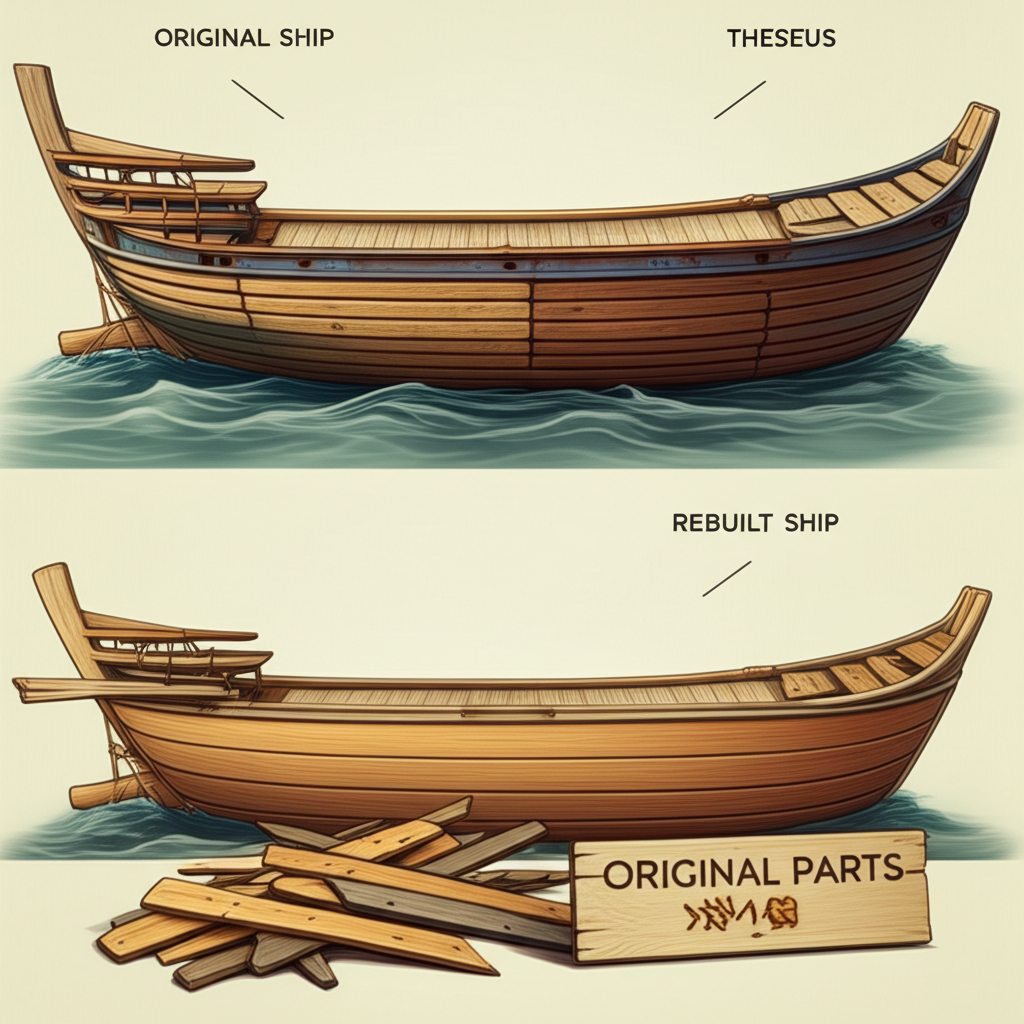
Perhaps the most compelling illustration of the Same and Other is the enduring Paradox of Change. How can something remain the Same if it is constantly becoming Other? The classic example is the Ship of Theseus. If Theseus's ship is preserved in a museum, and over time every single plank and mast is replaced with a new one, is it still the same ship?
- If identity is tied to the original parts, then it is no longer the Same ship.
- If identity is tied to its function, form, or historical continuity, then it is the Same ship, despite all its parts being Other.
This paradox forces us to consider which criteria are most salient for identity, revealing that our understanding of Sameness often depends on the context and the relation we prioritize. It highlights that identity is not a simple, monolithic concept but a complex interplay where sameness and difference continually redefine each other.
Conclusion: The Dynamic Equilibrium of Self
The concepts of "the Same" and "the Other" are not merely abstract philosophical tools; they are the very fabric of our reality and our self-understanding. From the logical principles governing objects to the profound questions of personal persistence, identity is a continuous negotiation. It's a dynamic equilibrium where sameness provides continuity and coherence, while otherness allows for distinction, change, and the rich diversity of existence. The relation between these two fundamental concepts is what gives identity its meaning, challenging us to constantly reflect on what it truly means for anything—or anyone—to be itself. The journey through the Great Books reveals that this puzzle is not meant to be solved definitively but to be perpetually explored, enriching our comprehension of being, knowledge, and the human condition.
Resources for Further Exploration
📹 Related Video: PLATO ON: The Allegory of the Cave
Video by: The School of Life
💡 Want different videos? Search YouTube for: "The Ship of Theseus - Iseult Gillespie TED-Ed"
📹 Related Video: What is Philosophy?
Video by: The School of Life
💡 Want different videos? Search YouTube for: "Personal Identity: Crash Course Philosophy #19"