

The Enduring Paradox: Navigating the Same and Other in Identity
Summary: At the very heart of philosophical inquiry lies the intricate dance between the Same and Other—a fundamental relation that shapes our understanding of identity. This article delves into how we define what something is by simultaneously recognizing its unique selfhood and distinguishing it from everything else. We'll explore the logic underpinning these concepts, drawing insights from the enduring wisdom found in the Great Books of the Western World, revealing how this seemingly simple distinction underpins complex questions about existence, change, and knowledge.
Unpacking the Core: What is "The Same" and "The Other"?
To speak of identity is immediately to invoke the concepts of the Same and the Other. These are not merely descriptive terms; they are foundational categories through which we apprehend reality.
- The Same: Refers to that which is identical to itself, or that which shares common properties with another. Philosophically, it can denote:
- Numerical Identity: When something is one and the same thing across time or different appearances (e.g., the morning star and the evening star are numerically the same planet, Venus).
- Qualitative Identity: When two or more distinct things share identical qualities or properties (e.g., two shirts of the exact same color and design).
- The Other: Refers to that which is distinct, different, or not identical to something else. It is the necessary counterpoint to "the Same," providing the contrast by which identity gains meaning. Without "the Other," "the Same" would be an undifferentiated void.
This relation between the Same and Other is not merely comparative; it is constitutive. We understand what something is by also understanding what it is not.
The Philosophical Quagmire of Identity Through Change
One of the most profound challenges presented by the Same and Other arises when considering identity over time. How can something remain the same when it is constantly undergoing change?
Consider the classic thought experiment of The Ship of Theseus: If a ship has all its planks replaced one by one over time, is it still the same ship? And if the old planks are reassembled into a new ship, which is the original?
This dilemma, pondered by ancient Greeks and modern philosophers alike, highlights the tension between:
- Continuity of Form/Function: The ship looks and functions the same, even with new parts.
- Continuity of Matter: The material composition has entirely changed.
Philosophers like John Locke, exploring personal identity, wrestled with similar questions, positing that identity might reside not in the unchanging substance, but in the continuity of consciousness and memory. Heraclitus famously declared, "No man ever steps in the same river twice, for it's not the same river and he's not the same man," emphasizing the ceaseless flux of existence. Yet, Parmenides argued for an unchanging, eternal reality, where change is merely an illusion. The Great Books offer a rich tapestry of these debates.
Definition and Distinction: The Logic of "Otherness"
The ability to define anything hinges on our capacity to distinguish it from everything else—to categorize it as this and not that. This process relies fundamentally on the concept of the Other.
| Aspect of Identity | Role of "The Same" | Role of "The Other" |
|---|---|---|
| Definition | Establishes what something fundamentally is. | Establishes what something fundamentally is not. |
| Classification | Groups entities sharing common properties. | Differentiates distinct groups or individual entities. |
| Understanding | Recognizes intrinsic characteristics. | Recognizes boundaries and unique attributes. |
Without "the Other," our definitions would collapse into an undifferentiated unity, rendering specific knowledge impossible. To define a "tree," we implicitly distinguish it from a "rock," a "cloud," or an "animal." This logical act of differentiation is paramount.
The Logic of Identity: A = A and Beyond
At the bedrock of formal logic lies the Principle of Identity (A = A). This principle states that everything is identical to itself. While seemingly trivial, its implications are profound: it asserts the self-sameness of a thing, a necessary precondition for coherent thought and communication.
However, the "Same and Other" extends beyond this simple axiom:
- Principle of Non-Contradiction: A thing cannot be both A and not-A at the same time and in the same respect. This principle, articulated by Aristotle, relies on the absolute distinction between "A" and "not-A" (the Other).
- Principle of Excluded Middle: A thing is either A or not-A. There is no third option. Again, the binary opposition of "Same" and "Other" is fundamental.
These logical principles, extensively discussed throughout the Great Books, demonstrate that the very structure of rational thought depends on our ability to clearly delineate between what is identical and what is distinct. From Plato's exploration of Forms (where a Form is perfectly itself and distinct from its earthly particulars) to Hegel's dialectical process where identity emerges through the negation of difference, the interplay of the Same and Other is a constant theme.
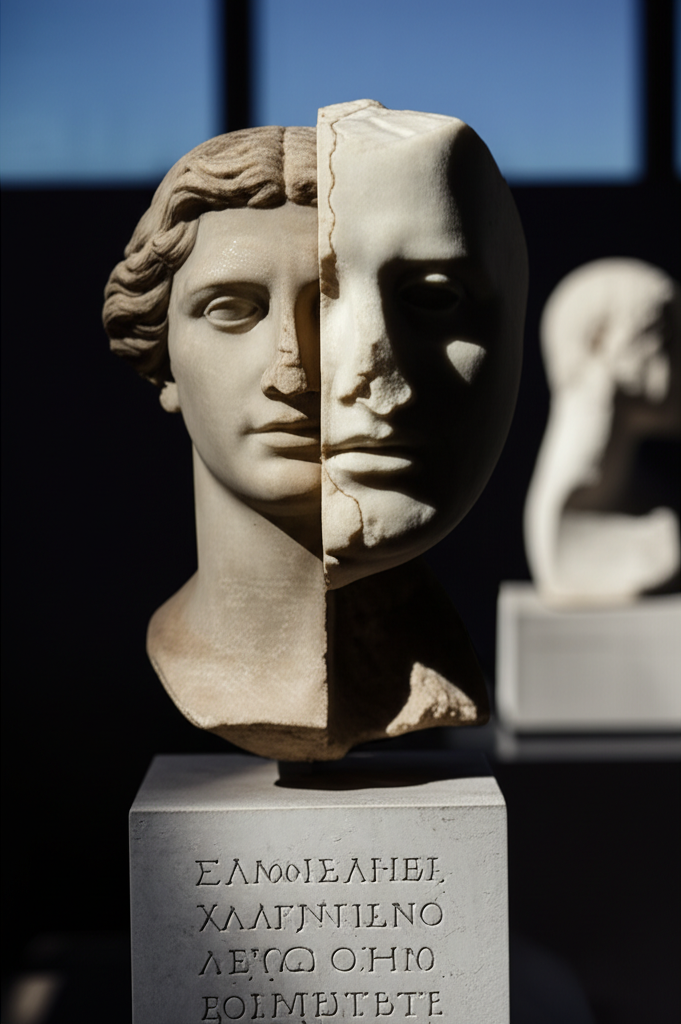
Conclusion: The Enduring Quest for Selfhood
The concepts of the Same and Other are not just abstract philosophical tools; they are the very fabric of our lived experience. From recognizing a friend despite their changing appearance to understanding complex scientific classifications, our minds constantly engage in the subtle art of identifying sameness and discerning otherness.
The Great Books of the Western World consistently return to this fundamental tension, inviting us to ponder: What truly makes something itself? How do we reconcile continuity with change? And how do our definitions shape the world we perceive? Engaging with these questions deepens our appreciation for the intricate logic that governs not just our thoughts, but the very nature of reality and our place within it.
YouTube Suggestions:
- "The Ship of Theseus: Identity, Change, and Philosophy Explained"
- "Hegel's Dialectic: Identity and Difference in Logic"
📹 Related Video: What is Philosophy?
Video by: The School of Life
💡 Want different videos? Search YouTube for: "The Same and Other in Identity philosophy"