

The Enduring Enigma of Identity: Navigating the Same and Other
To truly understand anything — a concept, an object, even ourselves — we must confront the fundamental philosophical problem of identity. At its heart lies the intricate dance between "the Same" and "the Other." This isn't merely a semantic distinction but a foundational principle that underpins our very capacity for thought, definition, and logic. Without a clear grasp of what makes something itself (the Same) and what distinguishes it from everything else (the Other), our world would dissolve into an undifferentiated haze. This article explores how this essential relation shapes our understanding of existence, drawing on insights from the rich tapestry of the Great Books of the Western World.
The Inescapable Duality: A Philosophical Primer
From the earliest stirrings of philosophical thought, thinkers have grappled with how to define and categorize reality. Is identity a fixed, immutable quality, or is it perpetually in flux, defined only by its relation to what it is not? This core question, explored through the lens of the Same and Other, is not just an abstract exercise but the very bedrock upon which we build our understanding of permanence, change, and meaning.
Consider a simple statement: "A rose is a rose." This seemingly tautological phrase, popularized by Gertrude Stein, subtly hints at the profound philosophical principle at play. It asserts the intrinsic identity of the rose (the Same) while implicitly distinguishing it from all that is not a rose (the Other). This act of distinguishing is not incidental; it is crucial for any meaningful definition.
Ancient Echoes: Parmenides, Plato, and the Logic of Being
The problem of the Same and Other finds its roots deep in ancient philosophy. Parmenides, with his radical assertion that "what is, is, and what is not, is not," pushed the concept of the Same to its absolute limit, denying the very possibility of change or difference. For him, true Being was an undifferentiated, eternal Same.
Plato, while acknowledging the allure of Parmenidean unity, sought to bridge the gap between the unchanging Forms (the ultimate Same, the perfect ideal) and the ever-shifting sensible world (the Other, in its constant state of becoming). In dialogues like the Sophist, Plato meticulously dissects the interweaving of Forms, arguing that for any definition to be possible, "being" must partake in "difference," and "difference" must partake in "being." Without the ability for Forms to be "other" to each other, all would collapse into a single, undifferentiated Same, making knowledge impossible. This intricate logic is essential:
- The Same: That which is identical to itself; its essence.
- The Other: That which is distinct from the Same; its difference.
- Relation: The connection or interaction between the Same and the Other, which often defines both.
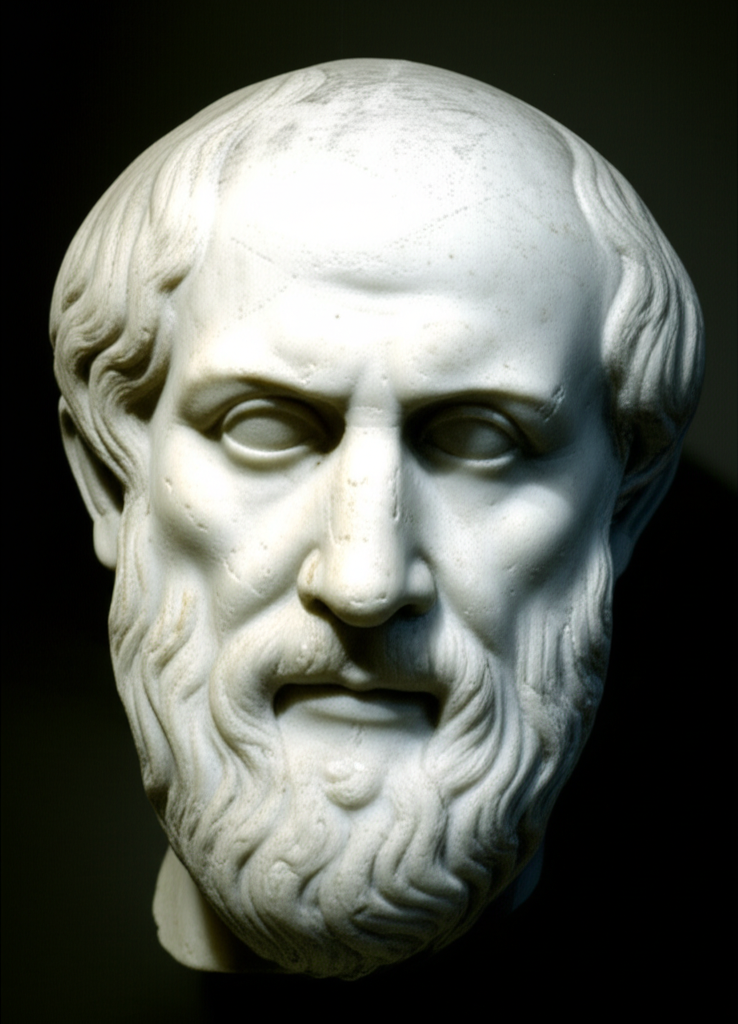
Aristotle's Categories and the Precision of Definition
Aristotle, ever the systematizer, provided a powerful framework for understanding the Same and Other through his categories and principles of logic. His principle of identity (A is A) and the law of non-contradiction (A cannot be both A and not-A at the same time and in the same respect) are direct articulations of how we distinguish the Same from the Other.
For Aristotle, a thing's identity is defined by its essence (what it is), which sets it apart from all that it is not. This distinction is not arbitrary but grounded in the nature of reality itself. His work on definition requires identifying a genus (a broader category, part of the Same) and a specific difference (what makes it Other within that genus).
Consider the definition of "human":
| Category Component | Description | Relation to Same/Other |
|---|---|---|
| Genus | Rational Animal | Broad "Same" group |
| Specific Difference | Capable of Logic and Abstract Thought | Distinguishing "Other" |
| Identity | A unique entity, distinct from other animals | The defined "Same" |
This systematic approach highlights how the Same and Other are not opposites in isolation, but rather in a dynamic relation that allows for precise understanding.
The Dialectic of Identity: Hegel's Dynamic View
Later philosophers, notably Hegel, would take this dynamic relation between the Same and Other to its zenith. For Hegel, identity isn't a static state but a process. A thing truly becomes itself (the Same) only through its engagement with its opposite (the Other). This dialectical movement—thesis (the Same), antithesis (the Other), synthesis (a new, richer Same)—suggests that difference is not merely external to identity but constitutive of it. To define something is to set it apart, and in that act of setting apart, its own particularity (its "Same-ness") is illuminated and deepened.
Why This Matters: Practical Implications of the Same and Other
The philosophical inquiry into the Same and Other is far from academic esoterica. It profoundly impacts how we perceive and interact with the world:
- Personal Identity: How do we remain the "same" person throughout our lives, despite constant physical and psychological change? This question forces us to consider which aspects of ourselves constitute the "Same" (e.g., consciousness, memory, character) and which are "Other" (e.g., physical cells, fleeting emotions).
- Object Recognition: Our ability to recognize a "chair" as a chair, regardless of its design or material, relies on identifying its core "Same-ness" while disregarding its superficial "Other-ness." This is fundamental to our cognitive processes.
- Ethical Considerations: Recognizing the "Same" humanity in individuals from vastly different cultural backgrounds (the "Other") is a cornerstone of empathy and ethical behavior. The challenge is to appreciate difference without letting it obscure shared identity.
- Scientific Classification: Every scientific field, from biology to chemistry, relies on meticulously defining categories (the Same) and distinguishing them from others. This is a direct application of the logic of the Same and Other.
Conclusion: The Unfolding Tapestry of Relation
The distinction between the Same and Other is not a boundary to be overcome, but a fundamental relation that enables definition and understanding. From the ancient Greeks' struggle with permanence and change, through Aristotle's systematic logic, to Hegel's dynamic dialectic, philosophers have consistently returned to this core duality. Our capacity to identify, categorize, and make sense of the world hinges on our ability to discern what something is (the Same) and what it is not (the Other). In this intricate interplay, the very fabric of knowledge and meaning is woven.
YouTube Video Suggestions:
-
📹 Related Video: PLATO ON: The Allegory of the Cave
Video by: The School of Life
💡 Want different videos? Search YouTube for: "Plato Sophist Same and Other Explained"
2. ## 📹 Related Video: ARISTOTLE ON: The Nicomachean Ethics
Video by: The School of Life
💡 Want different videos? Search YouTube for: "Aristotle Logic Identity Non-Contradiction"