

The Enduring Paradox: Navigating the Same and Other in Identity
Summary: The concept of identity, seemingly straightforward, unravels into a profound philosophical challenge when confronted with the dynamic interplay of the "Same" and the "Other." This article explores how Western thought, from ancient Greek metaphysics to modern considerations of selfhood, has grappled with defining what endures as identical amidst constant change. We will trace how philosophers have sought to reconcile the immutable core with the ever-shifting attributes, highlighting the crucial roles of Relation, Definition, and Logic in our understanding of identity.
Unveiling the Philosophical Dance of Being
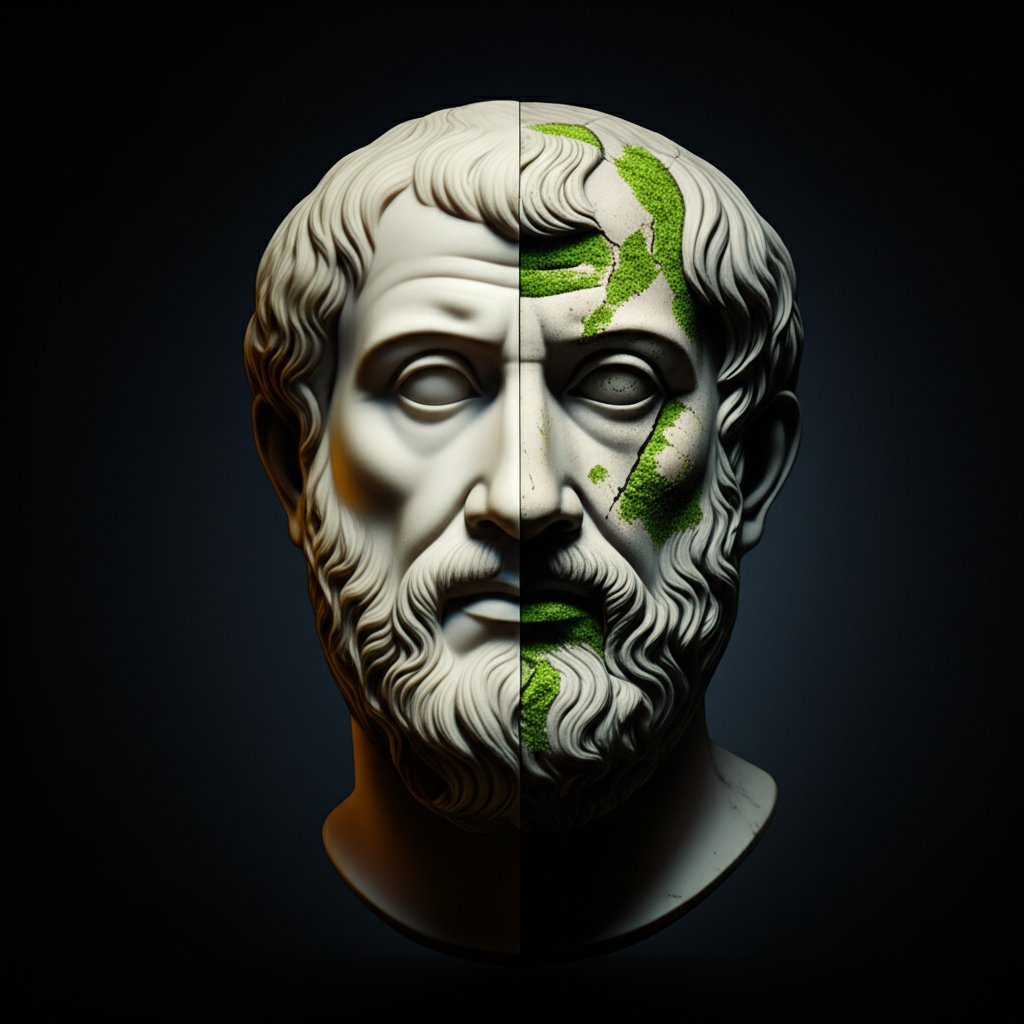
To speak of identity is to assert a fundamental truth: that something is itself and not something else. Yet, this simple assertion quickly becomes a labyrinth when we ask, "What makes a thing the Same across time, despite its evident transformation into something Other?" This isn't merely a semantic puzzle; it's a foundational inquiry that underpins our understanding of substance, personhood, and even the very fabric of reality. From the earliest inquiries into existence, thinkers have been captivated by this tension, seeking a stable ground in a world of flux.
Ancient Echoes: The Absolute vs. The Fleeting
The philosophical journey into identity often begins with two towering figures from ancient Greece, whose contrasting views laid the groundwork for centuries of debate:
-
Parmenides of Elea: The Immutable Same
Parmenides, a central figure in the Great Books tradition, posited a radical view: true Being is eternal, unchangeable, and indivisible. For him, change (becoming Other) is an illusion, a deception of the senses. What is, simply is, and cannot become not-is. Identity, in this view, is absolute and static. There is no room for the Other to genuinely emerge from the Same.- Key Idea: Reality is a single, undifferentiated, and unchanging whole.
-
Heraclitus of Ephesus: The Constant Other
In stark contrast, Heraclitus famously declared, "You cannot step into the same river twice." For him, everything is in a state of perpetual flux; change is the only constant. The river, though we call it "the same," is continually composed of new waters and new banks. Identity here is fleeting, almost an illusion itself, as everything is always becoming Other than it was.- Key Idea: "All things flow" (panta rhei); identity is a momentary snapshot in an ceaseless stream of becoming.
This ancient dichotomy presents the core problem: how can anything maintain its identity (remain the Same) if it is perpetually undergoing change (becoming Other)?
Plato and Aristotle: Seeking Synthesis and Structure
The profound challenge posed by Parmenides and Heraclitus prompted subsequent philosophers to seek reconciliation.
Plato's Realm of Forms: Enduring Sameness
Plato, deeply influenced by Parmenides' insistence on unchanging truth, proposed his theory of Forms. For Plato:
- The Same: Resides in the eternal, perfect, and immutable Forms (e.g., the Form of Beauty, the Form of the Good, the Form of Chair). These Forms are the true essences, the unchanging blueprints.
- The Other: Is found in the particular, imperfect, and changing sensible objects we experience. A specific chair in your living room is always becoming Other (wearing down, breaking), but it participates in the unchanging Form of Chair.
Identity, therefore, is understood through the Relation of participation, where particulars derive their identity and meaning from their connection to the eternal Forms.
Aristotle's Substance and Accidents: Identity in Essence
Aristotle, Plato's student, offered a more immanent solution. He argued that identity is rooted in a thing's substance—its essential properties that make it what it is—while its accidents are its non-essential properties that can change without altering its fundamental identity.
- Substance (The Same): The 'what-it-is' (e.g., humanity for a person, wood for a tree). This essential core endures.
- Accidents (The Other): Non-essential qualities that can change (e.g., a person's hair color, a tree's number of leaves). These can vary without the thing ceasing to be itself.
Aristotle's framework allows for a thing to remain the Same in its essence, even as it takes on new Other accidental properties. The Definition of a thing is, for Aristotle, the articulation of its essence.
The Modern Quandary: Personal Identity and the Shifting Self
The problem of the Same and Other takes on a deeply personal dimension in modern philosophy, particularly regarding personal identity.
-
John Locke: Consciousness as the Thread of Sameness
Locke famously argued that personal identity is not tied to a continuous body or even an unchanging soul, but to consciousness. The Same person is the one who can remember and appropriate the actions and thoughts of a past self.- Challenge: What happens when memory fails? Does a person cease to be the Same? The Other becomes a significant threat to continuous selfhood.
-
Gottfried Leibniz: The Principle of the Indiscernibility of Identicals
Leibniz's contribution to the Logic of identity is profound. His principle states that if two things are truly identical (the Same), then they must share all of the same properties. If there is even one property that distinguishes them, they are distinct (the Other). This principle emphasizes the absolute nature of identity, making it difficult for two things to be "the same" if any difference exists.- Implication: This principle is a powerful tool for discerning identity but also highlights the difficulty of finding perfect "sameness" in the ever-changing empirical world.
The Architecture of Identity: Relation, Definition, and Logic
Understanding the Same and Other requires careful attention to how we structure our thought:
-
Relation: Identity itself is a reflexive Relation—a thing is identical to itself. But how does a thing relate to its past and future iterations? Is it a continuous Relation of parts, a causal Relation, or a Relation of memory? The kind of Relation we posit dictates how we allow for difference (the Other) within continuity (the Same).
- Example: A ship that has had all its planks replaced over time; is it the Same ship? The Relation of its historical function might be what maintains its identity.
-
Definition: To identify something as the Same, we must first Define what that something is. What are the necessary and sufficient conditions for its existence and persistence? If our Definition is too strict, nothing can endure change. If it's too loose, everything becomes everything else. The precision of our Definition determines the boundaries between the Same and the Other.
- Consider: The Definition of "person" vs. "human organism." These different definitions lead to different conclusions about what constitutes personal identity.
-
Logic: The principles of Logic provide the formal framework for understanding identity.
- Law of Identity (A=A): A thing is identical to itself. This seems trivial but is foundational.
- Leibniz's Law (Indiscernibility of Identicals): If x and y are identical, then they share all properties.
- Identity of Indiscernibles (Converse of Leibniz's Law): If x and y share all properties, then they are identical. (This is more controversial, as some argue for distinct but indiscernible entities).
These logical principles help us articulate what it means for something to be the Same and how we can distinguish it from the Other.
Conclusion: The Unfolding Dialogue
The philosophical journey through the Same and Other in identity reveals that it's not a problem with a single, definitive answer, but an ongoing dialogue. From the stark contrasts of Parmenides and Heraclitus to the nuanced theories of Plato, Aristotle, Locke, and Leibniz, philosophers have continually sought to understand how something can remain itself while constantly transforming. Our ability to grasp identity—whether of an object, an idea, or a self—hinges on our capacity to navigate this intricate dance between continuity and change, guided by careful Relation, precise Definition, and rigorous Logic. It is in this dynamic tension that the profound mystery of being truly resides.
📹 Related Video: What is Philosophy?
Video by: The School of Life
💡 Want different videos? Search YouTube for: ""Philosophy of Personal Identity Explained - John Locke" and "Parmenides vs Heraclitus: The Battle for Reality""