

The Enigma of Identity: Navigating the Same and Other
Summary:
Identity, a concept seemingly straightforward, quickly unravels into a profound philosophical puzzle when scrutinized through the lenses of 'the Same' and 'the Other.' This article delves into how we define what something is by simultaneously recognizing its enduring sameness and distinguishing it from everything else. We will explore the intricate relation between these poles, examining the logic that underpins our understanding of identity and how this foundational dichotomy shapes our perception of reality, drawing insights from the rich tradition of the Great Books.
The Philosophical Crossroads of Being
The self, the object, the concept—each hinges upon an understanding of identity. Yet, what does it truly mean for something to be itself? Philosophy, from its earliest inquiries, has grappled with this fundamental question, inevitably stumbling upon the inseparable pair: the Same and the Other. These aren't mere linguistic distinctions but profound ontological categories that dictate how we apprehend existence. To understand identity, we must first confront this fundamental duality.
The Dialectic of Sameness and Difference
At the heart of identity lies a curious tension. To identify something is to affirm its sameness—its continuity, its inherent properties that persist through time or across instances. But simultaneously, it demands recognizing its otherness—what distinguishes it from everything else in the universe. Without this distinction, all would collapse into an undifferentiated unity, rendering identity meaningless.
Consider the common ways we perceive identity:
- Numerical Identity: This refers to being one and the same thing. If I say "that's the same car I saw yesterday," I mean it's literally the identical vehicle, not merely one of the same make and model. It occupies the same spatio-temporal coordinates at different points or is a continuous entity.
- Qualitative Identity: This refers to being exactly alike in quality or kind. Two identical twins might be qualitatively identical in many respects, yet numerically distinct. They share qualities but are distinct individuals.
This interplay is not just academic; it underpins our daily experience. How do we recognize a friend after years apart? By their enduring "sameness" in certain features or personality, while acknowledging the "other" ways they may have changed. This constant negotiation between what endures and what transforms is central to our understanding of the world.
Identity as Relation: The Interconnected Web of Being
Identity is rarely, if ever, an isolated attribute. It is almost always a relation. My identity as a human being places me in relation to other species. My identity as a citizen relates me to a state. Even the identity of a simple object, say a "table," is defined by its relation to its purpose (holding things) and its constituent parts (legs, top).
Philosophers throughout history, from Aristotle's categories to modern structuralism, have emphasized this relational aspect. Aristotle, in his Categories, meticulously laid out how substances are identified by their properties and their relations to other substances. A man is a man, but he is also taller than another, or son of someone. These relations are not incidental; they are constitutive of identity, weaving an intricate web of interconnectedness that defines each entity within the broader tapestry of existence.
The Logic of Identity: Principles and Paradoxes
The very possibility of coherent thought about identity rests upon fundamental principles of logic. The most foundational is the Law of Identity: A is A. This seemingly tautological statement asserts that everything is identical to itself and distinct from everything else. It forms the bedrock of rational thought, ensuring that concepts maintain their integrity.
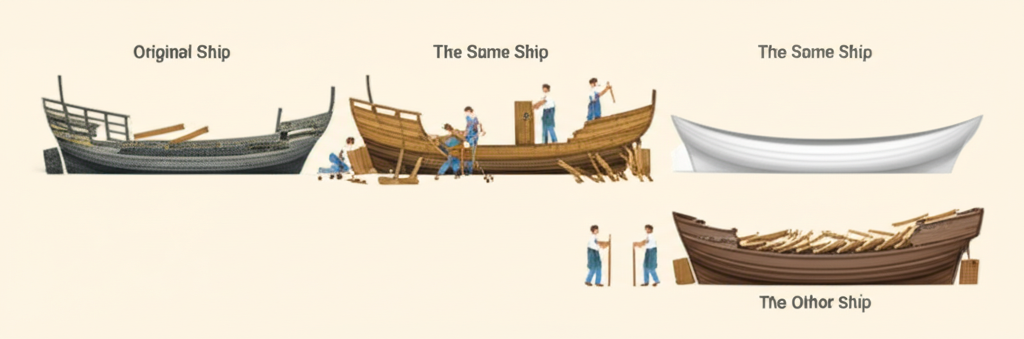
However, the application of this law in the real world, especially concerning change over time, often leads to paradoxes. The famous Ship of Theseus thought experiment, implicitly discussed since ancient Greece and explored by figures like Thomas Hobbes, perfectly encapsulates this challenge: If every plank of a ship is replaced, is it still the same ship? And if the old planks are reassembled, which is the original?
This highlights the tension between the immutable demands of logic and the fluid reality of existence. How do we reconcile the logical necessity of sameness with the undeniable reality of change? This is where our definition of identity becomes crucial – is it defined by its material composition, its form, its function, or its historical continuity? The answers profoundly shape our understanding of persistence.
Defining Identity: A Philosophical Endeavor
The quest to define identity is one of philosophy's most enduring tasks. Different philosophical traditions offer distinct frameworks:
- Plato's Forms: For Plato, the true identity of a thing resided in its participation in an eternal, unchanging Form. A particular chair is only truly a chair because it partakes in the Form of Chairness. This offers a robust notion of "sameness" that transcends individual, perishable instances.
- Aristotle's Substance: Aristotle, while rejecting separate Forms, grounded identity in the substance itself—its essential nature (form) combined with its matter. A human being's identity is tied to their rational soul and their physical body, a composite unity.
- Locke on Personal Identity: John Locke famously argued for psychological continuity as the basis for personal identity. It is not the same body, but the same consciousness and memory that makes a person the "same" person over time. This shifts the definition of identity from material to mental, emphasizing an enduring self-awareness.
These diverse approaches demonstrate that the definition of identity is not singular but depends heavily on the philosophical framework applied, and crucially, on how one weighs the significance of the Same against the Other. Each framework attempts to grapple with the elusive nature of what it means for something to persist as itself.
Conclusion: The Enduring Question
The philosophical journey through the Same and Other in Identity reveals that identity is far from a simple, self-evident truth. It is a dynamic interplay of continuity and distinction, deeply embedded in our understanding of relation, rigorously tested by logic, and constantly refined through definition. As we navigate the complexities of existence, from recognizing an old friend to contemplating the nature of the self, we are perpetually engaging with this fundamental dichotomy. The Great Books of the Western World serve as a testament to humanity's ongoing quest to unravel this profound enigma, reminding us that the very act of knowing what is is inextricably linked to knowing what is not.
YouTube Video Suggestions:
-
📹 Related Video: What is Philosophy?
Video by: The School of Life
💡 Want different videos? Search YouTube for: "Ship of Theseus explained philosophy"
2. ## 📹 Related Video: PLATO ON: The Allegory of the Cave
Video by: The School of Life
💡 Want different videos? Search YouTube for: "Plato Sophist Same and Other explained"