

The Unseen Architect: The Enduring Role of Rhetoric in Opinion Formation
Summary
Rhetoric, often misunderstood as mere ornamentation or deception, is in fact a fundamental force in the shaping of human opinion. From the ancient agora to the modern digital forum, its role has been to persuade, influence, and move individuals and collective bodies. This article explores how rhetoric, through its various appeals and strategies, constructs and modifies opinion, underscoring its critical importance for every citizen navigating the complex landscape of public discourse.
The Art of Persuasion: An Introduction to Rhetoric's Power
In the intricate dance of human interaction, few forces are as potent yet as subtly pervasive as rhetoric. Far from being a mere academic discipline or a tool for sophistry, rhetoric is the very fabric by which ideas are communicated, debated, and ultimately, accepted or rejected, thereby forming our collective and individual opinion. As Daniel Fletcher often contemplates, understanding its mechanics is not just for orators or politicians, but for every thoughtful citizen who wishes to engage meaningfully with the world around them.
The role of rhetoric is not simply to present facts, but to frame them, to give them weight, and to imbue them with meaning that resonates with an audience. It is the art of effective communication, designed to sway belief and action.
Ancient Foundations: Plato's Caution and Aristotle's System
The philosophical roots of rhetoric stretch back to ancient Greece, where its power was both celebrated and feared.
Plato's Skepticism and Aristotle's Pragmatism
Plato, in works like Gorgias, viewed rhetoric with deep suspicion, often seeing it as a dangerous art capable of manipulating the ignorant masses, prioritizing persuasion over truth. For Plato, true knowledge was derived through dialectic, not through the emotive appeals of rhetoric.
However, it was Aristotle, Plato's student, who provided the most comprehensive and enduring framework for understanding rhetoric. In his seminal work, Rhetoric, he defined it as "the faculty of observing in any given case the available means of persuasion." Aristotle recognized that while rhetoric could be misused, it was also an indispensable tool for public discourse, particularly in a democracy where citizens needed to be convinced through reasoned argument. He systematically broke down the components of effective persuasion, outlining three primary appeals:
- Ethos: The appeal to the speaker's credibility, character, and authority. An audience is more likely to be swayed by someone they trust and respect.
- Pathos: The appeal to emotion, designed to evoke feelings such as anger, pity, fear, or joy in the audience. This connects the message to the audience's deeply held values and experiences.
- Logos: The appeal to logic and reason, involving the use of facts, evidence, statistics, and logical argumentation. This aims to convince the audience through rational thought.
These three pillars remain the bedrock of understanding how rhetoric operates to shape opinion, demonstrating its timeless role.
The Mechanics of Persuasion: How Rhetoric Shapes Opinion
Rhetoric, then, is not just what is said, but how it is said. It involves strategic choices in language, structure, delivery, and appeal to influence an audience's perceptions and beliefs.
| Rhetorical Appeal | Primary Focus | How it Shapes Opinion | Example |
|---|---|---|---|
| Ethos | Speaker's Credibility | Builds trust, respect, and confidence in the message. | A renowned scientist presenting data on climate change. |
| Pathos | Audience's Emotions | Connects message to values, experiences, and feelings. | A politician sharing a personal story to illustrate the impact of a policy. |
| Logos | Logic and Reason | Provides rational justification, facts, and evidence. | An economist presenting statistics to support a fiscal proposal. |
Beyond these appeals, rhetorical devices like metaphor, analogy, repetition, and rhetorical questions further enhance the persuasive power, embedding ideas more deeply into the minds of listeners and readers, thereby solidifying or shifting their opinion.
Rhetoric in the Public Sphere: The Citizen's Landscape
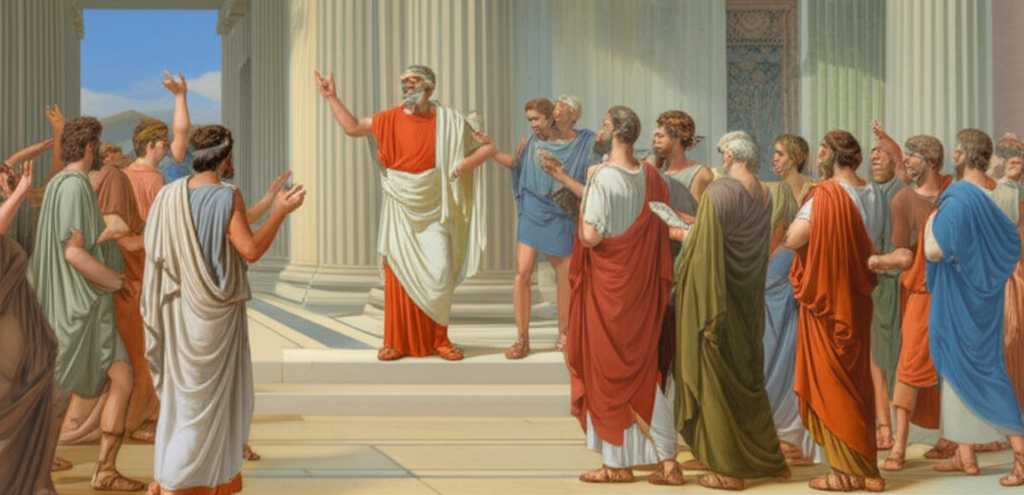
In any functioning society, especially a democratic one, the role of rhetoric in forming citizen opinion is paramount. From ancient Athenian assemblies to the Roman Senate, and continuing through the Enlightenment salons to modern parliaments and digital town squares, rhetoric has been the primary vehicle for political discourse.
The Citizen's Burden: Discerning Truth from Persuasion
For the contemporary citizen, the landscape of opinion formation is more complex and saturated than ever before. Mass media, social platforms, and constant information flow mean that rhetorical strategies are employed by countless actors—politicians, advertisers, activists, and even individuals—all vying for attention and to shape public opinion.
This places a significant burden on the citizen:
- Critical Analysis: To discern the underlying appeals (ethos, pathos, logos) in any message.
- Source Evaluation: To question the credibility of the speaker and the validity of their evidence.
- Emotional Intelligence: To recognize when emotional appeals are being used to bypass rational thought.
- Contextual Understanding: To understand the broader context in which arguments are made and opinions are formed.
The role of rhetoric here is dual: it can enlighten and empower, but it can also mislead and manipulate. A well-informed citizen is one who can critically evaluate the rhetoric they encounter.
The Ethical Dimension: Responsibility in Persuasion
The power of rhetoric necessitates an ethical consideration. The role of a rhetorician carries a significant responsibility, as does the citizen's engagement with it. Misinformation, demagoguery, and propaganda are all examples of rhetoric employed unethically, exploiting the very mechanisms of persuasion for harmful ends.
Great thinkers, from Cicero stressing the orator's duty to serve the state with wisdom and virtue, to later philosophers emphasizing reason and clear understanding, have grappled with this ethical challenge. For a healthy public sphere, rhetoric must ideally serve truth and the common good, not just partisan advantage or personal gain. It is in this ethical crucible that the true role of rhetoric in shaping opinion for societal benefit or detriment is forged.
Conclusion
The role of rhetoric in opinion formation is undeniable and enduring. It is the invisible architecture that structures our understanding of the world, influencing everything from personal choices to national policies. For every citizen, cultivating an awareness of rhetorical strategies—how ethos, pathos, and logos are employed—is not merely an academic exercise but a vital skill for navigating the modern information age. By understanding rhetoric, we empower ourselves to critically assess the messages we receive, to articulate our own views more effectively, and ultimately, to participate more thoughtfully in the ongoing dialogue that shapes our collective future.
YouTube Video Suggestions:
-
📹 Related Video: ARISTOTLE ON: The Nicomachean Ethics
Video by: The School of Life
💡 Want different videos? Search YouTube for: ""Aristotle Rhetoric explained Ethos Pathos Logos""
-
📹 Related Video: PLATO ON: The Allegory of the Cave
Video by: The School of Life
💡 Want different videos? Search YouTube for: ""Plato Gorgias rhetoric philosophy summary""