

The Unseen Architect: The Role of Rhetoric in Opinion Formation
Summary: In the complex tapestry of human discourse, rhetoric plays an inescapable and often underestimated role in shaping public opinion. Far from mere ornamentation, rhetoric, as understood by the great thinkers of the Western tradition, is the art of persuasion — a fundamental tool through which ideas are disseminated, understood, and ultimately adopted by the citizenry. This article explores how rhetorical strategies, both subtle and overt, construct and transform our collective beliefs, making it a critical area of study for anyone seeking to understand the dynamics of societal thought.
The Ancient Art of Persuasion: Defining Rhetoric
The term rhetoric often carries a negative connotation in modern parlance, frequently associated with empty promises or manipulative language. However, to the philosophers and orators of the Great Books of the Western World, rhetoric was a profound and essential discipline. Aristotle, in his seminal work Rhetoric, defined it not as mere trickery, but as "the faculty of discovering in any particular case all of the available means of persuasion." This classical understanding positions rhetoric as a neutral tool, capable of being wielded for noble or ignoble ends.
It is the strategic deployment of language, argument, and emotional appeal designed to influence the beliefs and actions of an audience. This influence is not always about overt manipulation; often, it’s about making complex ideas accessible, relatable, and compelling enough to resonate with the existing values and perspectives of the citizen.
Rhetoric's Indispensable Role in Opinion Formation
The formation of opinion, whether individual or collective, is rarely a purely rational process. While logic (logos) certainly has its place, human beings are also swayed by emotion (pathos) and the perceived credibility of the speaker (ethos). This is precisely where rhetoric asserts its profound role.
Consider how political debates unfold, how public policy is discussed, or even how scientific consensus is communicated. In each instance, the presentation of facts is interwoven with persuasive language, narrative structures, and appeals designed to garner acceptance. An argument, however logically sound, might fail to gain traction if it is poorly articulated, devoid of emotional resonance, or delivered by someone lacking perceived authority.
Rhetoric, therefore, doesn't just present information; it frames it. It guides the audience towards a particular interpretation, highlighting certain aspects while downplaying others. This framing is crucial in establishing the initial parameters within which an opinion can form and evolve.
The Citizen and the Polis: A Rhetorical Landscape
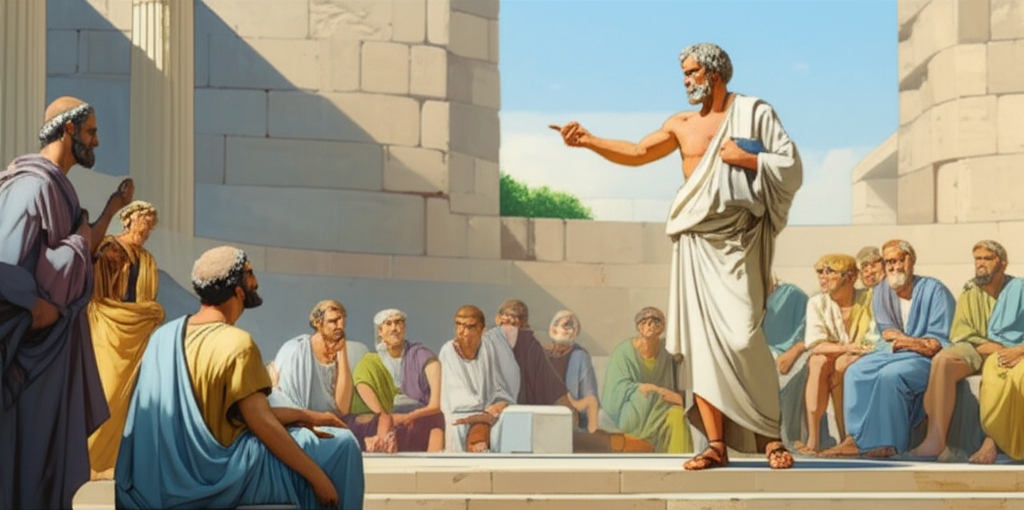
For the ancient Greeks, particularly in the context of the polis, the ability to engage in effective public discourse was central to the identity of the citizen. Deliberation, debate, and the art of persuasion were not peripheral activities but fundamental pillars of democratic life. The opinion of the collective was forged in the agora, through speeches and counter-speeches, where rhetorical skill determined the ascendancy of ideas.
Even in modern societies, where mass media and digital platforms have replaced the physical assembly, the essence remains. Every news report, editorial, social media post, and public address is, to varying degrees, a rhetorical act aiming to shape perceptions and build consensus or dissent. The informed citizen must not only be able to discern facts but also to critically evaluate the rhetorical strategies employed in their presentation.
Mechanisms of Influence: How Rhetoric Shapes Belief
The tools of rhetoric are manifold, ranging from sophisticated logical structures to evocative imagery. Understanding these mechanisms is key to appreciating their role in opinion formation.
Here are some core rhetorical appeals and devices:
- Ethos (Credibility): Persuading by the character of the author or speaker. This involves establishing authority, trustworthiness, and shared values with the audience. A scientist presenting research, for example, relies on their ethos as an expert.
- Pathos (Emotion): Appealing to the audience's emotions to create a connection or evoke a desired response. Stories, metaphors, and vivid descriptions are powerful pathos tools.
- Logos (Logic): Using reason, facts, and logical arguments to persuade. This involves presenting evidence, statistics, and clear reasoning.
- Analogy and Metaphor: Explaining complex ideas by comparing them to something familiar, making them more understandable and memorable.
- Repetition: Reinforcing key messages by repeating words or phrases, which can embed ideas more deeply in the audience's mind.
- Antithesis: Presenting contrasting ideas in a balanced way to highlight a point, e.g., "Ask not what your country can do for you, ask what you can do for your country."
- Rhetorical Questions: Posing questions not to elicit an answer, but to make a point or provoke thought, guiding the audience toward a particular conclusion.
The Ethical Quandary: Rhetoric's Dual Nature
The immense power of rhetoric naturally raises ethical questions. Plato, particularly in his dialogue Gorgias, was deeply suspicious of rhetoric, viewing it as a manipulative art that prioritized persuasion over truth. He feared that skilled orators could sway the masses towards unjust or unwise decisions, appealing to their passions rather than their reason.
While this critique holds validity, it doesn't negate the necessary role of rhetoric. The alternative to persuasive communication is often coercion or silence. For a society to function, ideas must be articulated, debated, and presented in a way that allows for public engagement and decision-making. The challenge, then, lies in fostering a rhetorically literate citizenry capable of discerning between ethical and unethical persuasion.
Conclusion: The Enduring Influence on Opinion
The role of rhetoric in opinion formation is as vital today as it was in the ancient world. It is the invisible hand that often guides how we interpret information, how we connect with arguments, and ultimately, what beliefs we adopt. From the political arena to personal interactions, understanding rhetoric is not merely an academic exercise; it is a fundamental skill for navigating the complex landscape of ideas. As citizens, our ability to critically analyze the persuasive techniques employed around us is paramount to forming informed, independent opinions and participating meaningfully in public discourse.
YouTube Video Suggestions:
-
📹 Related Video: ARISTOTLE ON: The Nicomachean Ethics
Video by: The School of Life
💡 Want different videos? Search YouTube for: ""Aristotle Rhetoric Summary Explained""
2. ## 📹 Related Video: PLATO ON: The Allegory of the Cave
Video by: The School of Life
💡 Want different videos? Search YouTube for: ""Plato Gorgias Rhetoric Philosophy""